Cape Lookout, NC 





Select a photograph to view a photo gallery

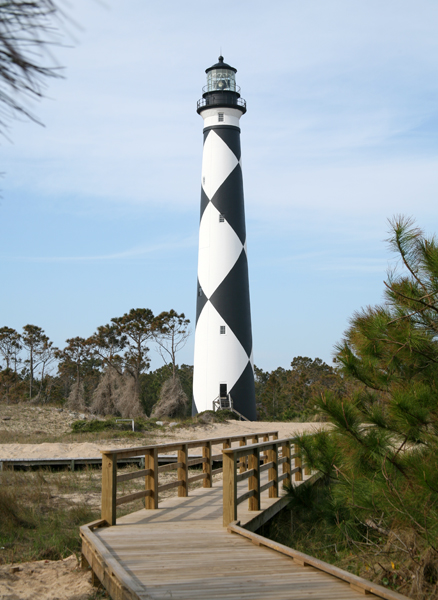
Photo Gallery
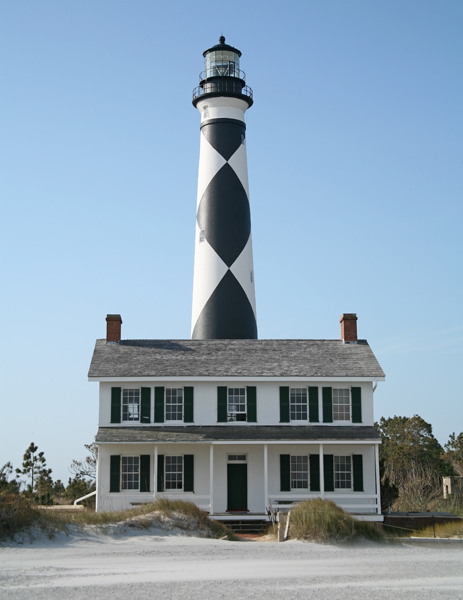
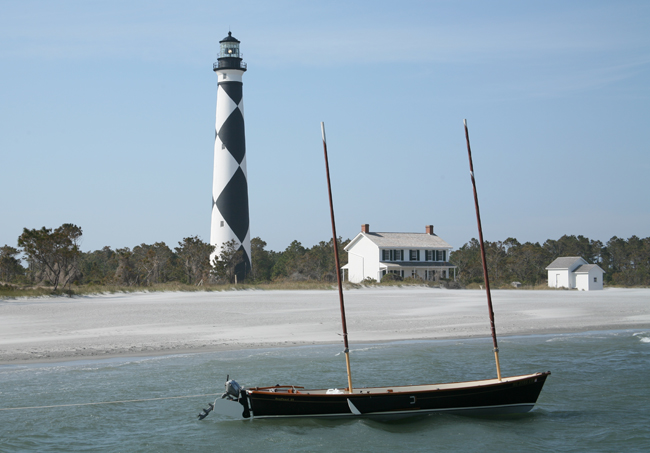
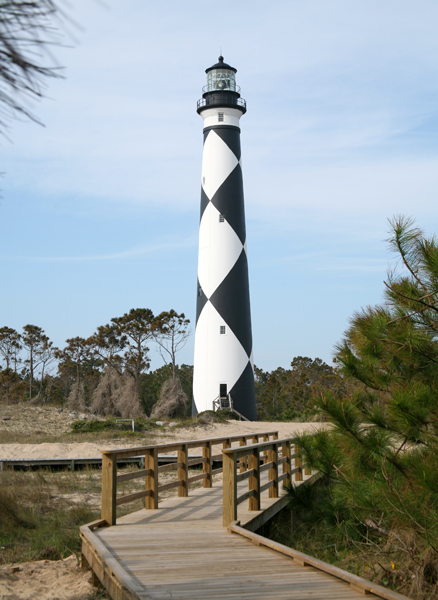
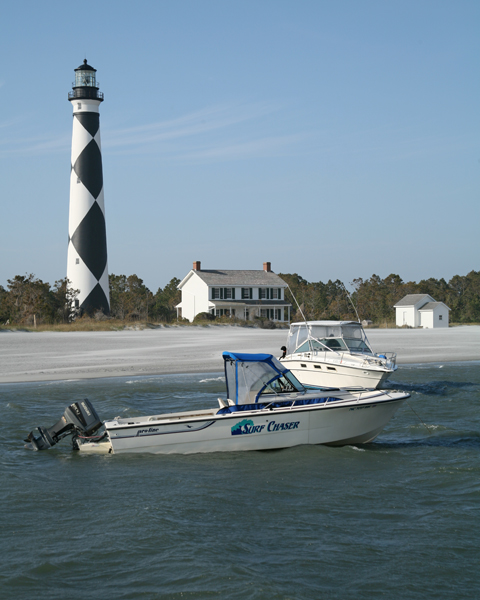
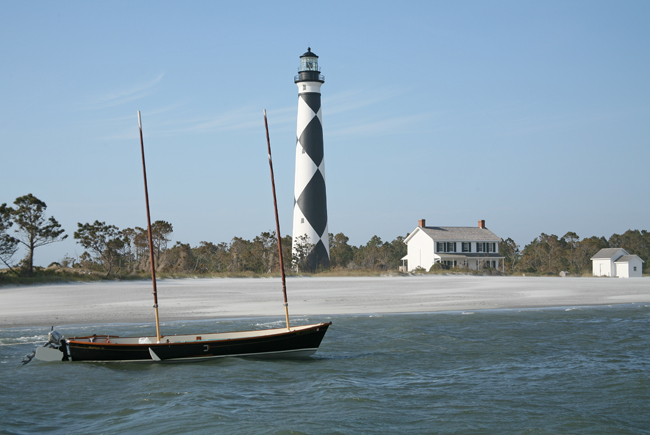
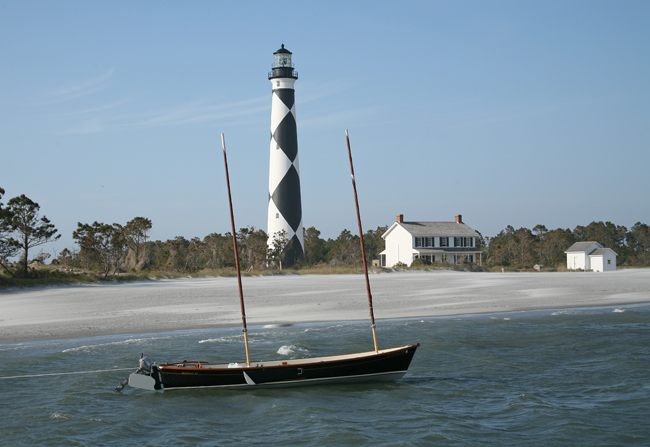
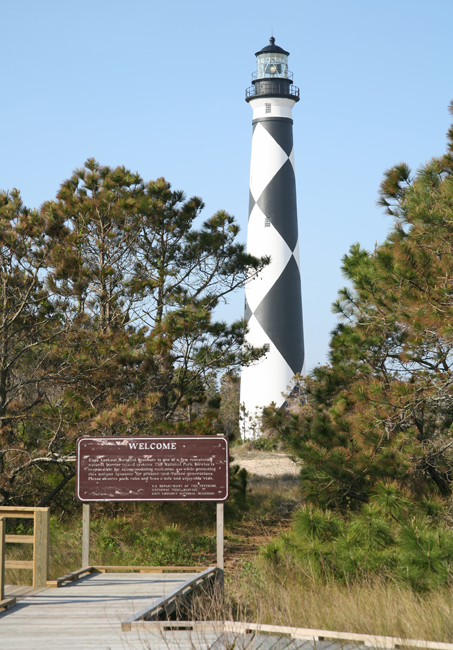
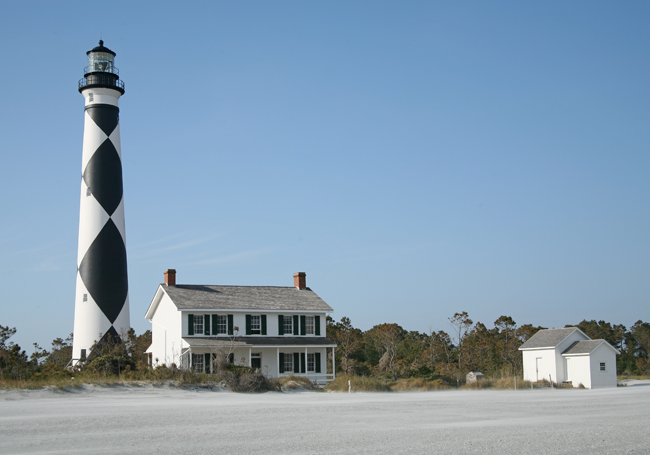
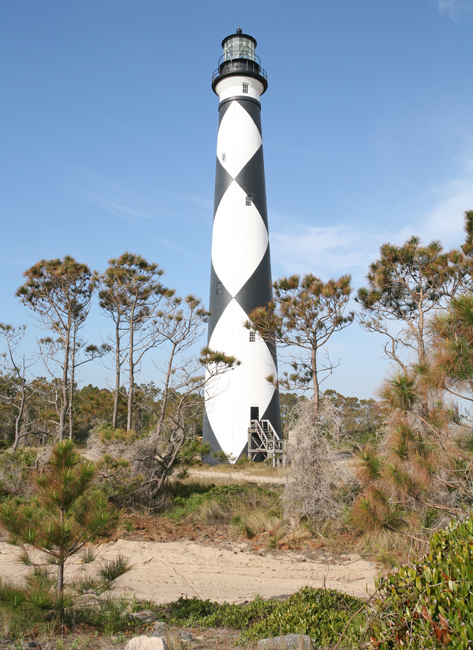
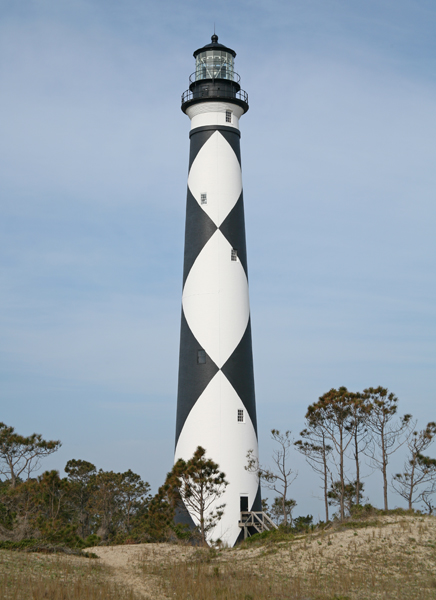
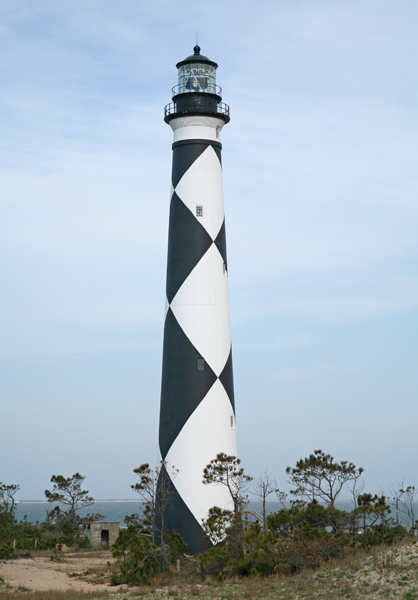
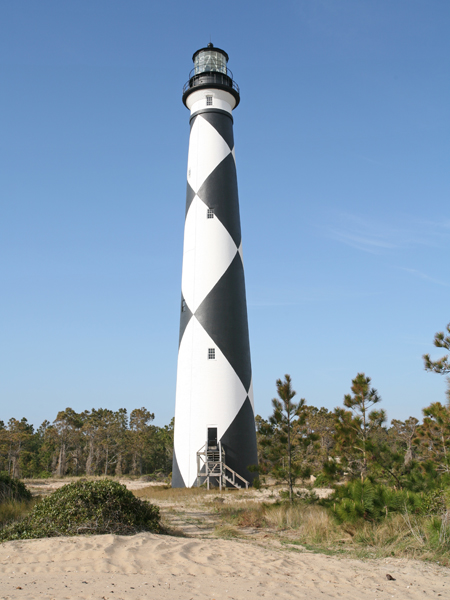
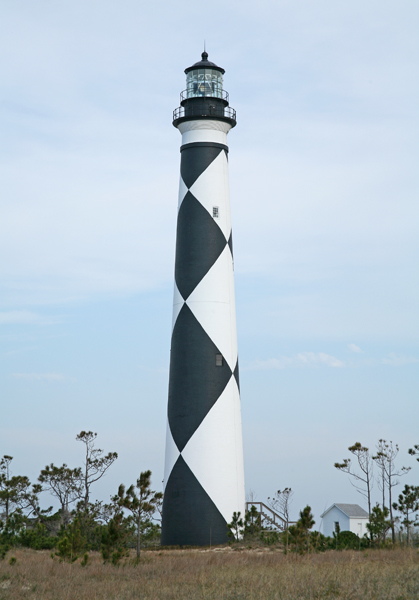
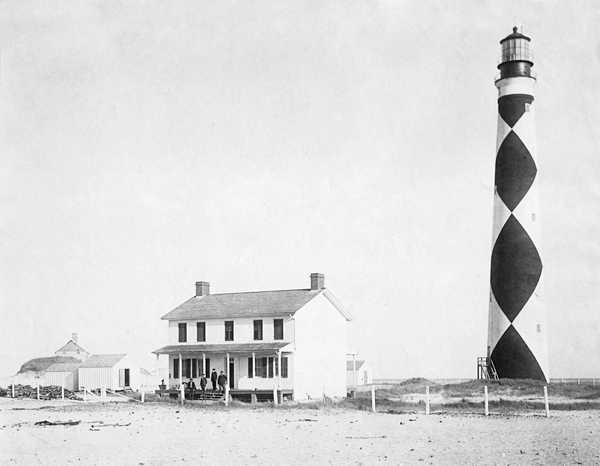
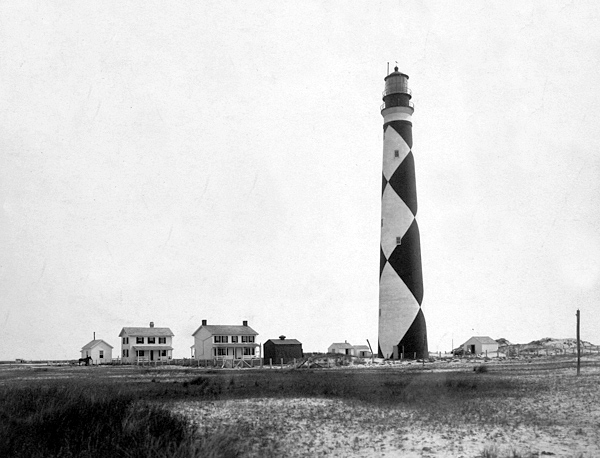

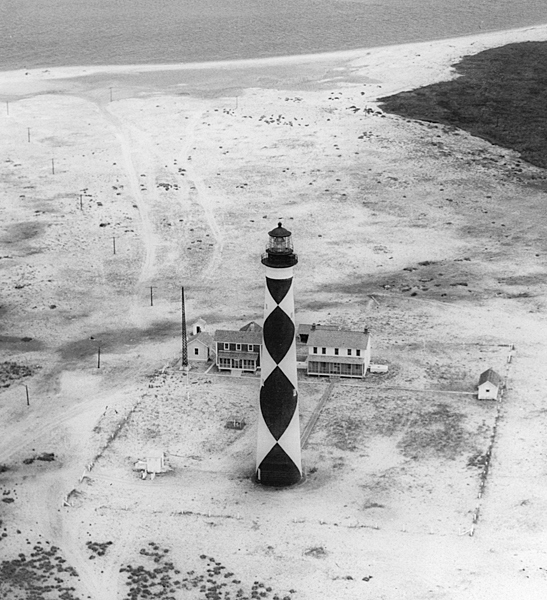
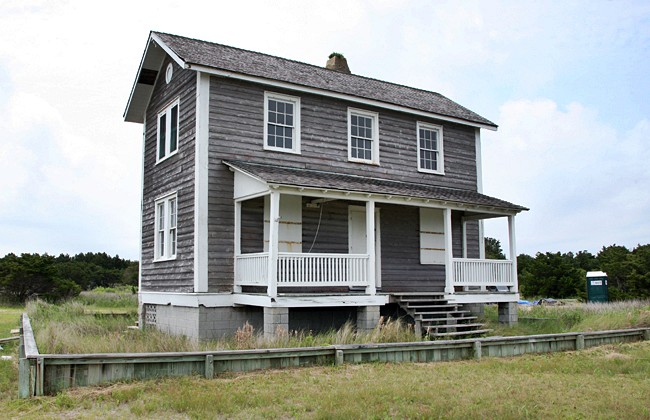
Photo Gallery
Photo Gallery
The twenty-one-mile stretch of Cape Lookout Shoals has a history as long and interesting as its country’s. The land has been inhabited for centuries; in 1524, the Florentine explorer Giovanni da Verrazano reported native peoples living in the area, and between 1540 and 1570 Spain sent several explorers to the region, although none attempted to colonize. It wasn’t until English settlers came that the Old World got its foot firmly in the door of this part of the New World.
North Carolina saw the first attempts at English colonization in 1585, and by 1650 hundreds of settlers had moved south from Virginia. The region was under control of the Lords Proprietor — complete with a constitution drafted by John Locke — until 1729, when North Carolina became a royal colony. But on April 12, 1776, North Carolina became the first colony to call for independence from England.
|
Because of opposing currents, the Outer Banks proved tricky to navigate. Vessels sailing south needed to keep close to land to avoid the northbound waters of the Gulf Stream, and vessels sailing north needed to stay in the Gulf Stream to avoid the southbound Labrador Current. However, all vessels had a common problem: the warm Gulf Stream mixed with the cool Labrador Current to produce intense fog and dangerous shoals. The particularly treacherous area off Cape Lookout earned the name the “Horrible Headland.”
In 1803, Congress appropriated $5,000 for a committee to evaluate the possibility of building lighthouses along the eastern seaboard. The long-term plan was to build lights along the Outer Banks approximately forty miles apart, so that as soon as ships lost sight of one light, the next would come into view. In 1804, Congress authorized a lighthouse at Cape Lookout, and in February 1805, a four-acre plot of land was deeded to the government by Joseph Fulford and Elijah Piggot. Getting construction for the lighthouse underway took some time though, and it wasn’t until 1812 that the first Cape Lookout Lighthouse was completed at a cost of $20,678.54.
Built on a sand dune, the ninety-six-foot brick tower was encircled by an octagonal wooden tower covered in cedar shingles and painted with wide, horizontal red and white stripes. Winslow Lewis stated in 1817 that the tower’s stripes made it appear “at a distance like a ship of war with her sails clewed up, and was often taken for such during the later war.” The first keeper, James Fulford, whose parents had provided the land for the lighthouse, was appointed by President James Madison and paid an annual salary of $300.
Sadly, it was immediately apparent that the much-anticipated light was a busted flush. Thirteen oil lamps produced a fixed white light that was supposed to be visible sixteen to eighteen miles out to sea, but in actuality it was visible only eleven miles in good weather, and less than that in bad. Because the tower was too low to be effective, mariners griped that seeking the light was more dangerous than braving the shoals. Lieutenant H.J. Hartstene, captain of the mail steamer Illinois, complained that “…the lights on Hatteras, Lookout and Cape Florida, if not improved had be better dispensed with as the navigator is apt to run ashore looking for them.”
By 1850, the lighthouse was in serious disrepair, and the keeper had to constantly shovel piles of sand that would build up against his quarters. Additionally, the coast had eroded enough that the ocean was now dangerously close to the lighthouse, which was an important seacoast light that needed to be elevated to more properly assist mariners. A first-order Fresnel lens was installed atop the tower in 1856, but it wasn’t until March 3, 1857 that Congress appropriated $45,000 to build a new taller lighthouse.
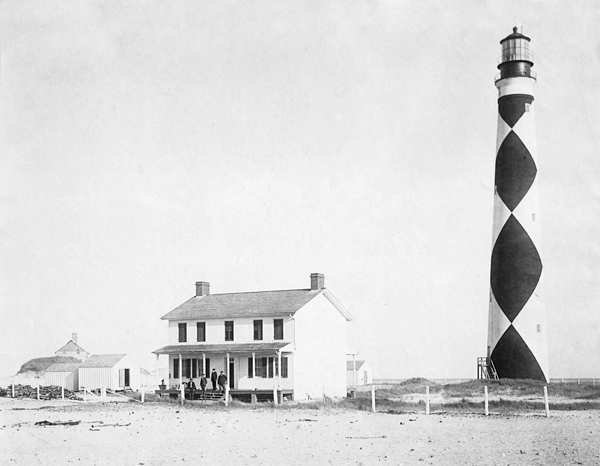
First lit on November 1, 1859 by Keeper John Royal, the second Cape Lookout Lighthouse proved to be a model for the other lighthouses that would be rebuilt along the Outer Banks at Cape Hatteras, Bodie Island, and Currituck. Standing 163 feet tall, the graceful new tower was just over twenty-eight feet in diameter at its base with nine-foot thick walls. It was made of red brick and displayed the Fresnel lens from the old tower. At the new height, the fixed white light was visible for nineteen miles and could easily be seen above the almost opaque salt spray whipped up by fierce winds. The old tower remained standing for several years and was converted into a residence.
The new tower was not destined to be in peaceful service for long, however. Just eighteen months after its completion, North Carolina joined the Confederacy. As Union forces advanced on the Carolina coast, Confederate troops dynamited Bodie Island Lighthouse and dismantled the Cape Hatteras light. In the spring of 1862, retreating Confederate troops attempted to blow up Cape Lookout Lighthouse. They were unsuccessful, but they did manage to damage the tower. The lens had been removed from the tower the previous year and was eventually taken to Raleigh. A third-order lens was placed in the lantern room in 1863, and the light was returned to service.
|
After the war, the Lighthouse Board lost no time repairing the damages. Congress authorized $20,000 for Cape Lookout Lighthouse in 1866, and the next year, the temporary wooden stairs were replaced with cast iron, and the first-order lens, “much injured by the rebels” was restored to its place. The lens had been sent to its manufacturer in France for repairs in 1865.
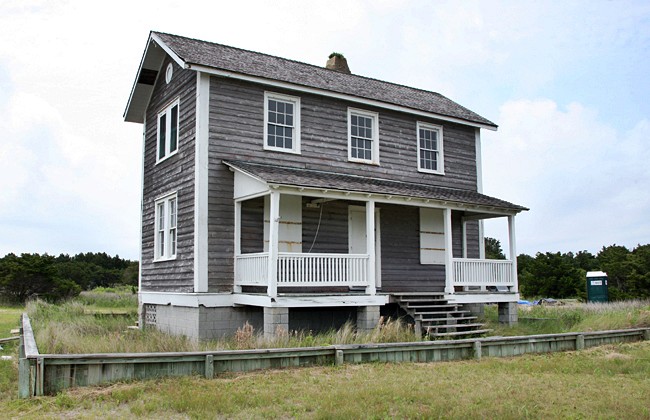
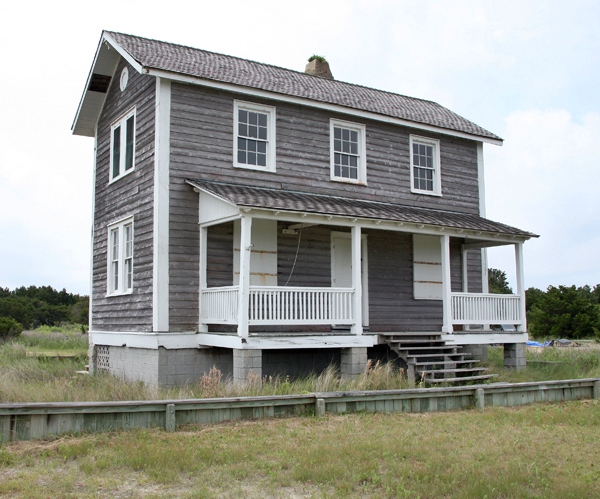
In 1871, Congress appropriated $5,000 for a new keeper’s dwelling, complete with summer kitchen and woodshed, as the old residence was in danger of being destroyed in stormy weather, leaving the keepers without any shelter on the desolate coast.
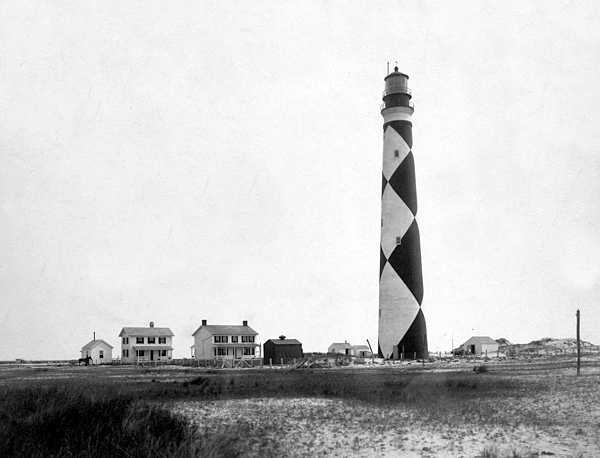
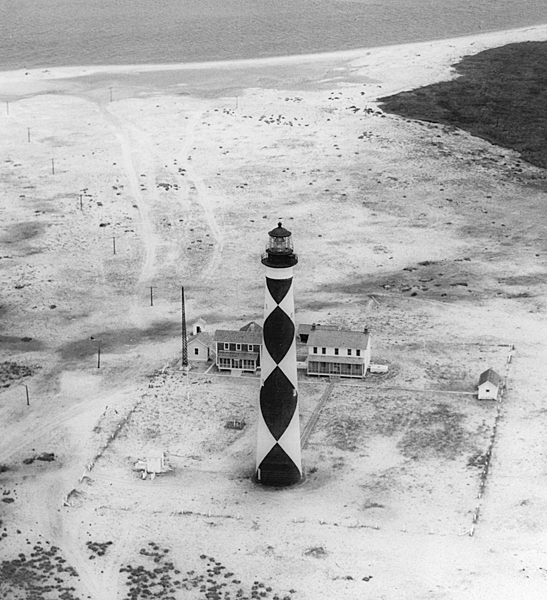
The year 1873 was a big one for Cape Lookout Lighthouse. The keepers’ cottage—large enough to house the head keeper and his two assistants —was completed, and the tower was painted. Because the four tall towers on the Outer Banks were so similar, the Lighthouse Board designed striking patterns for each to make them easily distinguishable. Cape Lookout was painted with large, diagonal checkers that appear as alternating black and white diamonds. Following the traditional daymark aids to navigation, the black diamonds are orientated north and south toward the shallow waters of the shoals and around the headlands, while the white diamonds are orientated east and west facing the deeper waters of Raleigh’s Bay to the east and Onslow Bay to the west.
The next few decades proved relatively uneventful, with only minor changes to the lighthouse. By 1855, the price of sperm oil had jumped to $2.25 per gallon from its 1841 price of fifty-five cents. This increase prompted the Lighthouse Board to search for alternative fuels. By 1867, colza oil was being used in smaller lights and lard oil in many of the larger lights. Cape Lookout Lighthouse was one of the exceptions and continued using whale oil until switching to mineral oil in 1883. In 1907, a six-room, head keeper’s dwelling was built for $4,479. In the years prior to this, the keeper and his two assistants had been sharing the 1873 dwelling, which made it impossible for their families to life with them. The Lighthouse Board started requesting funds in 1900 to remove this hardship, but Congress took a few years to provide the money.
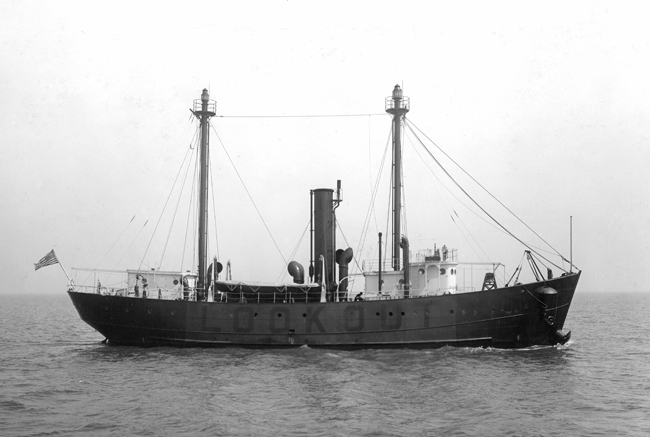
In 1904, a lightship, equipped with a steam fog signal, was stationed off the coast to provide additional help for mariners. In July 1918, five sailors took the lightship’s whaleboat to deliver mail to a passing steamer, but they misjudged the speed of the steamer, and their wooden vessel was sliced in two. Three of the sailors drowned, while the other two were rescued and placed back aboard the lightship. A bell buoy replaced Cape Lookout Shoals Lightship in 1933.
In 1914, the light exhibited from Cape Lookout Lighthouse was changed from fixed to flashing, through the installation of a three-mantle oil-vapor lamp with occulting screens. By 1916, war had again come within sight of Cape Lookout, as German submarines began plying the Atlantic. Cape Lookout became subject to “brown outs” in an effort to avoid helping the enemy.
Two gasoline engines connected to electric generators were added to the station in 1933 to power a radiobeacon, whose antenna was suspended between the lighthouse and an eighty-foot steel tower located 210 feet away. At the same time, the incandescent oil vapor light used in the lighthouse was replaced by four 250-watt lamps, which increased the light’s candlepower from 77,000 to 160,000.
The submarine threat of WWI would prove to be child’s play compared with what lay ahead. In the early days of WWII, Germany instigated a secret plan, named Operation “Paukenschlag” (drumbeat), for a massive submarine attack against the eastern seaboard. By the beginning of 1942, “wolf packs” of German U-boats prowled the Carolina coast looking for easy prey. Sadly, they found it in the merchant-rich waters guarded by woefully ill-prepared Navy patrol vessels.
Between January and April of 1942, German U-boats sank over eighty ships off the coast of North Carolina. This time, neither any of the lighthouses nor any of the offshore lighted buoys had been darkened, causing German sub commanders to dub the exercise the “Atlantic Turkey Shoot.” The Fifth Naval District, part of which included the waters off Cape Lookout, was protected by the Coast Guard vessel Dione, a cutter that had been built during Prohibition to combat rum-runners. Although perfectly suited for the Coast Guard, the vessel was no match for the U-boats.
Dire warnings as well as offers of help came from the British allies, who had developed successful convoy tactics and had broken the German code, but, inexplicably, America initially ignored them. The area off the North Carolina coast became known as “Torpedo Junction” as the casualties mounted. At one point, a tanker burned in Lookout Bight for three weeks.
|
The peaceful days of 1950 changed Cape Lookout Lighthouse forever. After the station was connected to commercial power, the light was completely automated, eliminating the need for resident keepers. The head keeper’s cottage was subsequently sold to Dr. Graham Barden, Jr., who moved it down the island in February 1958, while the 1873 dwelling was abandoned.
The Fresnel lens was removed from the tower in 1975 and replaced by two aero-beacons. After being displayed at a Coast Guard facility in Portsmouth, Virginia for several years, the lens was installed in Block Island Southeast Lighthouse in 1994.
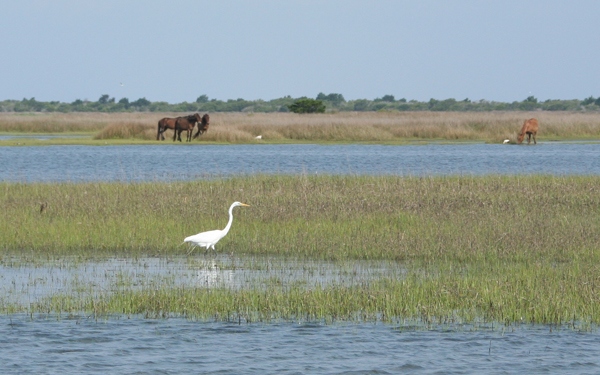
Beginning in 1979 and continuing through the 1990s, dredging operations have helped to stave off erosion from the tidal currents in Bardens Inlet. On nearby Shakleford Banks, wild ponies, said to be the descendants of those brought by Spanish explorers, still roam freely. Friends of Cape Lookout National Seashore was formed in 2008 to partner with the National Park Service in preserving and interpreting the seashore. One of their first goals was to rehabilitate the lighthouse, which has been owned by the park service since 2003, so it could be regularly opened to the public.
A celebration recognizing the 150th anniversary of the lighthouse began October 10, 2009. Over the following three weeks, two 1,000-watt spotlights illuminated the tower each night from sunset until 11 p.m. Various activities were held during the celebration including an art contest and events to recognize members of the U.S. Lighthouse Service, U.S. Lifesaving Service, and U.S. Coast Guard who once served at Cape Lookout. On Sunday, November 1, the anniversary of the lighting, the lighthouse was ceremonially relit after having been extinguished for one day.
Perhaps the most important event during the celebration was the announcement by the U.S. Department of Interior that Cape Lookout Lighthouse would receive $487,000 for repairs needed to reopen the tower, which had been closed to visitors since an inspection in 2008 found the structure unsafe. The repair work included stabilizing the spiral iron staircase that corkscrews up the lighthouse, adding a new handrail, improving accessibility to the lantern room, and installing a new guardrail around the outside gallery. The tower reopened for climbing on July 15, 2010 and welcomed numerous visitors each summer until 2021, when several structural issues with the stairs and hanrails were found. After Cape Lookout National Seashore secured funding, Stone and Lime Historic Restoration Services of North Brookfield, Massachusetts was awarded the contract for restoring the lighthouse. Work began in August 2025 and is expected to take two to three years.
The resotration work will address the repair or replacement of stairs, handrails, landings, glass panes, and doors. The tower will also be stripped to its bare brick, and then its signature black-and-white diamond pattern will be repainted with a breathable paint that will help stabilize the moisture contact of the bricks.
In September 2017, the Coast Guard and National Park Service completed the solarization of Cape Lookout Lighthouse. This modernization process included the removal of a revolving DCB-224 aero-beacon, which was powered by a submarine cable, and the installation of a solar-powered, multi-tier LED optic. The old lighting apparatus will be placed on display in the Park Service’s Cape Lookout Visitor’s Center and the spare in the Beaufort Maritime Museum.
Keepers:
References