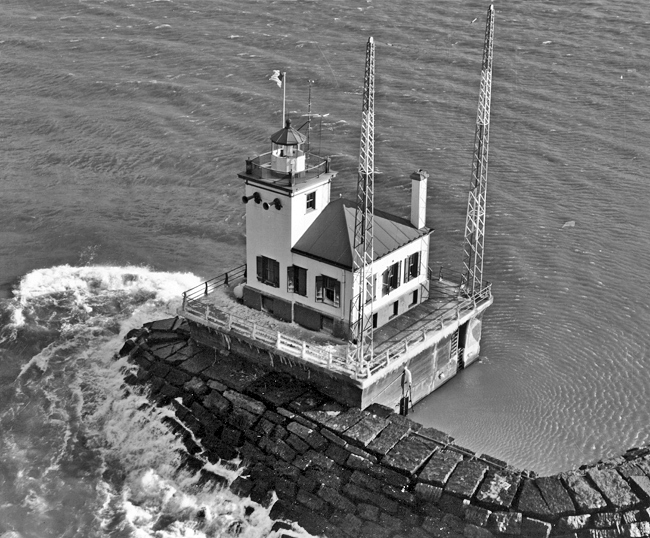
Oswego West Pierhead, NY 
Select a photograph to view a photo gallery
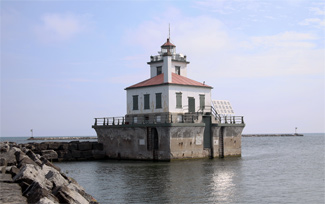
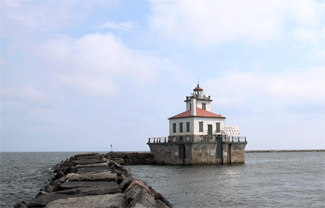
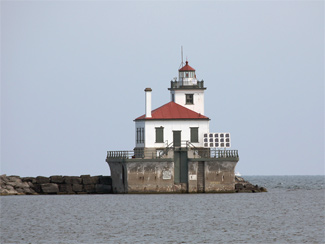
Photo Gallery
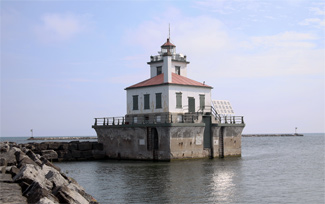
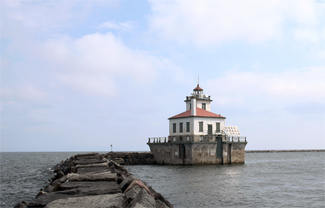
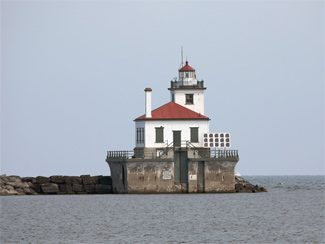
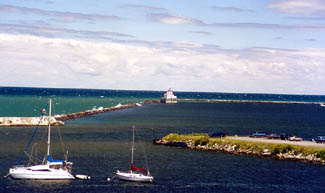
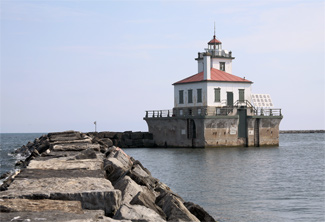
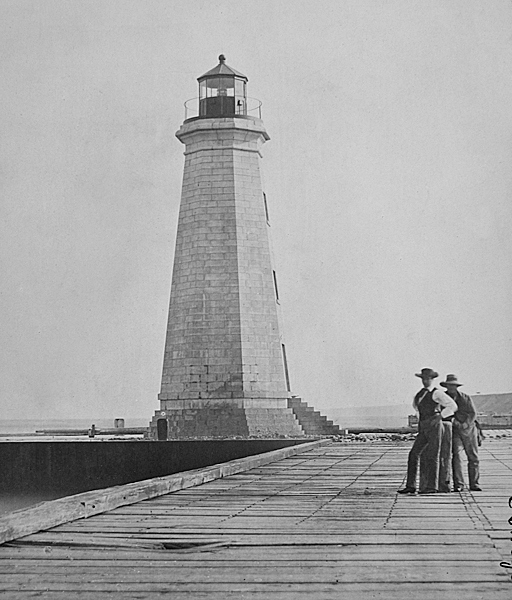
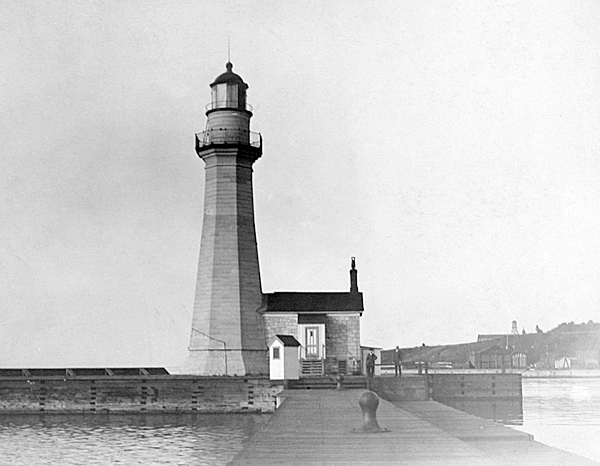
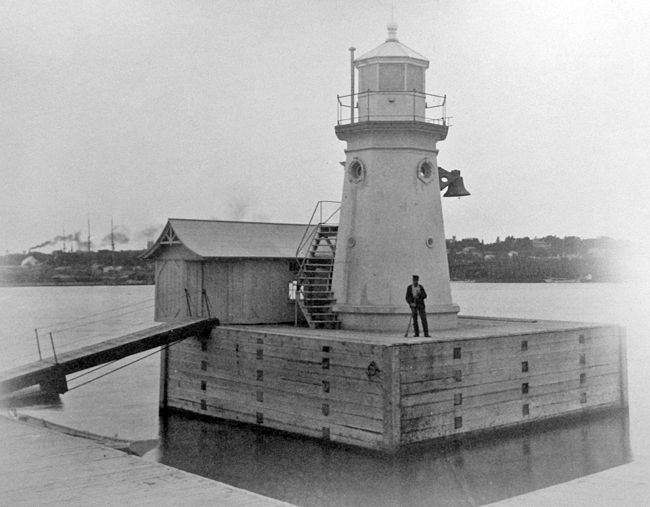
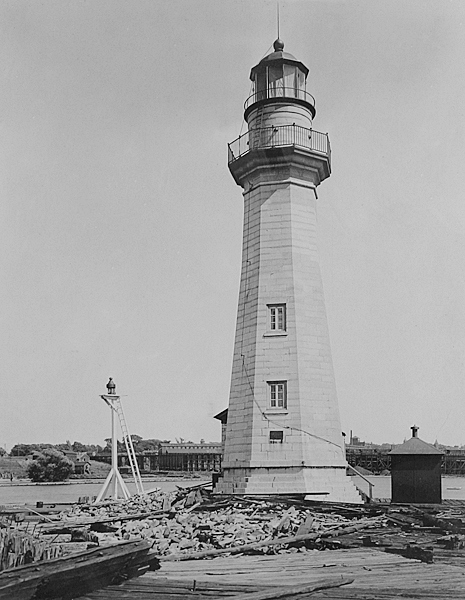
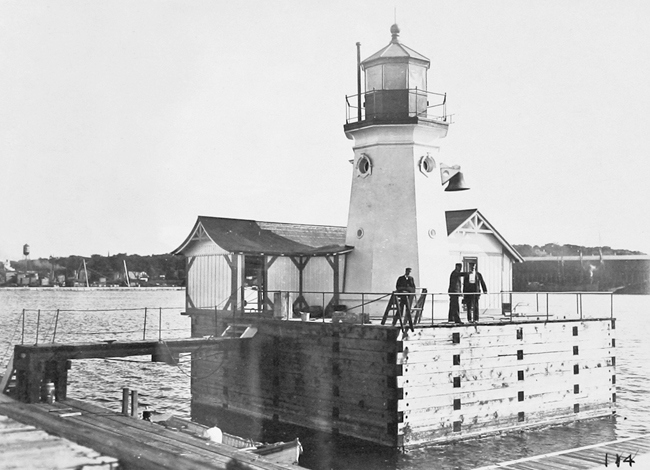
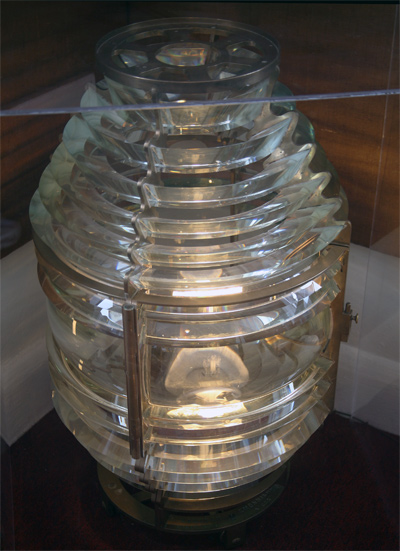
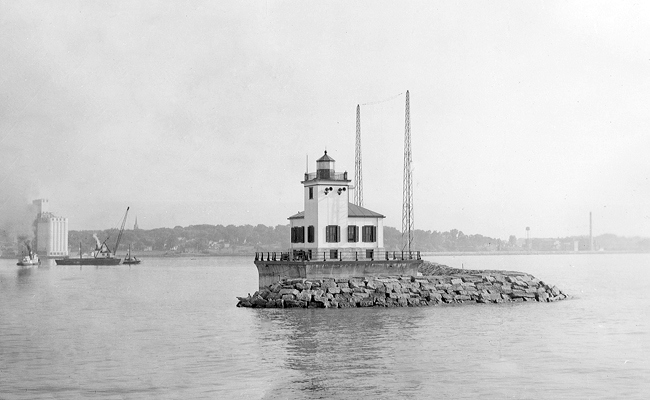
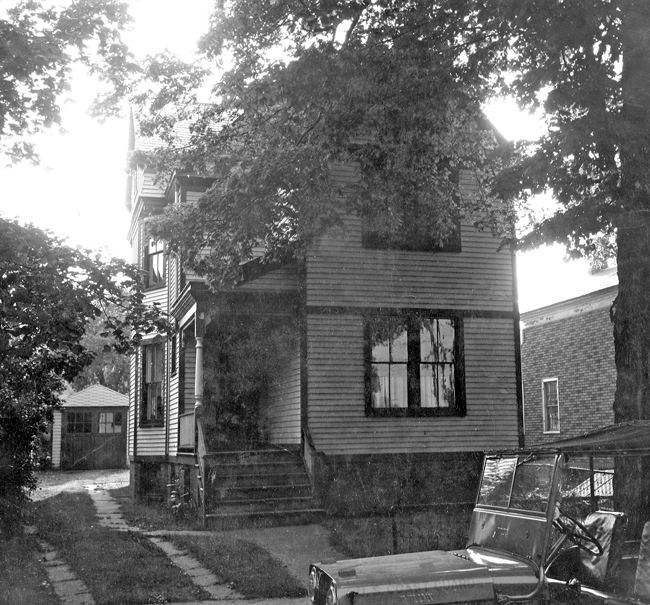
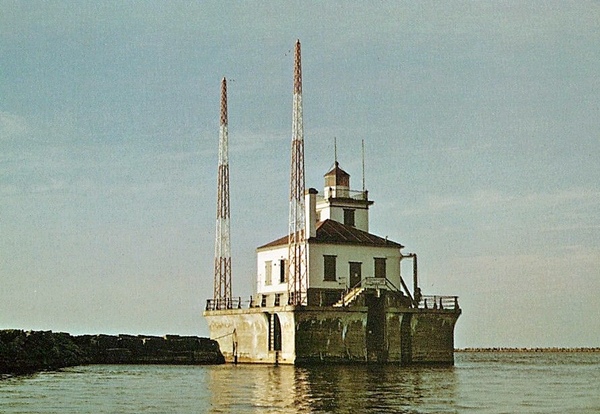
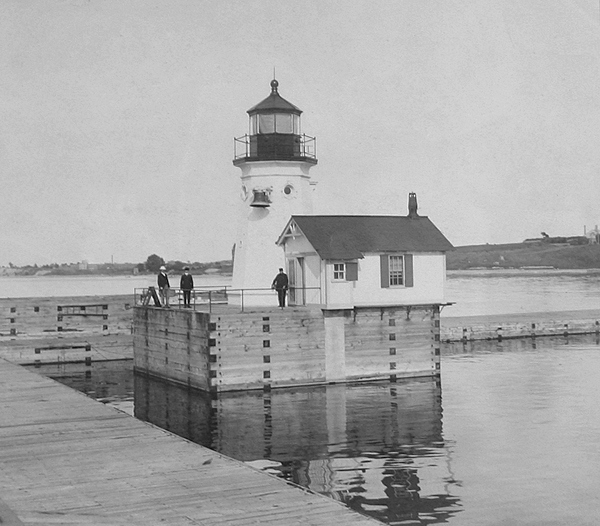
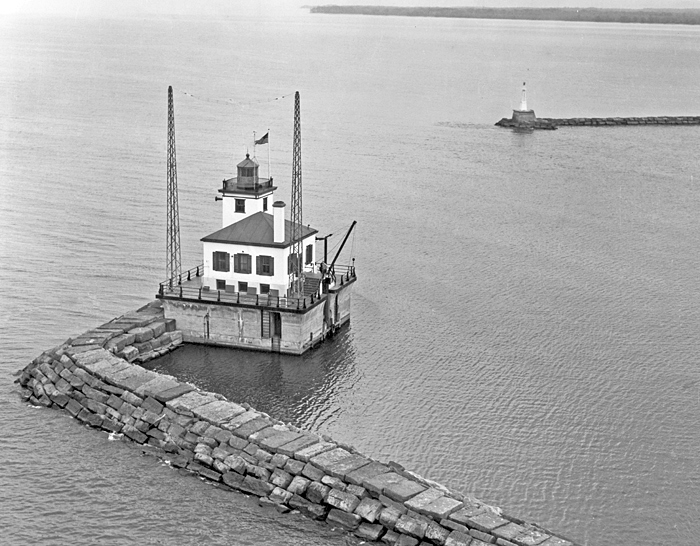
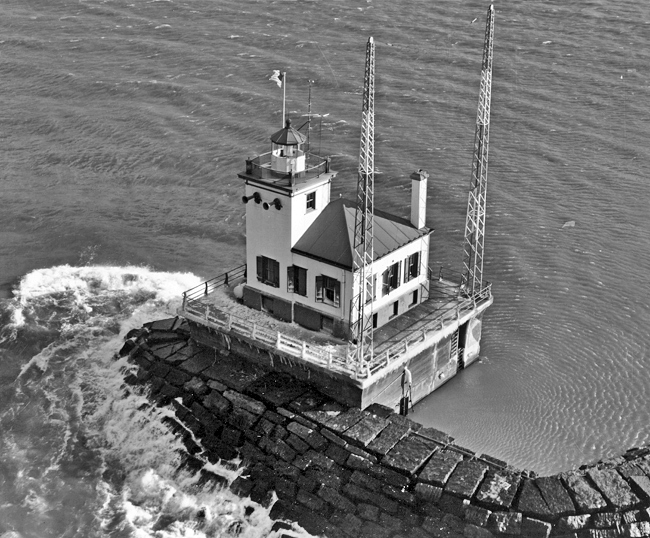
Photo Gallery
Photo Gallery
|
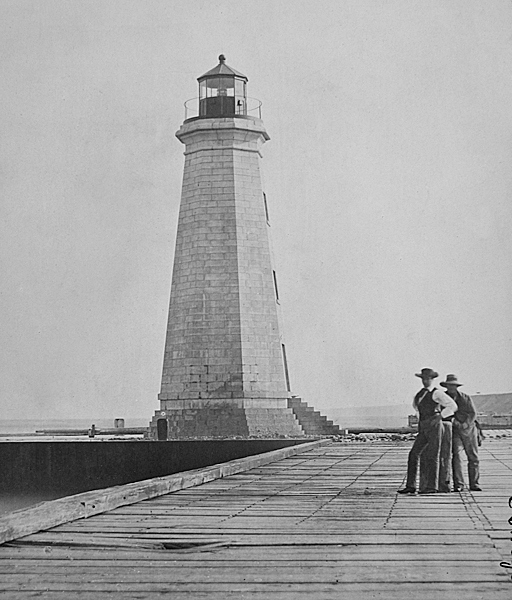
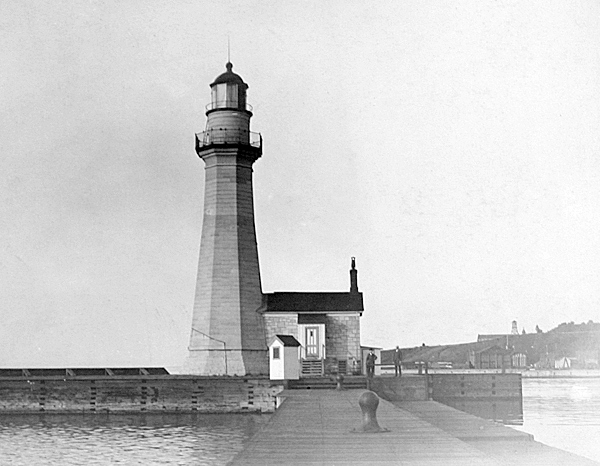
In 1828, the Oswego Canal was opened, linking Oswego and Lake Ontario to the Erie Canal and thus to the major harbors of New York City and Buffalo. The port of Oswego quickly grew in importance and soon merited a substantial lighthouse. Congress provided just over $12,000 in funds, doled out piecemeal starting in 1834 and continuing through 1837. Oswego’s second lighthouse was a majestic octagonal stone tower with an attached oil house built as part of a pier that extended lakeward from the western side of the river’s mouth. This lighthouse exhibited a light at a height of fifty-nine feet and would witness Oswego become an important milling center and the largest American city on Lake Ontario.
In 1838, Lieutenant Charles T. Platt visited Oswego and made the following report on its two lighthouses:
Oswego light-house, or beacon, is lighted with thirteen lamps, with the same number of bright reflectors, and located on the west pier, at the entrance of the harbor. This is a first-rate building, and is kept in excellent order. The supplies furnished by the contractor are without fault. The public improvements in the rebuilding of the piers are in rapid progress, and, when finished, will remain for at least a century. This is a splendid harbor, extending about half a mile in the river, with sufficient depth of water for the largest class of vessels; its breadth is about 2,400 feet.No longer needed, the first lighthouse was sold in 1841 and dismantled. In 1854, $5,000 was spent on repairing the new tower’s foundation.The commercial importance attached to this harbor is such as places it beyond competition on this lake.
The old light-house is in a dilapidated state; the fixtures, however, are taken care of, and are in the possession of the keeper. The dwelling wants trifling repair; all of which may be done for fifty dollars.
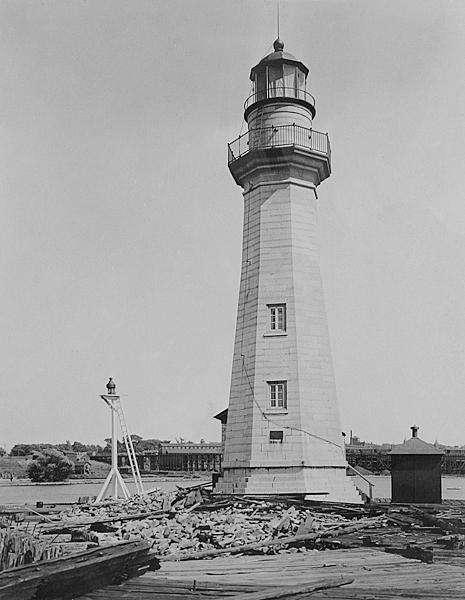
The second lighthouse was substantially rebuilt in 1868 and 1869. A fourteen-foot addition to the tower was made, a watchroom and inner brick wall were built, and a new lantern room was installed. A third-order, Barbier and Fenestre Fresnel lens was mounted in the new lantern room, replacing a fourth-order lens that had been in use since 1855. The height of the limestone tower was now seventy-four feet, three inches.
|
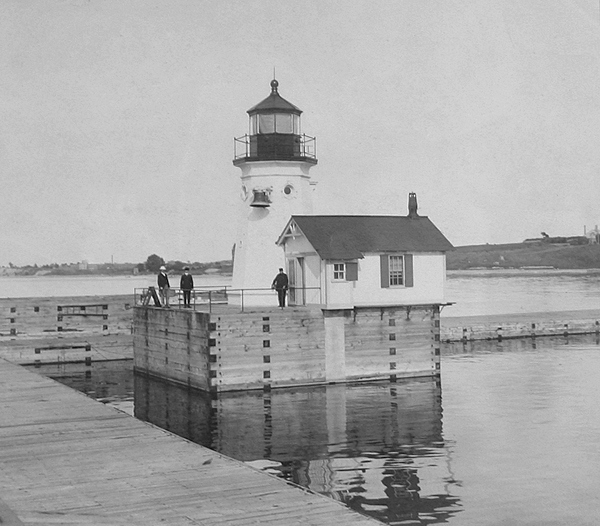
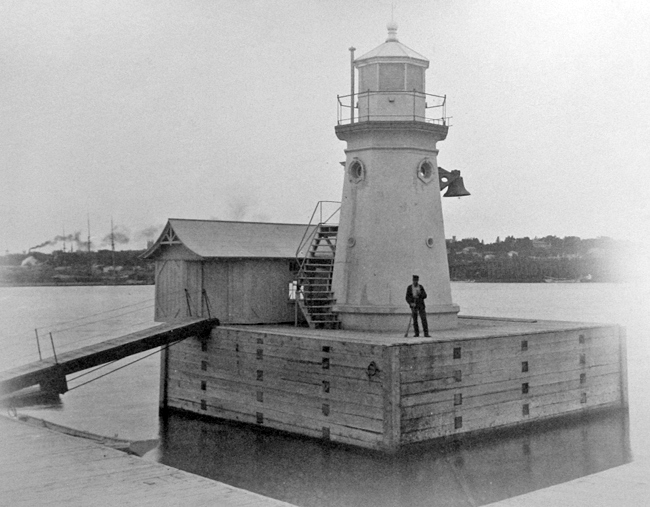
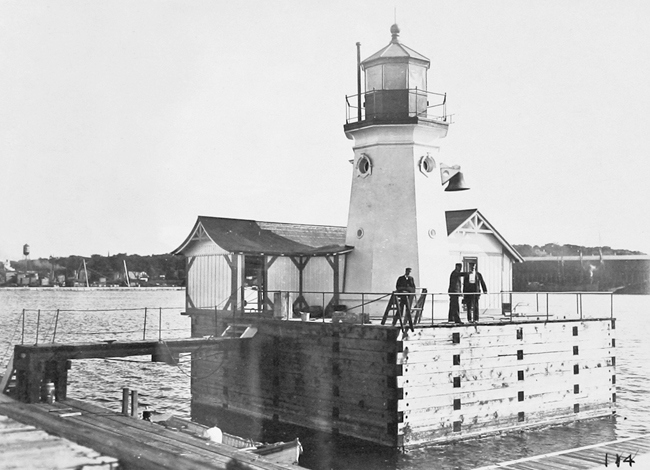
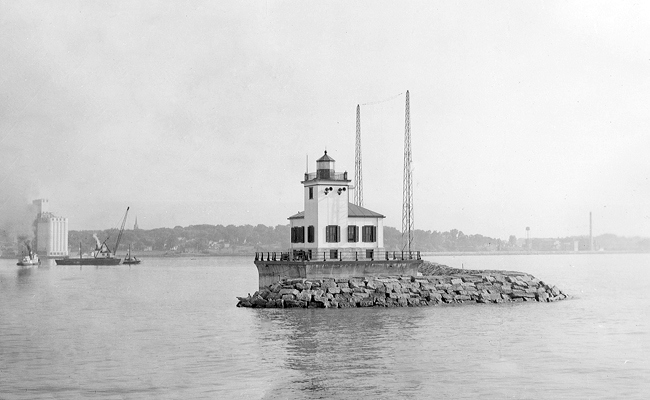
In 1870, a plan was approved for the construction of a roughly mile-long outer breakwater that would create a 100-acre safe harbor on the western side of the river entrance. The Lighthouse Board requested $20,000 in 1879 for a “strong light” and a fog bell to be built on a crib just inside the end of the breakwater, and while waiting for funds, the red light of the pierhead beacon was screened off on September 13, 1880, so it would only be visible to mariners when they were east of the breakwater and could safely enter the harbor. After a thirty-five-foot-square crib was built at the end of the breakwater, the iron pierhead beacon was relocated to it on October 17, 1881 and equipped with a fourth-order lens visible from all points of the compass. The iron tower was equipped with a locker, cupboard, and bunk for the use of the keeper, and a fog bell was suspended from a bracket on the north face of the tower. A year later, a boathouse was placed on the south side of the crib. The breakwater or beacon light was initially maintained by an assistant keeper supervised by the keeper of Oswego Lighthouse, but by 1887, it had its own pair of keepers. In September 1900, the color of the iron tower was changed from brown to white.
Captain John Budds served as a keeper of Oswego Lighthouse for twenty-two years. Born in Kent England in 1819, he immigrated to Canada with his family as a youth. At the age of seventeen, he signed aboard the schooner Fanny of Ontario, which sailed to Cleveland where it was loaded with coal for delivery to Toronto. The Fanny was the first vessel to deliver coal on Lake Ontario. Budds eventually worked his way up to captain, a title he held on a number of ships. John and his wife Sophia relocated to Oswego in 1854, and in 1874 he gave up his sailing career and accepted a position of assistant keeper of Oswego Lighthouse.
The local paper’s announcement of Captain Budds’ fiftieth wedding anniversary in 1893 noted that the faithful manner in which he discharged his duties had won the approbation of the Lighthouse Board and all who had anything to do with navigation on Lake Ontario. The article also contained this glowing description of his service: “The failure of the sun to go down on time or to rise at the proper hour would scarcely cause more surprise than would the failure of the Oswego lighthouse to send out its brilliant light over the dark water of Lake Ontario at the hour appointed for it to do so. And no lighthouse inspector has ever visited Oswego and failed to find everything at the lighthouse in the very best of order.” Another of Keeper Budds’ accomplishments was the rescue of a distraught damsel who jumped off the lighthouse pier hoping to end her life.
|
On April 15, 1917, the third-order light display from Oswego Lighthouse was discontinued, and the breakwater light was renamed Oswego Light Station. The breakwater light was changed from fixed to a double flash every twelve seconds on October 12, 1920, and the following year, it was electrified. Though inactive, the tall stone tower remained standing until 1927.
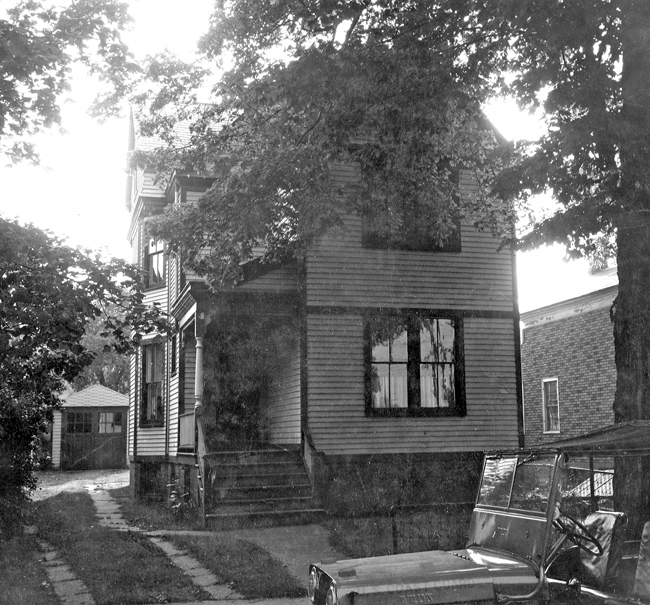
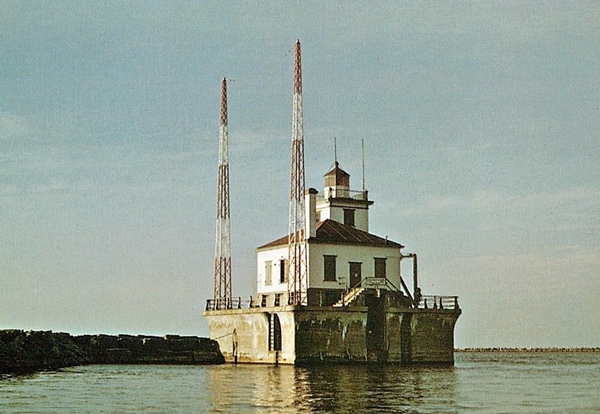
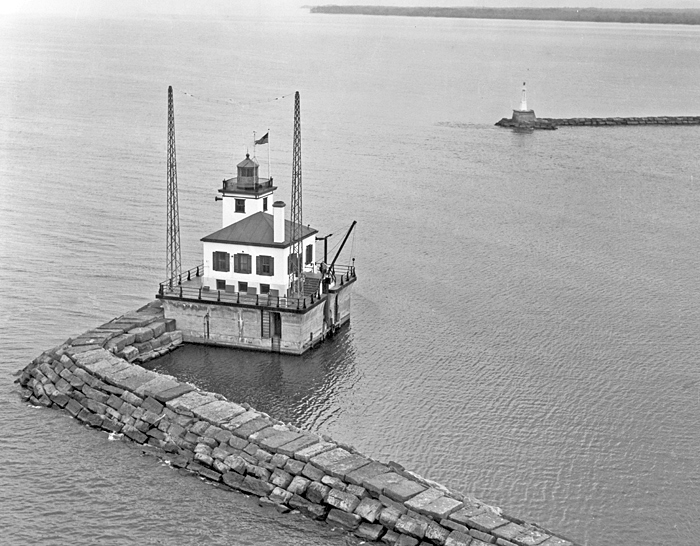
In May 1931, the Great Lakes Dredge and Dock Company began work on a new arrowhead breakwater entrance at Oswego. The octagonal iron breakwater tower was discontinued on August 10, 1931, and a temporary light was established the same day on the roof of the New York state barge canal terminal elevator. After the western breakwater was extended, a fifty-foot-square crib was built at its outer end, filled with stone, and capped with reinforced concrete so it could withstand the onslaught of wind-driven waves sweeping down Lake Ontario. In 1934, a metal lighthouse, fabricated in Buffalo and consisting of a thirty-foot-square building with a thirteen-foot-square tower in one corner, was erected over a basement built inside the crib. A fourth-order Fresnel lens, manufactured in France by L. Sautter, Lemonnier & Co., was installed in the lantern room, and with the aid of red-tinted panels, it produced a flashing red light, fifty-seven feet above the water. An electric tyfon fog signal in the new lighthouse sounded a three-second blast every thirty seconds when necessary. A duplex, which remains standing today, was built at 31 W. Fifth Street in 1934 to house two keepers and their families. A radiobeacon, synchronized with the fog signal for distance finding, was activated at the station on April 25, 1936.
Representatives of the local newspaper, the Palladium-Times, visited the lighthouse in 1938. They reported that the bottom story, accessed from the dock wall, housed the fog signal equipment and a backup generator, and a steel stairway led to the second floor, where a living room, radio room, kitchen, and bedroom were located. The lighthouse was found to be spic-and-span from the basement floor to the top of the tower. The reporter made sure to note that anyone that believed a keeper’s job was ten percent work and ninety percent leisure was one hundred percent wrong. Besides maintaining the light, fog signal, and radiobeacon, the keepers were also responsible for gas buoys in the harbor, the acetylene light on the east breakwater, and a light atop a grain elevator in the harbor. The keepers on duty that day were Bert Egelston, Karl Jackson, and Osgar Elmer. Keeper Egelston began his lightkeeping career as a fourth assistant keeper at Buffalo Harbor Lighthouse, and quickly worked his way up to first assistant, a position he held until being made head keeper at Oswego in 1929.
On Friday December 4, 1942, Lieutenant Wilson, commander of the Oswego Coast Guard Station, along with seven coastguardsmen from the station and lighthouse keepers Bert Egelston and Carl Sprague, set out at 10 a.m. in a picket boat to relieve Karl Jackson, who had been on duty since Tuesday. A winter storm, the worst Wilson had seen in his thirty-five years of service, had prevented the crew from spelling the keeper earlier, but on Friday the winds had fallen from 65 to 30 mph, and Wilson felt it was safe to reach the lighthouse.
|
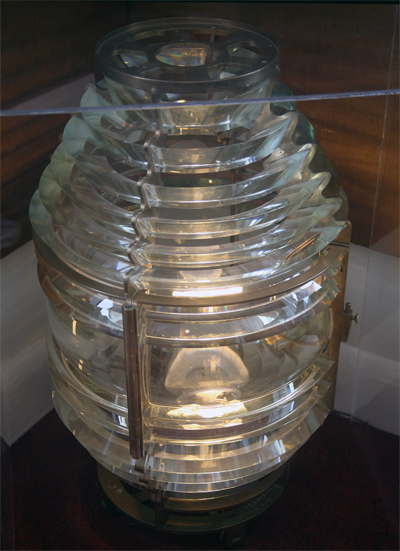
Oswego Lighthouse was automated and Coast Guard personnel were withdrawn from the station in 1968. The Fresnel lens was removed from the lantern room in 1995, when the lighthouse was solarized, and placed on display in the H. Lee White Maritime Museum.
In 2006, Oswego Lighthouse was offered to federal, state and local agencies and non-profit, educational and community development organizations under the auspices of the National Historic Lighthouse Preservation Act of 2000. Someone at the Maritime Museum interpreted the word ‘disposal’ in the announcement to mean ‘demolition,’ and greatly alarmed, officials of Oswego City and the H. Lee White Maritime Museum quickly sprung into action. Their initial fears were soon assuaged, and they found out that parties had sixty days to send a letter of interest for the lighthouse. Backed by a unanimous vote by the City Common Council, Acting Mayor Randolph Bateman submitted the letter, followed a few months later by a master plan for the long-term maintenance of the lighthouse. Under the plan, the City of Oswego would own the lighthouse while the Maritime Museum would help interpret the site.
In May 2009, the City of Oswego received the deed for the lighthouse after negotiating a lease agreement with the U.S. Army Corps of Engineers, which owns the harbor breakwall on which the lighthouse is built. The city has obtained a $225,000 grant from the New York State Canal Corporation to help with restoration of the lighthouse, but it is estimated that $500,000 will be needed for immediate repairs, and up to $2 million for a complete renovation. The lighthouse has been on deferred maintenance since 1994, and birds have gained access to the interior. Oswego Mayor Randy Bateman, who is one of the few to see the interior recently, remarked, “There are floor tiles in there with asbestos and the paint is falling off the walls, but the varnish on the wood looks like it was put on a month ago. It’s beautiful.”
A $73,750 contract was awarded to A.C.C. Contracting Inc. of Rochester to clean the inside of the lighthouse of any hazardous materials such as lead paint, asbestos, PCBs and bird droppings, and this work commenced the last week of September 2012. The H. Lee White Maritime Museum leased the lighthouse from the city in 2014, a move made to expedite the restoration process. Interior restoration was nearly complete in 2015, which will likely allow limited public access in 2016.
Keepers (Main):
Keepers (Breakwater/Beacon):
References