Duluth Harbor North Breakwater, MN 
Select a photograph to view a photo gallery
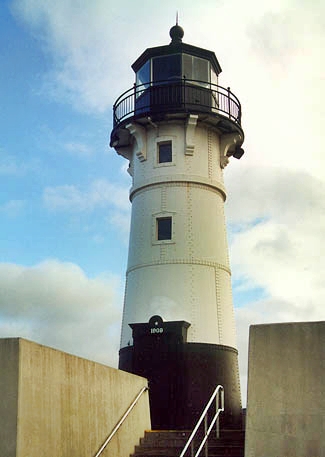
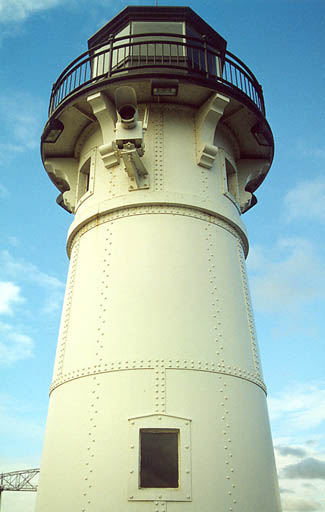
Photo Gallery
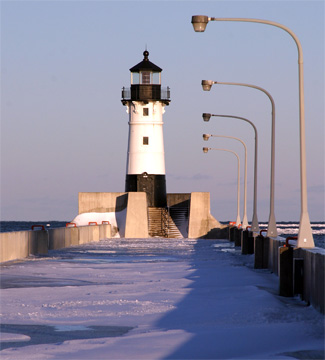
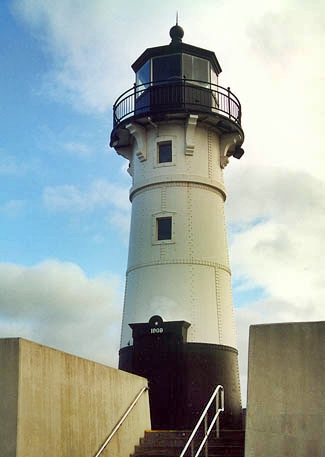
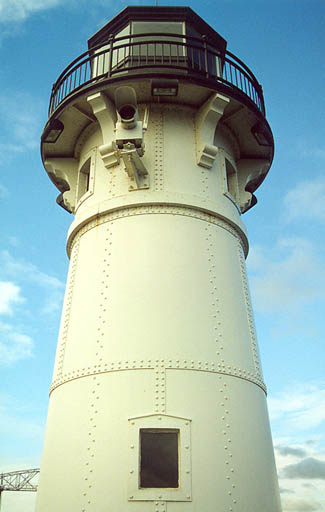
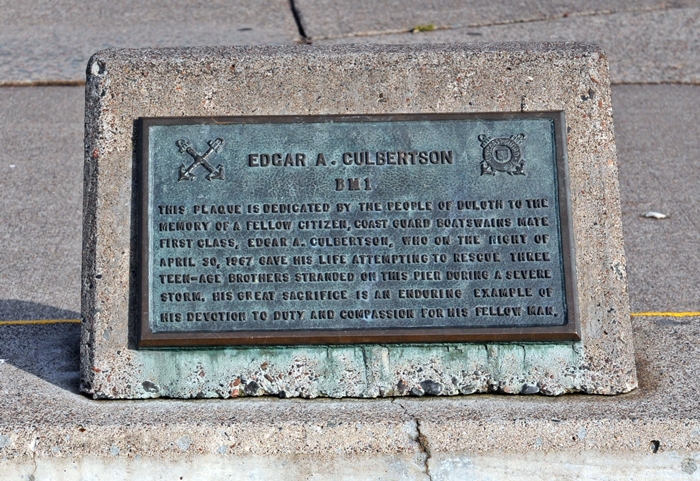
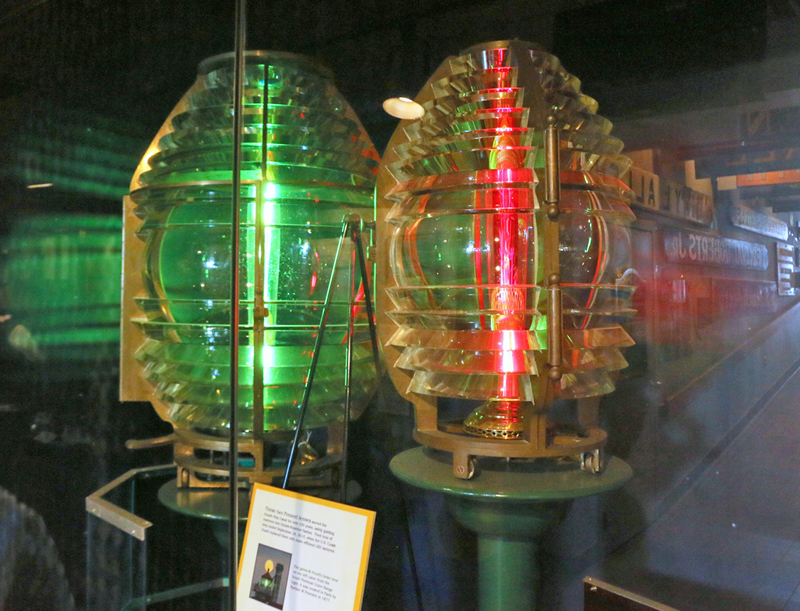
Photo Gallery
Photo Gallery
|
In 1908, the Lighthouse Board acknowledged the need to mark the north pier:
The approach to Duluth Harbor is one of the worst and most dangerous on the whole chain of lakes. The entrance piers are only 300 feet in width, and the north pier is so close to the shore that a vessel making a mistake in judging the width would be immediately on the rocks. The Lake Carriers’ Association considers this a matter of such importance that it has made arrangements for the exhibition of private lights for the balance of the season of navigation in 1908.The local officers of the Eleventh district, after careful investigation, state that navigation will be very decidedly facilitated by the establishment of a light on the north pier, and the Board therefore recommends that such light be established, at a cost of $4,000.
In its annual report for 1908, the Lake Carriers’ Association noted that it had paid to have lights on the north pier until the close of shipping that year:
The City of Duluth has maintained lights on the north entrance at Duluth for a number of years for the benefit of passenger traffic, and at the close of the passenger season these lights have been discontinued. Notwithstanding that repeated efforts have been made to have this pier properly lighted by the Lighthouse Department until the close of navigation, nothing has been accomplished in this respect. The lights were discontinued by the city as usual this year, on September 15th, but by special arrangement made by your President, through the Board of Public Works and the U. S. Engineer at Duluth, a cluster of 6 lights, carried by three of the iron lamp posts, was maintained at the outer end of the north pier until the close of navigation. …The expense of continuing these lights from the close of the passenger season until the close of navigation was borne by the Lake Carriers’ Association. Major Keller, Lighthouse Engineer of the Eleventh District, in his report, has recommended an appropriation of $4,000 for a permanent lighthouse on the end of the north pier, with a suitable flash light, to be about fifty feet above the lake level. The amount has been included by the Lighthouse Board in its estimates, and we have every reason now to believe that this appropriation will be granted, which will add much to the safety and comfort of our masters in entering Duluth Harbor.
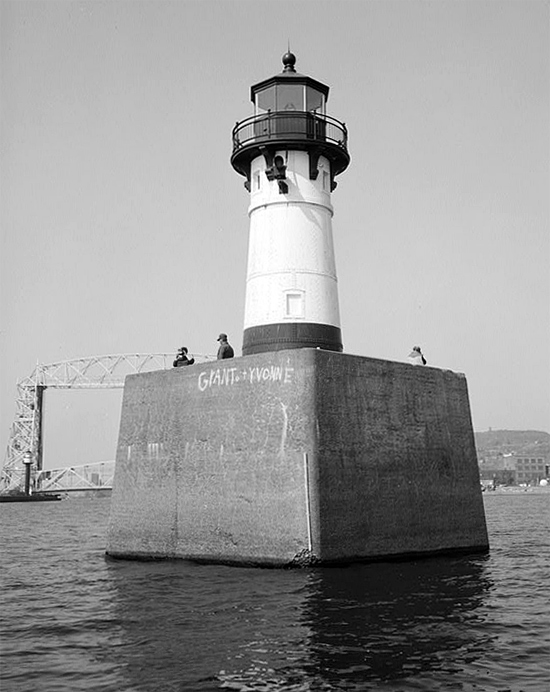
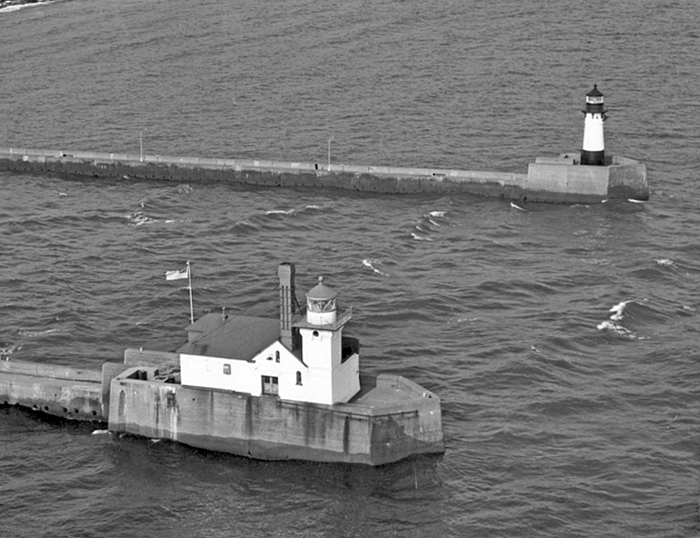
Congress appropriated $4,000 on March 4, 1909 to light the north pier, and after plans and specifications were prepared for a metal tower, the lowest bid for furnishing and delivering the metalwork was accepted. A conical tower consisting of latticed steel columns covered with a 5/16” steel shell was erected on the outer end of the north pier and lit for the first time on April 7, 1910. The lighthouse stands thirty-seven feet tall and tapers from ten feet six inches at its base to eight feet at the base of the octagonal lantern room.
|
A radiobeacon was established at Duluth Canal on August 24, 1927. The beacon originally transmitted during four half-hour periods at six-hour intervals for general navigation purposes.
The Duluth Canal piers are a dangerous location during a storm. On the night of April 30, 1967, Nathan and Arthur Halverson, sixteen-year-old twins, and Eric Halverson, their seventeen-year-old brother, were challenging ten to fifteen-waves on the north pier, when witnesses observed a huge wave sweep one of them away. Boatswain’s Mate First Class Edgar Culbertson, Boatswain’s Mate Second Class Richard R. Callahan, and Fireman Ronald C. Prei from the local Coast Guard base braved the storm and ventured out on the pier to rescue the two boys reportedly stranded at the pierhead light. The men tethered themselves together, with a spacing of twenty-five feet, and by the light of hand lanterns, proceeded to the end of the pier.
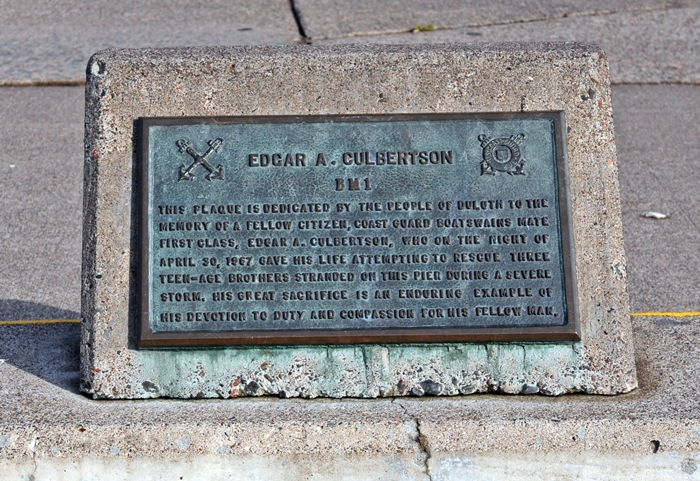
After finding no trace of the boys at the lighthouse, the coastguardsmen headed back. While making their way along the pier, a twenty-foot wave swept Culbertson off his feet and carried him over the breakwater wall and into the turbulent Lake Superior waters. Despite a valiant effort by his crewmates, Culbertson perished. The tether linking the men together had broken Callahan’s wrists, which made it impossible for him to help pull Culbertson to safety. Culbertson was posthumously awarded the Coast Guard Medal, and a plaque on the north pier commemorates his sacrifice. The three Halverson brothers all perished that night as well.
In 2014, an LED beacon replaced the active Fresnel lens in the lantern room of the north pier lighthouse. The change reduced the range of the light from about fourteen nautical miles to ten-and-a-half nautical miles, but the historic lens will no longer be subjected to temperature fluctuations and ultraviolet rays that can cause the lens to deteriorate. The lens is now on display at the Lake Superior Marine Museum. The lighthouse was added to the National Register of Historic Places in 2016.
In 2023, ownership of Duluth Harbor North Breakwater Lighthouse was transferred to Rethos, a St. Paul-based nonprofit that focuses on historic perservation, education, and economic development. Rethos plans to have tours involving the lighthouse beginning in the summer of 2027.
Keepers:
References