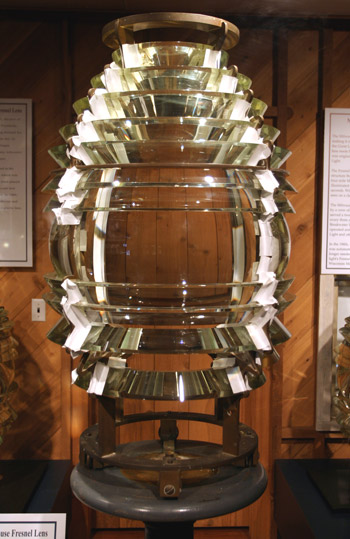
Manitowoc Breakwater, WI 
Select a photograph to view a photo gallery
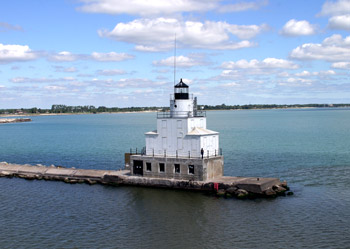
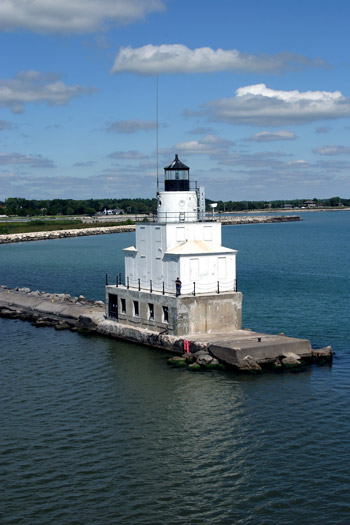
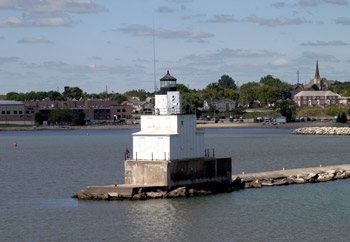
Photo Gallery
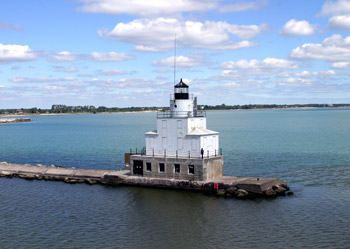
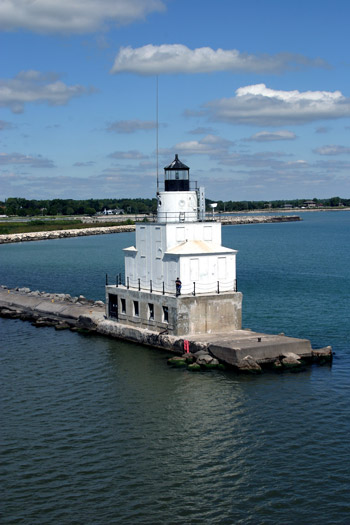
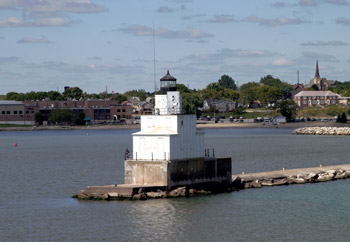
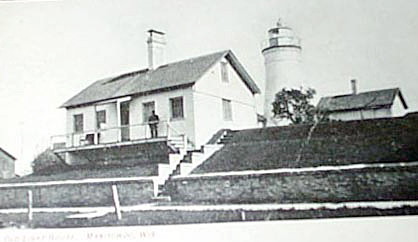
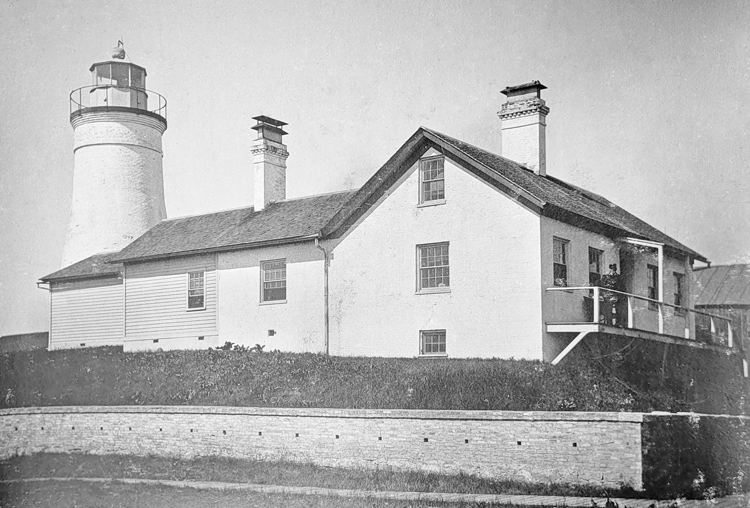
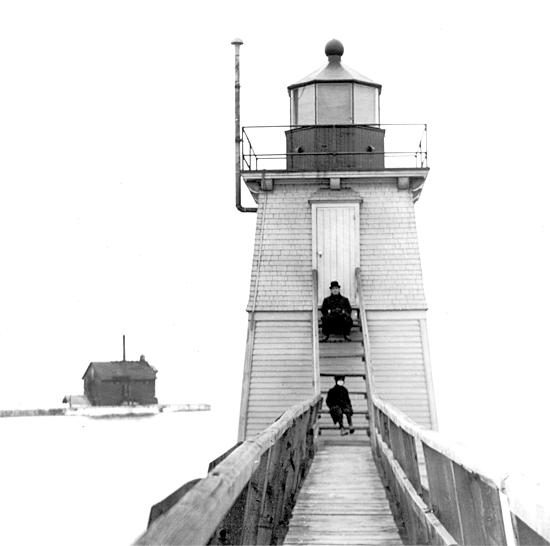
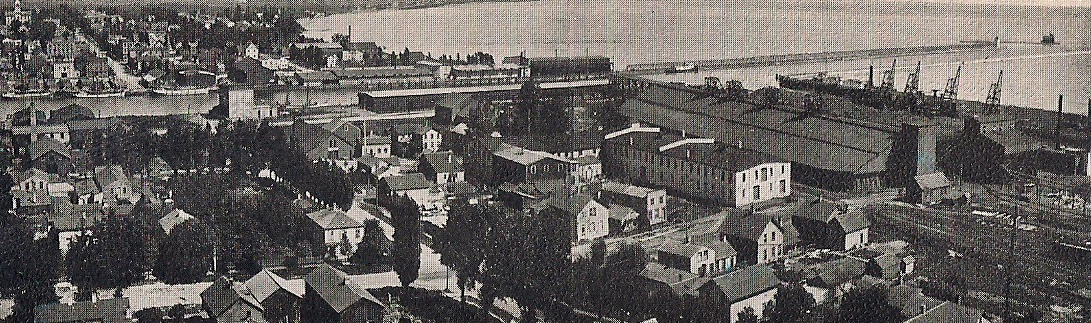
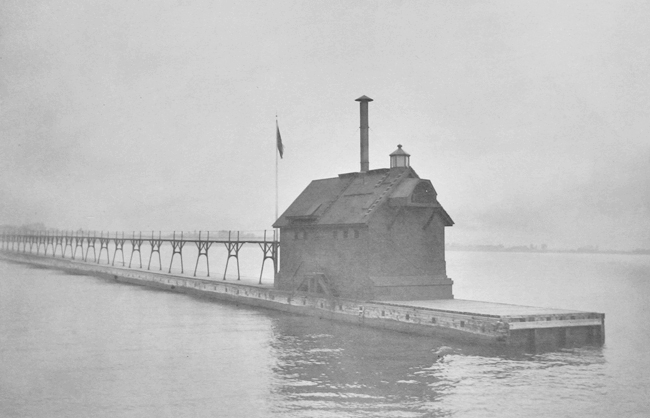
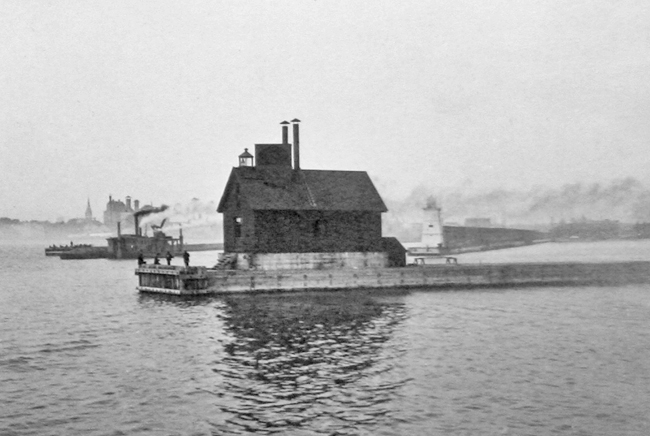
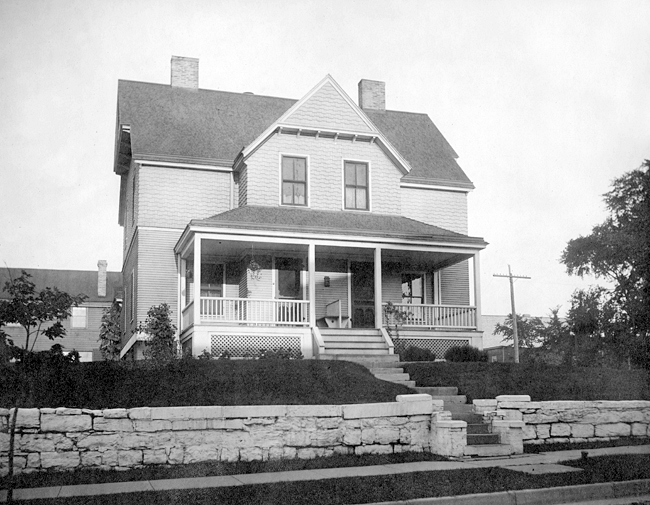
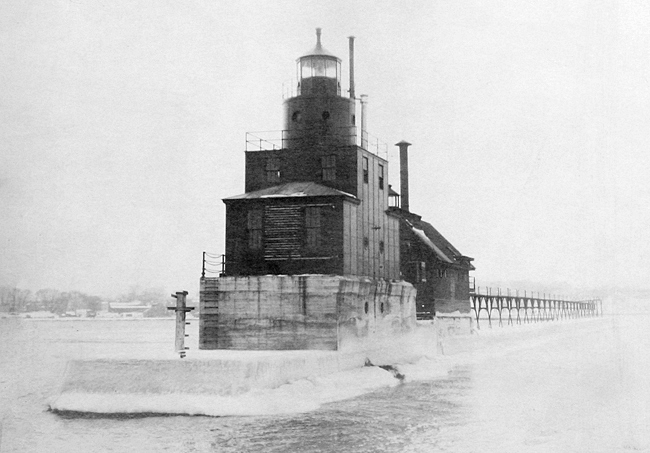
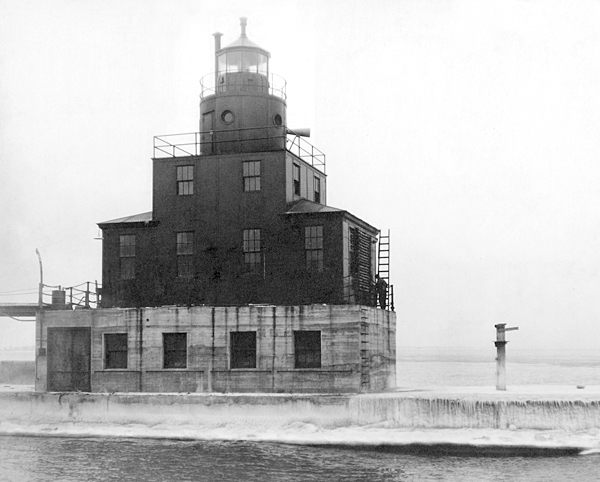
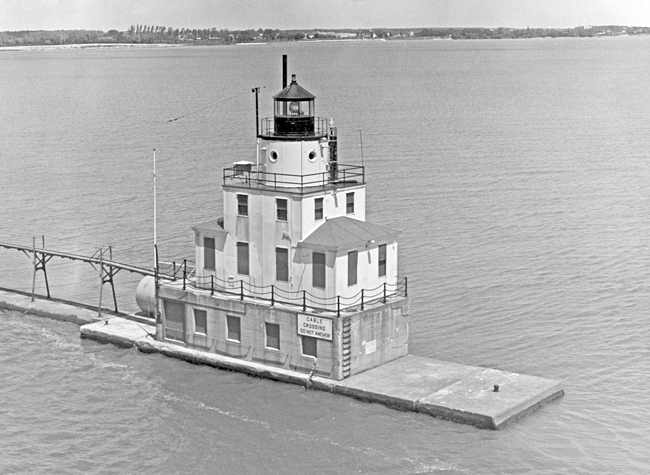
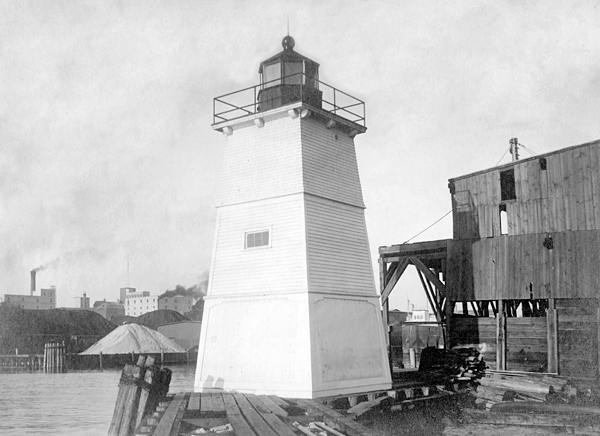
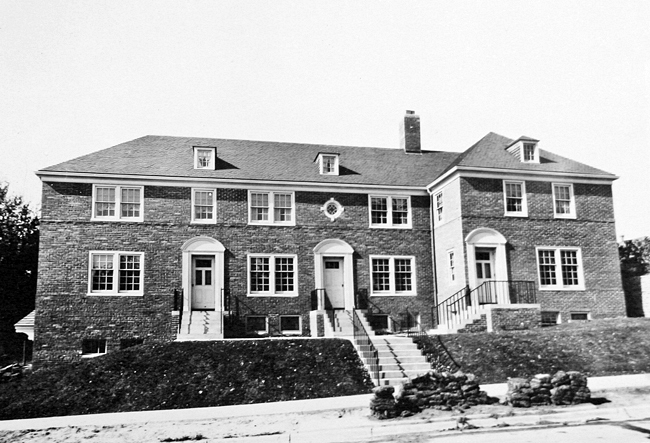
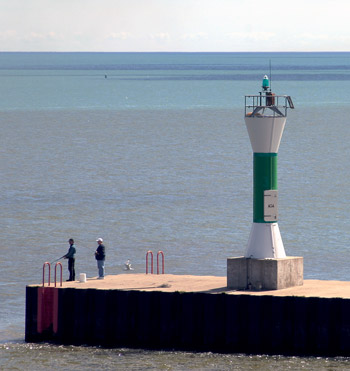
Photo Gallery
Photo Gallery
|
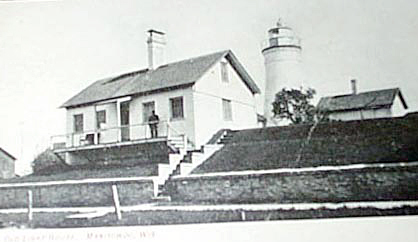
Congress had appropriated $5,000 for the construction of a lighthouse at Manitowoc on March 3, 1837, and following the favorable report by Lt. Pendergrast, a Mr. Lyon of Tecumesh, Michigan was charged with selecting a suitable site and seeing the work was carried out. After land was purchased from William and Anna Jones, work began on a brick tower that tapered from a diameter of twelve feet at its base to six-and-a-half feet at the lantern room. Stone steps led up to the lantern room, where the light was displayed through two windows, each with twelve, seven-by-ten-inch glass panes. The tower measured thirty feet tall from base to ventilator ball, but due to the hill on which it stood, the light from its lamps and reflectors had a focal plane of sixty-three feet. The lighthouse, which was painted white, entered service in 1839.
The nearby one-and-a-half-story brick keeper’s dwelling was also white, and it measured thirty-four by twenty feet. Keeper Peter Johnson, who cared for the light until 1842, was the dwelling’s first occupant. In 1856, a fifth-order Fresnel lens was installed atop the tower, but then in 1859 the tower was torn down some ten feet and rebuilt one foot taller to accommodate a new lantern room. The following description of the improvements appeared in a local newspaper in October 1859:
The old tower being too small at the top for the new lamp and fixtures, was torn down some ten feet and suitably rebuilt, one foot higher than before. It is now thirty-one feet high, and the focal plane of the light is sixty six feet above the lake level. The light is a lens light, fixed and varied by white flashes, which occur at intervals of two minutes. It will be exhibited on and after the 15th inst. The old abiding place of the keeper, is converted into an airy, pleasant dwelling. The lot has been graded and terraced, and the whole surrounded by a wall of mason-work 280 feet in length. The area of the terraces is about 600 square yards, which were sodded by Mr. Chas. Baumgarten of this village. The cost of the new lamp and fixings is $700, and the expense of other improvement is $1000.
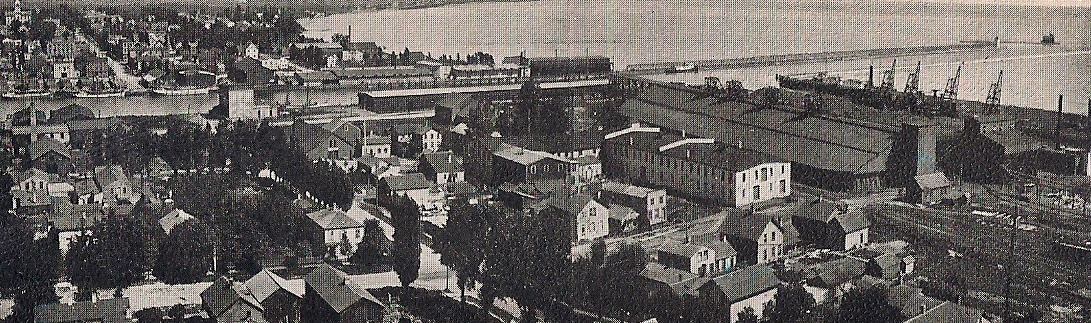
The Legislature of Wisconsin petitioned Congress in 1865 for improvement of the harbor at Manitowoc. As a result, work on parallel piers at the mouth of the Manitowoc River began in 1867. At that time, there were roughly 680 arrivals and departures at the harbor each year, importing and exporting around 150,000 tons of merchandise. Wood in the form of lumber, shingles, broom handles, pickets, and staves made up most of the export tonnage, with wheat being the dominant agricultural export.
|
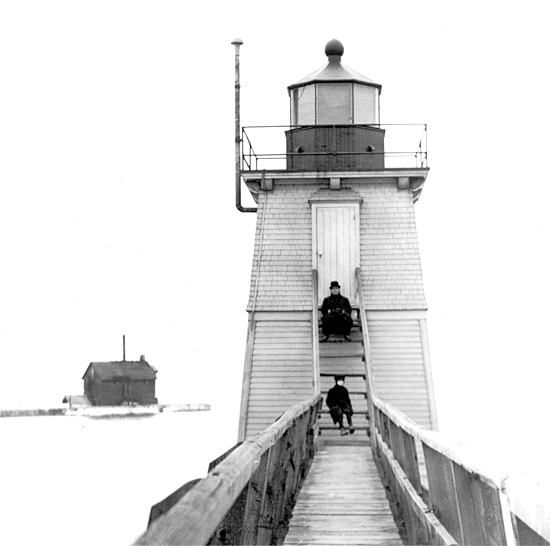
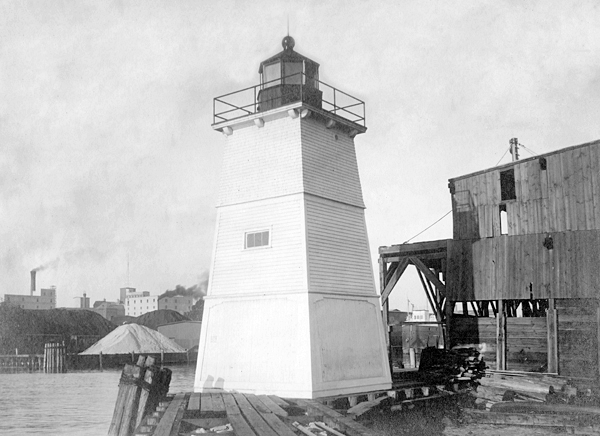
The keeper of the 1839 Manitowoc Lighthouse was charged with looking after the pierhead light as well. He continued to perform this double-duty for three years until Manitowoc Lighthouse was discontinued at the opening of navigation in 1877.
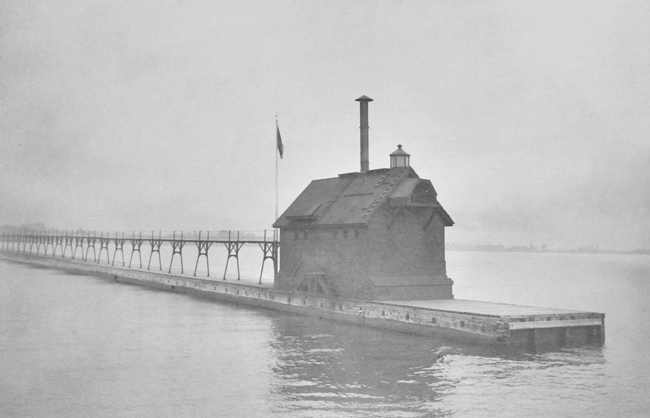
In 1881, a fog bell, struck by machinery, was established at the pierhead light. Also that year, the light was moved lakeward 100 feet, and the tower’s elevated walkway, used by the keeper in inclement weather, was extended the same amount. In 1884, this walkway, which was 784-feet-long, was extended another 240 feet shoreward.
In 1892, the Lighthouse Board requested $5,500 for a steam fog signal to guide the numerous steamers that, after the closing of the Straits of Mackinac in winter, transported goods form Manitowoc to railroad terminals on the eastern shore of Lake Michigan. Located at the northerly limit of the portion of Lake Michigan that remains comparatively ice free in the winter, Manitowoc was the natural outlet for the region northwest of the city.
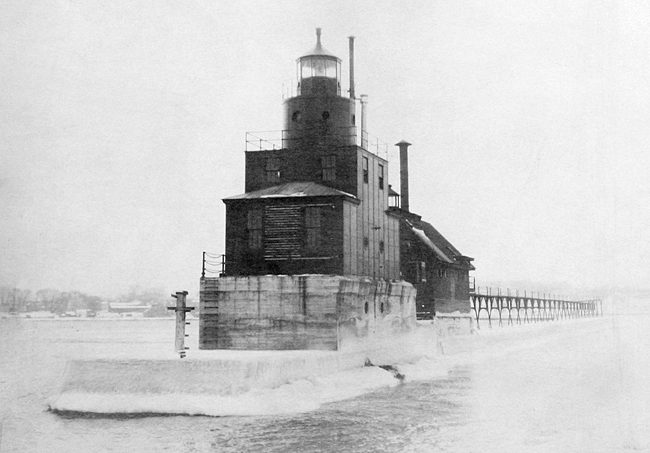
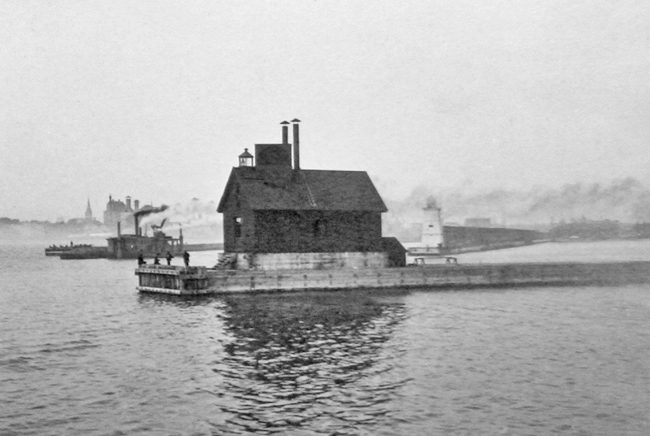
A 400-foot-long breakwater, built off the northern pier at an angle of 45°, had been proposed for Manitowoc in 1890 to protect the harbor, and this work was carried out in 1895. After Congress provided $5,500 on March 2, 1895, a substantial frame fog signal building, covered with corrugated iron and equipped with an enclosed lantern atop its gable end, was constructed on the southeast end of the breakwater. This structure’s light and fog signal were placed in operation on November 28, 1895. A boathouse was placed behind the breakwater lighthouse to store the keepers’ boat used to access the light and fog signal. A parabolic reflector was placed around the fog whistle to direct the sound lakeward, and in 1904, the boathouse was rebuilt and a craned was erected for lifting the keepers’ boat.
As another keeper was needed to help run the fog signal and additional light, the original keeper’s dwelling was torn down, and a double dwelling was completed in its place on December 27, 1895. Each of the dwelling’s two apartments had a parlor, dining room and kitchen on the first floor, and three bedrooms on the second floor. The discontinued old brick lighthouse was also razed in 1895.
The Flint and Pere Marquette Railroad launched a railroad car ferry service between Manitowoc and Ludington in 1897 using the Pere Marquette, the first steel car ferry. In 1900, the ferry transported 27,000 railroad cars across Lake Michigan. The S.S. Badger, which has been converted to carry automobiles and passengers, is the last of the fourteen railcar ferries that served this route.
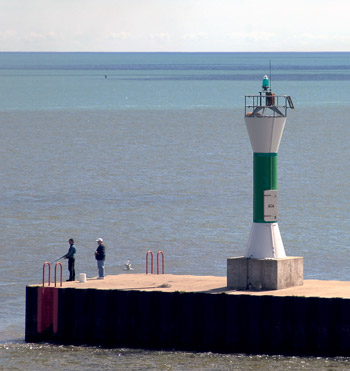
Following the extension of the breakwater, the light and fog signal were relocated 400 feet southeast and commenced operation there on May 17, 1904. In 1907, a project for improving the harbor necessitated the removal of the outer 500 feet of the breakwater and the old piers. The breakwater light and fog signal were therefore relocated 500 feet shoreward, and the 1873 pier light was relocated to the stub of the old north pier. By 1910, new converging breakwaters were in place.
|
The seas were running very high and carried away Warren’s boat and tore away the steps leading to the signaling station and for a time the station was in danger of being swept into the sea. The waters flooded the floors and quenched the fires in the boilers. It was impossible to get a boat to the breakwater near enough to get Warren out of his dangerous position. Even the large car ferries of the Ann Arbor & Pere Marquette line were unable to get close enough to the station. He remained at the station all day and late into the night. He was finally taken off by the tug Arctic after the storm had somewhat abated. The boats in the harbor had to be taken from their moorings and the steamer Wildlar, which was lying at a coal dock unloading, parted its lines several times.
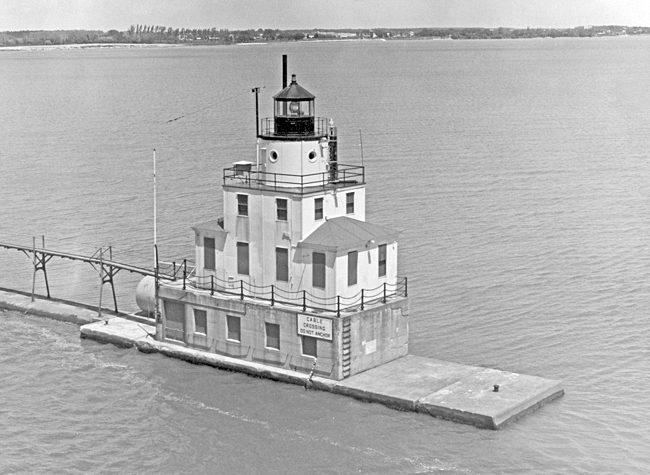
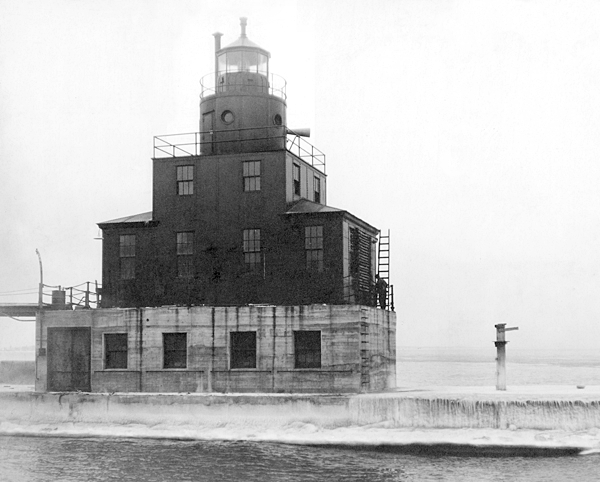
In 1912, the Lighthouse Bureau recommended that a new fog signal building be constructed as the existing structure was very shaky “due to movement and settlement of [the] pier and to the fact that the building has been moved twice.” After repeated requests, Congress finally approved $21,000 for the project on June 12, 1917. The old structure was removed from the breakwater in 1918, and the current steel lighthouse was constructed atop a concrete basement that measures twenty-two feet wide, by forty-eight feet six inches long, and eleven feet two inches high. The lighthouse was built of one-fourth inch steel plate and is nineteen by thirty-four feet on its first story and nineteen feet square on its second story. The second story supports the round diaphone room, which has a diameter of twelve feet four and three-quarters inches, and the lantern room. A steel switch house was built at the shore end of the breakwater to provide power to the lighthouse via a 2,400-foot-long electric cable, housed in a two-inch galvanized pipe.
A temporary oil light was exhibited from the tower’s decagonal lantern room on November 15, 1918, and then work was suspended until $9,000 in additional funding was provided on July 19, 1919. After this date, electric and oil engine compressors, a diaphone fog signal, and an electric light were installed. The station’s permanent light, displayed from a fourth-order Fresnel lens at a height of forty-six feet above the breakwater, commenced operation on December 13, 1919, the same date the type “F” diaphone fog signal was established.
The basement of the lighthouse was used as a boathouse. The first story, which was lined with hollow tile, was used as a power room, and the second story, which was lined with plaster on metal lath, was fitted with a shower and lavatory, and furnished with desk and chairs.
Joseph Napiezinski served as keeper of Manitowoc Breakwater Lighthouse from 1911 to 1941, and Ross F. Wright served as his first assistant from 1911 to 1932. Besides their duties of minding the light and fog signal, the keepers kept a watchful eye for anyone on the water who might need his assistance. In 1913, Keeper Wright rescued a party of boys and girls adrift on Lake Michigan and towed the disabled motorboat of the Two Rivers Lifesaving Station into port. In 1915, the two keepers helped float a grounded dredge and scow. In 1918, the keepers helped recover the body of one of two young people who drowned in the Manitowoc River, and the following year, Mrs. Wright rescued two bathers from drowning. In 1919, the keepers rescued aviators from a fallen plane, and in 1921, they assisted in recovering the body of a woman who drowned near the lighthouse.
The rescue of the aviators occurred on August 6, 1919 during Navy Day, when the German submarine UC-97 and a fleet of destroyers and submarine chasers called at Manitowoc. Lieutenant L.A. Walker and Clarence Kite, his mechanic, were giving an exhibition flight over the city as part of the celebration, when Walker attempted to put his seaplane into a tailspin and land in the midst of the fleet. Something went wrong with the controls, and the plane plummeted into the harbor from a height of 3,000 feet. The lighthouse keepers rescued the aviators, who were promptly rushed to the hospital and treated for minor injuries.
|
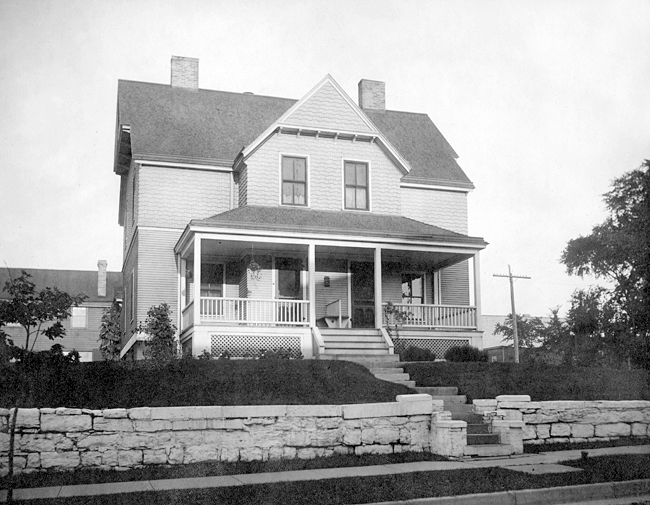
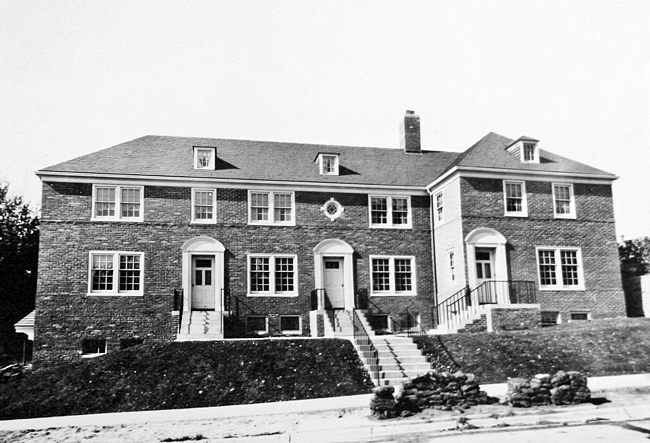
Efforts to obtain a new dwelling for the three keepers assigned to Manitowoc Lighthouse began in 1921, after the view of the harbor from the keepers’ duplex, which housed the keeper and first assistant, had been cut off by new construction. (The second assistant was forced to board with a private family.) After considerable difficulty in clearing title on a site at the end of the northern breakwater, a dwelling for the three keepers was finally completed in 1935 at a cost of $27,329. The old keepers’ duplex was sold in 1938 to the Otto Oas Post of the Veterans of Foreign Wars, who had been renting the property. The redbrick triplex is still standing at the corner of Chicago Street and North Lake Street. In 2017, the government auctioned off the triplex, which had been vacant since 2008.
The diaphone fog signal was removed from Manitowoc Breakwater Lighthouse in 1964 and replaced by an electronic foghorn. The lighthouse was automated in 1971, and the In 2009, Manitowoc Breakwater Lighthouse, deemed excess by the Coast Guard, was offered at no cost to eligible entities, including federal, state, and local agencies, non-profit corporations, and educational organizations under the provisions of the National Historic Lighthouse Preservation Act of 2000. When no interested party was found to assume ownership of the lighthouse, it was put up for auction by the government on October 18, 2010. Only two bids were received for the property: the minimum bid of $25,000 on December 6, followed just hours later by a bid of $30,000 from “philross.” The auction closed the next day after no new bids were received.
The winning bidder was later identified as Philip Carlucci of Melville, New York. In July 2011, the executive director of Wisconsin Maritime Museum called for graffiti on the lighthouse to be removed ASAP. Carlucci did not respond to repeated interview requests from the Herald Times Reporter initially, but later explained that he had not yet received the deed for the lighthouse, but when he did a thorough restoration of the lighthouse was planned. The Coast Guard hinted that they might be willing to allow personnel from its Two Rivers station to help paint the lighthouse as a community service project, and that did indeed happen on July 25.
Carlucci, a New York businessman, said owning a lighthouse has been a dream of his ever since going to the beach as a youth and climbing lighthouses. Carlucci has been involved with lighthouse restoration projects on Long Island and had an architectural consultant perform a comprehensive photographic survey of the interior and exterior of Manitowoc Lighthouse so that restoration can begin once he obtained the key to the front door.
Phil Carlucci spent roughly $325,000 to renovate and paint the lighthouse in time for the 100th birthday of the lighthouse in 2018. The gleaming white lighthouse was the talk of the town after its restoration, and Carlucci hoped to work with the Wisconsin Maritime Museum to coordinate tours and events at the lighthouse. Since 2019, Manitowoc Sunrise Rotary has been working with Philip Carlucci to offer tours of the lighthouse to schoolchildren and other interested groups. Information on tours can be found on the Wisconsin Maritime Museum website.
Keepers:
References