Bluff Shoal, NC 
Select a photograph to view a photo gallery
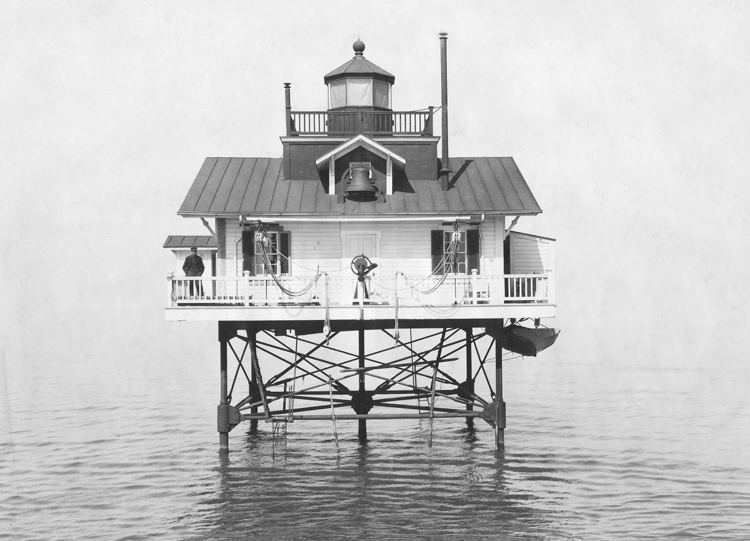
Photo Gallery
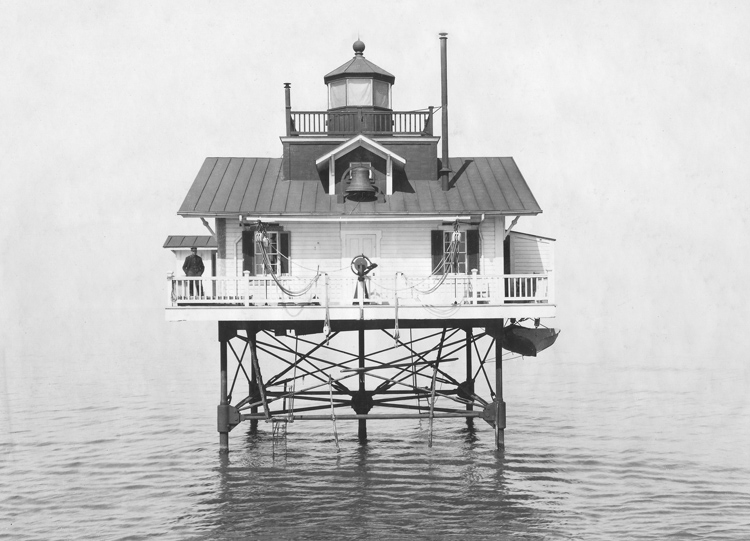
Photo Gallery
Photo Gallery
Bluff Shoal Lighthouse stood in one of the most unusual and strategically important locations in the inland waters of North Carolina. Established in 1904 in the broad reaches of Pamlico Sound, the lighthouse marked a dangerous shoal that effectively divided the sound into two vast basins and guided vessels approaching the ever-changing channels leading toward Ocracoke Inlet. Though less famous than the great ocean lights of Cape Hatteras or Ocracoke, Bluff Shoal Light played a critical role in coastal navigation for more than three decades. Its history reflects not only the hazards of navigation in Pamlico Sound, but also the evolving engineering practices of the Lighthouse Board and the daily labor of the keepers who maintained the isolated station.
Pamlico Sound itself is a shallow inland sea separated from the Atlantic Ocean by the Outer Banks. Within the sound, Bluff Shoal formed a long underwater ridge extending from Royal Shoal near Ocracoke Inlet northward toward Bluff Point on the mainland. The shoal divided the sound into northern and southern basins. Water from Albemarle Sound and its tributaries flowed through the northern basin, while the southern basin received the waters of the Neuse and Pamlico Rivers. These opposing movements of water converged near Ocracoke Inlet, where they met in a complicated network of channels and shoals.
The shoal was believed to have been formed by sediment deposited where these opposing currents slowed and collided. Depths atop Bluff Shoal averaged only about ten feet, while waters on either side were roughly twice as deep. Because maritime traffic relied heavily on the channels threading through the sound toward Ocracoke Inlet, the shoal became a significant navigational hazard. Conditions at the inlet were especially unstable because the various channels from the north basin converged with the concentrated flow from the south basin in Wallace Channel. The existence or closure of inlets farther north along the Outer Banks also affected the movement of water and the formation of shoals. Mariners navigating the sound therefore required dependable aids to navigation in a region where channels shifted and storms regularly altered the bottom.
Before Bluff Shoal Lighthouse was built, the principal aid to navigation in the area was Northwest Point Royal Shoal Lighthouse. By the late nineteenth century, however, that station had become increasingly endangered. The lighthouse stood on the edge of a shoal that was steadily eroding away beneath it. During the powerful hurricane of August 17–19, 1899, seas swept completely over the low structure, causing serious damage and underscoring the vulnerability of the station. Iron bands were placed around the foundation piles, new tension braces were added, and new fourth-order lamps were installed. These efforts proved unsuccessful. The Lighthouse Board reported that the structure oscillated badly even in ordinary weather, making it impossible to prevent leaks in the roof.
Recognizing the danger, the Lighthouse Board recommended that a new lighthouse be constructed farther back on the shoal at a safer location. The station was considered one of the most important lighthouse sites in North Carolina’s inland waters, and Congress appropriated $30,000 in 1901 for rebuilding the light. In the meantime, conditions at Northwest Point Royal Shoal deteriorated further. The main fourth-order light was discontinued in January 1900 and replaced with a simpler post lantern light. To distinguish it from nearby Southwest Point Royal Shoal Lighthouse, the light was changed to fixed red in June 1900 by the use of ruby chimneys. The fog bell apparatus was removed, and the keeper was transferred to the neighboring Southwest Point station, from which he could tend the light.
After further investigation, the Lighthouse Board concluded that rebuilding directly on Northwest Point Royal Shoal would not provide the best navigational aid. Officials determined that a new lighthouse located on nearby Bluff Shoal would better guide vessels around the dangerous shoals where navigation routes through Pamlico Sound changed direction. In December 1901, Secretary of the Treasury Lyman J. Gage formally requested legislative authority to use the existing appropriation for a lighthouse on Bluff Shoal instead of Northwest Point Royal Shoal.
The resulting legislation briefly became the subject of political humor in Congress. Representative John H. Small of North Carolina had introduced a straightforward bill transferring the previously appropriated funds to the new site. However, the House Committee on Interstate and Foreign Commerce rewrote the measure, accidentally including language that repealed a much larger portion of the previous year’s appropriations act. The mistake was discovered in time in the Senate before broader lighthouse appropriations were jeopardized. Small later joked publicly that the embarrassment belonged not to him, but to the committee that had revised his original bill.
Construction of Bluff Shoal Lighthouse began in earnest during 1903. The metalwork for the station was completed and delivered to the Lazaretto lighthouse depot in March of that year. Contractors transported materials to the isolated site and built a working pier from which crews could drive the foundation piles and assemble the structure. The work was not without hardship or danger. In June 1903, Mate Edward W. Daniels of the schooner Rover died of Bright’s disease while delivering lighthouse materials from Baltimore. A few months later, the steamer Lakewood, bound from Norfolk to Bluff Shoal to be used as a tender in the lighthouse construction project, sprang a leak during rough weather and had to be beached near Wade’s Point Light. The crew was rescued through the efforts of the Wade’s Point keepers, who made repeated trips through heavy seas to save the passengers and crew.
Despite these difficulties, construction proceeded rapidly. By August 1903, the foundation piles had been driven, and work on the wooden superstructure commenced shortly thereafter. The lighthouse was completed by mid-December. The new station consisted of a square one-story wooden dwelling mounted atop five wrought-iron piles—one central pile and one at each corner. Above the dwelling rose an iron lantern with a copper roof. The light was first exhibited on January 15, 1904.
Bluff Shoal Light displayed a flashing red fourth-order light every ten seconds, visible for approximately eleven and one-half miles in clear weather. The focal plane stood thirty-eight feet above mean high water. A fog bell, struck mechanically every fifteen seconds, provided additional warning during periods of fog or thick weather. The lighthouse stood in approximately eleven feet of water and was painted in a distinctive color scheme consisting of a white dwelling, brown roof, black lantern, and brown iron piles.
At the same time the new light was activated, Northwest Point Royal Shoal Lighthouse was permanently discontinued. Charts thereafter identified the former structure simply as an “old tower.” Bluff Shoal effectively replaced the older station while providing a safer and more useful guide for navigation through the sound. Because the lighthouse itself adequately marked the shoal, a nearby buoy formerly maintained southwest of the site was discontinued in March 1904.
The first head keeper of Bluff Shoal Lighthouse was Amasa J. Simpson, who had previously served at Northwest Point Royal Shoal. His transfer symbolized the continuity between the old station and its replacement. Over the years a succession of keepers and assistants maintained the isolated light. Life at the station demanded constant vigilance against corrosion, storms, and mechanical failure. The iron foundations required continual painting and maintenance due to the harsh saltwater environment.
Conditions at the station are vividly illustrated by a 1916 inspection report sent to Keeper Victor L. Watson. The inspector criticized the condition of the ironwork beneath the structure, noting severe deterioration in the paint and rust protection. Watson was ordered to scrape, red-lead, and repaint all iron components within thirty days or face suspension of shore leave. Additional criticisms concerned greasy clockwork, dirty fog-signal machinery, and discrepancies in the station records. Six months later, however, the station was reinspected and found to be in very satisfactory condition.
Among the station’s keepers, Joseph M. Burrus achieved the longest tenure and became closely identified with Bluff Shoal Lighthouse. Originally serving as assistant keeper, Burrus was promoted to head keeper on January 1, 1917. He had entered the Lighthouse Service in 1903 and would remain in charge of Bluff Shoal until automation in 1929. During his years there, he earned Commissioner’s Efficiency Stars in both 1922 and 1924, recognition awarded for exemplary service. In 1926, when nearby light stations at Hatteras Inlet and Gull Shoal were converted to acetylene operation, additional duties were assigned to the Bluff Shoal keepers, effectively making the station a supervisory center for several automated lights in the region.
Technological changes gradually transformed the station during the 1920s. On December 31, 1921, the light characteristic was changed from flashing red to flashing white every ten seconds, with a candlepower of 1,800. In 1929, the light was again modified slightly, and that same year the station was automated, ending the era of resident keepers at Bluff Shoal. Joseph M. Burrus was transferred to Ocracoke Lighthouse, where he continued serving until his retirement in 1946.
The original pile dwelling did not survive indefinitely. In 1935, the old structure was replaced with a black skeleton tower mounted on brown piles, and the intensity of the light was reduced. Like many offshore lights in shallow southern waters, Bluff Shoal evolved from a staffed wooden cottage-style lighthouse into a simpler automated beacon requiring far less maintenance.
Although Bluff Shoal Lighthouse never possessed the grandeur of North Carolina’s great coastal towers, it occupied a place of exceptional importance within the navigational system of Pamlico Sound. Built to replace the failing Northwest Point Royal Shoal station, it marked a critical turning point in the channels leading to Ocracoke Inlet and warned mariners of one of the sound’s most persistent shoals. Through storms, shifting channels, and decades of maritime change, the lighthouse stood as a vital safeguard for the vessels navigating North Carolina’s inland waters.