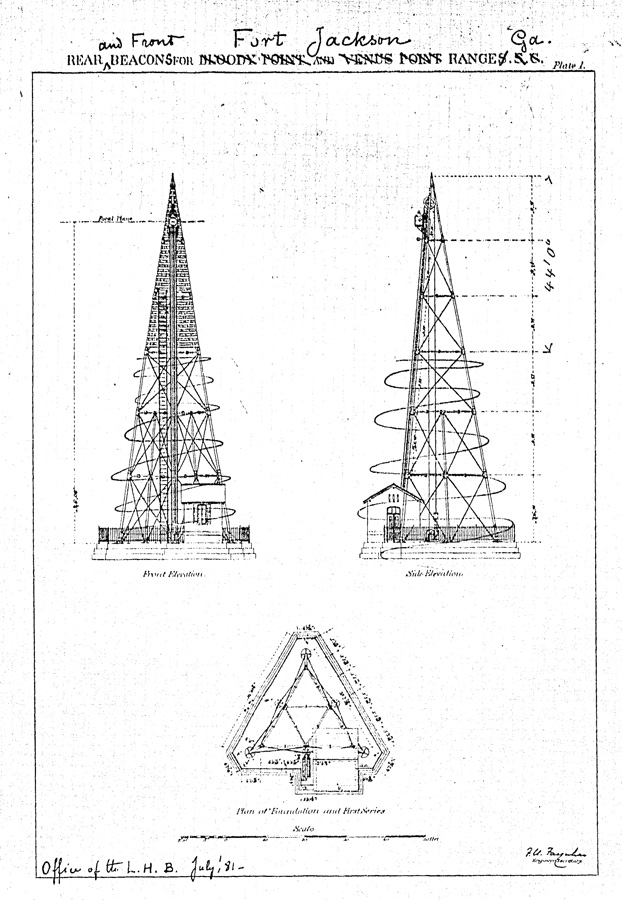
Fort Jackson Range, GA 
Select a photograph to view a photo gallery
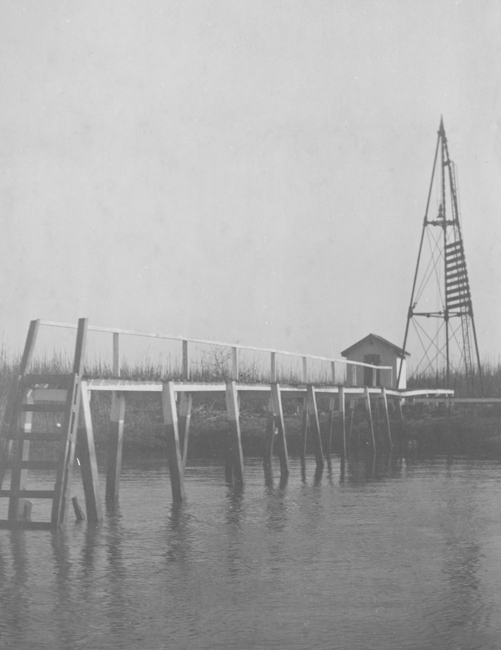
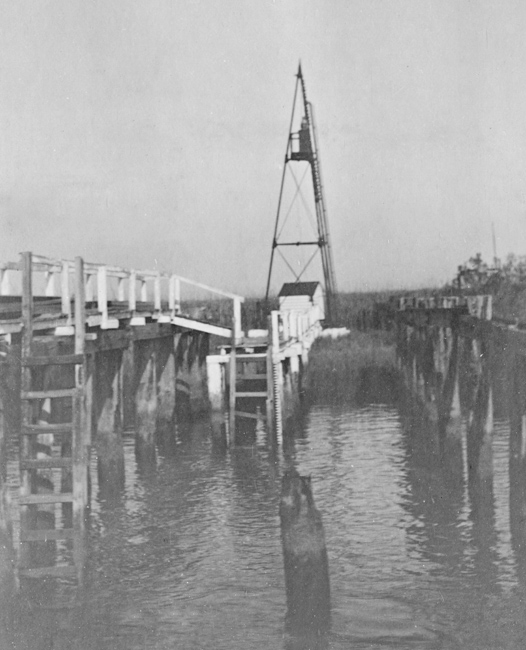
Photo Gallery
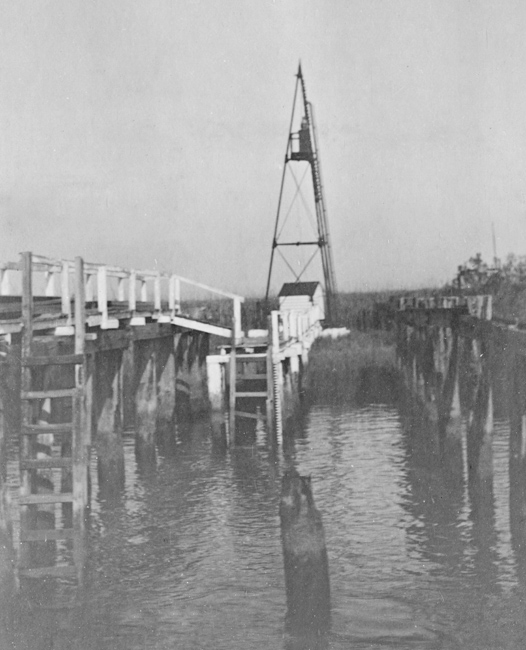
Photo Gallery
Photo Gallery
For much of the nineteenth century, the Savannah River was one of the most commercially important waterways in the American South, yet it remained among the most dangerous to navigate. Shoals shifted constantly, sandbars formed overnight, and narrow channels were easily lost in fog, darkness, or storm. From the bar at Tybee Roads to the wharves of Savannah, pilots and captains depended on a scattered assortment of day beacons and temporary lights that were often destroyed by hurricanes or swept away by floods. By the late 1870s, it was widely recognized that the river could no longer rely on piecemeal navigation aids. What was needed was a coordinated system of range lights, carefully aligned so that vessels could follow a continuous illuminated path upriver.
Fort Jackson Range Lights were among the final and most critical links in that system. Located on the Georgia mainland near the northwestern end of Elba Island and just below the historic brick fort that guarded Savannah’s river approaches, these two fixed red lights marked one of the most treacherous reaches of the channel. Their history is inseparable from the long struggle to secure land, funding, and political cooperation for the larger project to light the Savannah River.
On March 3, 1881, Congress appropriated $60,000 “for lighting the Savannah River between the mouth of said river and the city of Savannah.” The Savannah Morning News hailed the decision that summer, reporting on June 11 that the National Lighthouse Board had approved a comprehensive plan to “light the river from Tybee to the city.” Capt. Norton, lighthouse inspector for the district, was ordered to place new buoys, while permanent range lights were to be erected at key points along the channel. Once completed, the Board declared, the river would be “as safe for navigation by night as by day.”
|
The enthusiasm of 1881 soon collided with reality. Hurricanes destroyed existing beacons, and by January 1882 not a single new light had been erected. Investigations by the Morning News revealed that the delay did not stem from indifference in Washington, but from the difficulty of acquiring suitable land for the beacons. Owners demanded exorbitant prices, and in some cases the titles themselves were unclear or disputed.
Among the nine sites selected by the Lighthouse Board were two “near Fort Jackson, on land belonging to Mr. Wm. P. Carmichael.” Unlike many other property owners, Carmichael was willing to sell an acre for $400, a price the Board found reasonable. Yet even here, the government encountered obstacles. As later reports revealed, Carmichael held only a defective title, and quit-claims had to be secured from mortgage holders before construction could begin.
By 1883, twelve iron towers had been fabricated and stored at Castle Pinckney in Charleston Harbor, awaiting resolution of the land disputes. Two lights on Daufuskie Island were completed, but the remaining ten—including the Fort Jackson pair—remained unerected. Titles to only four sites had been approved, and condemnation proceedings were required for others under South Carolina law.
Public frustration mounted. In January 1884, the Morning News called the situation “A Job for Our Congressmen,” urging Savannah’s representatives to pressure the Lighthouse Board into action. The materials, it complained, had been sitting idle for more than a year, while the river remained hazardous and poorly marked.
Finally, in the spring of 1884, the long stalemate was broken. The legal and title issues were sufficiently resolved to allow construction to proceed. On May 26, 1884, Fort Jackson Range Lights were officially exhibited, as announced in a federal Notice to Mariners. The two fixed red lights, spaced about one-eighth of a mile apart, were “intended to guide past obstructions near the northwest end of Elba Island.” Together with the ranges at Jones Island, Long Island, Elba Island, and Daufuskie, they completed the illuminated chain from the sea to Savannah.
Like the other Savannah River ranges, the Fort Jackson lights were iron-framed structures with keeper’s quarters below and lanterns hoisted by machinery. The rear light stood approximately eighty feet tall, while the front light rose to about forty feet. When aligned by mariners, the two lights formed a precise visual corridor marking the safest path through the channel.
The Fort Jackson range guided vessels through a difficult bend of the river where shoals and shifting bars threatened ships nearing the city. Their red color distinguished them from nearby ranges and buoys, helping pilots identify the correct alignment even amid the growing constellation of river lights.
The station required constant maintenance. A fireproof brick oil house was built in 1893 to store lamp fuel. After a burglary damaged the structure, it was repaired in 1894, along with 205 feet of trestlework and a boat landing. Additional improvements followed, including a new plank walk in 1899 and repairs in 1903.
Three men served as keepers at Fort Jackson: Charles Anderson in 1884, Samuel S. McFall from 1884 to 1888, and Daniel Z. Duncan from 1888 to 1908. In 1908, the Lighthouse Board abolished the Fort Jackson keeper position, placing the lights under the care of a keeper responsible for several nearby stations. Duncan was transferred to Elba Island, where he served until 1914. He was seventy-three years old when he finally left lighthouse service.
Duncan, an African American keeper, served for over twenty-five years under challenging conditions. In a 1911 efficiency report, the district inspector noted one of Duncan’s “special qualifications”: “Is not afraid of venomous snakes which are abundant at Station.”
Fort Jackson Range Lights represented the culmination of Savannah’s first fully integrated river lighting system. Though modest in size, they played a vital role in protecting vessels in the final miles of their journey to the city’s docks. Their story—marked by legal wrangling, political pressure, and persistent local advocacy—mirrors the broader struggle to modernize navigation on the Savannah River.
Together with the other ranges from Tybee to the city, the Fort Jackson lights transformed one of the South’s most dangerous waterways into a navigable corridor of commerce and connection, securing Savannah’s place as a major port well into the twentieth century.