Dames Point, FL 
Select a photograph to view a photo gallery
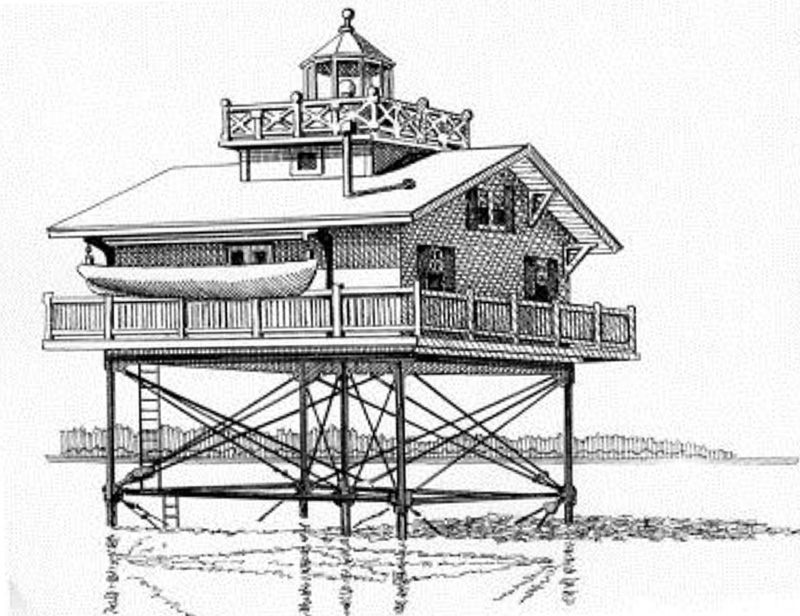
Photo Gallery
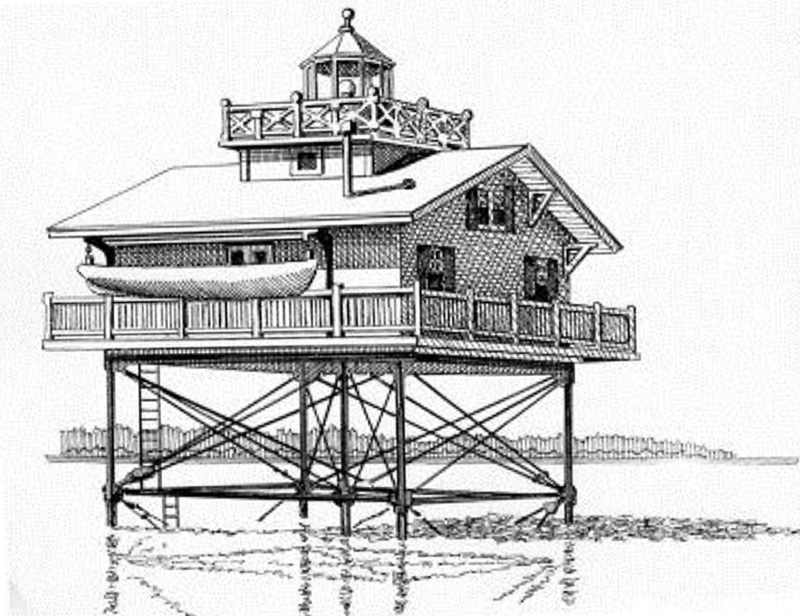
Photo Gallery
Photo Gallery
Dames Point Lighthouse marked one of the most hazardous bends on the lower St. Johns River, an essential commercial artery leading to Jacksonville, Florida. Located approximately eleven miles downstream from the city, Dames Point was characterized by a sharp curve in the river channel and an eight-foot-deep shoal that posed a persistent threat to vessels navigating to and from Jacksonville and the upriver settlements of Palatka and beyond. Over the course of the nineteenth century, changing navigation needs, technological advances, and extensive channel improvements shaped the evolution—and eventual obsolescence—of this aid to navigation.
Federal attention to the dangers at Dames Point began in the mid-nineteenth century, when increasing river traffic highlighted the need for reliable navigational aids. On August 18, 1856, Congress appropriated $9,500 for a small light-vessel to be stationed near Dames Point in St. Johns River. This floating aid was intended to mark the shoal and guide vessels safely around the bend.
In 1857, the authorized light-vessel was placed in position, accompanied by buoys and stakes marking the channel. Contemporary reports noted that these aids were received “to the great satisfaction of those navigating that river.”
Before the outbreak of the Civil War, the light-vessel continued to serve effectively at Dames Point. During the conflict, however, the vessel was removed, and navigation aids along St. Johns River were disrupted or abandoned. In the years immediately following the war, the Lighthouse Board reassessed the necessity and cost of restoring such aids.
In 1867, the Board observed that although a light-vessel had previously been stationed at Dames Point, this was an expensive method of marking the danger. It proposed instead that a beacon light placed on shore would serve the same purpose more economically. Nonetheless, Dames Point was considered a comparatively unimportant station at that time, and re-establishment was deferred.
The following year, in 1868, the Board recommended that the Dames Point light-vessel not be re-established, concluding that the interests of commerce did not require a light at that location. Acting on this recommendation, the Secretary of the Treasury directed that the station be discontinued.
Despite earlier conclusions, renewed commercial activity on St. Johns River soon altered official thinking. By 1870, navigation to Jacksonville, Palatka, and intermediate settlements had increased significantly, prompting strong appeals for the restoration of an aid at Dames Point.
An estimate was submitted for a screw-pile lighthouse, similar to those successfully erected in the Chesapeake Bay and North Carolina waters. Such a structure, to be placed on the shoal opposite Dames Point, was deemed more economical and better suited to the river environment than a light-vessel.
Congress approved this recommendation on March 3, 1871, appropriating $20,000 for the construction of an iron screw-pile lighthouse on the shoals off Dames Point. That same year, the district engineer examined the proposed site. Borings revealed soft mud to a depth of sixteen feet, suggesting that a screw-pile structure was feasible, though further examination of the foundation was advised before construction commenced.
Construction proceeded during the winter of 1871–1872. The lighthouse was framed at the Lighthouse Board’s workshops at Lazaretto Point, Maryland, while the ironwork was prepared under contract. In March 1872, a working party was dispatched to Florida, and by June the structure was completed.
Dames Point Lighthouse stood on a shoal in eight feet of water, approximately 500 yards southwest of Dames Point itself. The foundation consisted of six wooden piles fitted with cast-iron sleeves, supplemented by two fender piles positioned upstream and downstream to protect the structure from river traffic. The ironwork of the foundation was painted red, while the superstructure was painted white.
The lighthouse was surmounted by a lantern housing a fifth-order Fresnel lens displaying a fixed white light. The focal plane was 38 feet above mean tide, and the light illuminated the entire horizon. It was visible from Redel’s Point above and Mill Cove Point below, providing continuous guidance around the dangerous bend. The light was first exhibited on or about July 15, 1872, as announced in a formal Notice to Mariners issued by the Lighthouse Board.
Samuel Somers was appointed the first head keeper of Dames Point Lighthouse in 1872, receiving an annual salary of $600. He served until 1880, overseeing the station during its early years. The lighthouse also maintained an assistant keeper position from 1872 to 1882, reflecting the demands of maintaining a manned offshore structure in a busy river channel.
One notable keeper family was Edwin A. Fernandez, who served as head keeper from 1880 to 1882, and his wife, Marie L. Fernandez, who served concurrently and was the last assistant keeper at the station.
Throughout the 1880s, the Lighthouse Service continued routine maintenance of the structure. In 1880, the station was repainted throughout and minor repairs were made. The lighthouse endured not only constant exposure to river currents and passing vessels but also notable natural events.
On the night of August 31, 1886, Keeper Joseph Champagne reported experiencing a series of earthquake shocks, which were part of the Charleston earthquake that had an estimated magnitude of 7.0. The first tremor, lasting approximately seven seconds, was followed by three others over the next several minutes. The shocks were accompanied by a rushing sound likened to wind through a forest, despite calm conditions. The force was sufficient to crack plaster, stop the station clock at 9:44 p.m., and splash water from iron tanks as the structure shook east and west.
In 1891, after the lighthouse had been struck lightly by lightning on several occasions, an additional copper lightning conductor was installed, running from the lantern sill to one of the iron piles and extending below the lowest water line.
By the early 1890s, navigation on St. Johns River was undergoing a fundamental transformation. Numerous post lights had been established above and below Dames Point, and extensive dredging projects were underway to improve the channel. In 1893, the cut around Dames Point was dredged to a depth of fourteen feet, with plans to deepen it further to nineteen feet and widen it to 200 feet.
As a result of these improvements, the Lighthouse Board determined that Dames Point Lighthouse was no longer necessary. The light was officially discontinued on February 28, 1893. The lantern and lens were removed and transferred to Charleston, South Carolina, and the lantern parapet was roofed over with shingles.
In the months that followed, a complex system of new post lights and beacons was established along the dredged cut, rendering the former lighthouse obsolete as a navigational aid. Bearings and depths were carefully adjusted to reflect the new channel alignment, and many older aids were discontinued or renumbered accordingly.
Although the lighthouse was officially discontinued, August Haine—who had been head keeper at the time—appears to have continued living at the station and caring for nearby aids to navigation. Records list him as keeper at Dames Point through at least 1895.
The lighthouse structure remained standing for two decades after its light was extinguished. On December 25, 1913, Dames Point Lighthouse was destroyed by fire, bringing a final end to the physical presence of the station.
Though its service life was relatively brief, a light at Dames Point played a critical role during a period of rapid commercial growth on St. Johns River. From its beginnings as a light-vessel station to its replacement by a screw-pile lighthouse and eventual supersession by modern channel improvements, the history of Dames Point reflects the evolving relationship between navigation technology, river engineering, and commerce in northeast Florida.