Frying Pan Shoals, NC 


Select a photograph to view a photo gallery
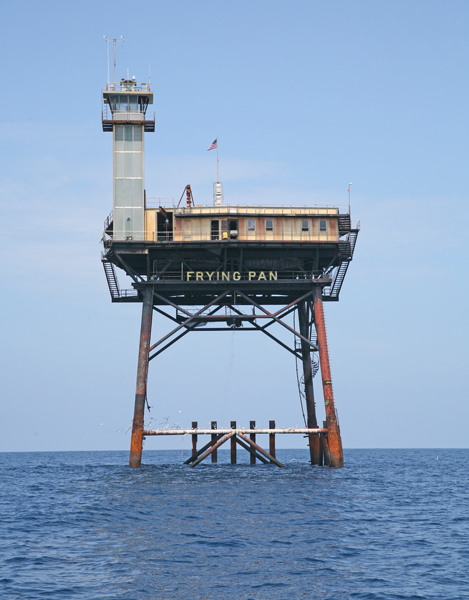
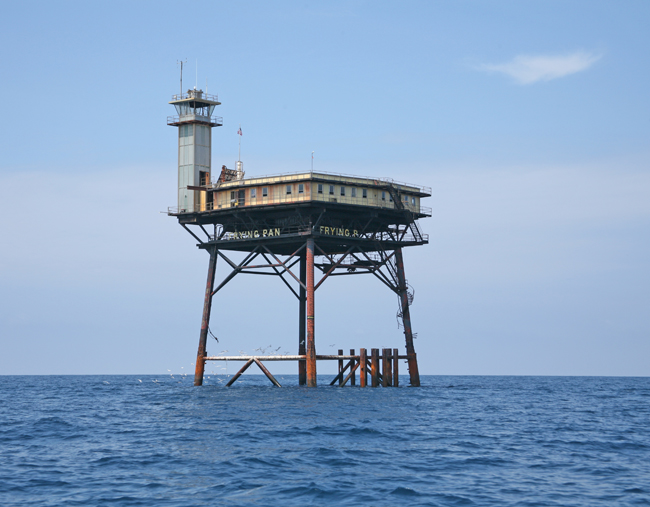

Photo Gallery
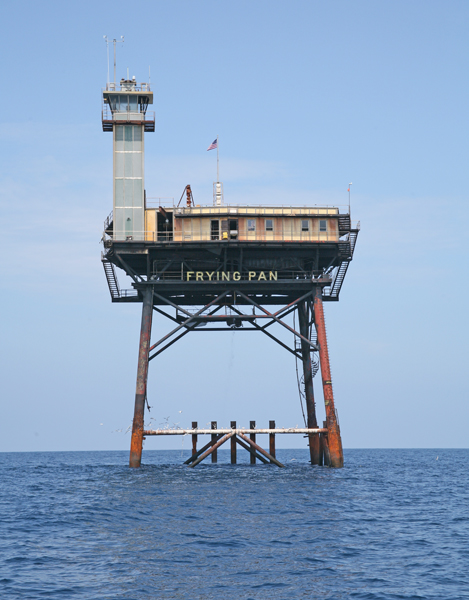
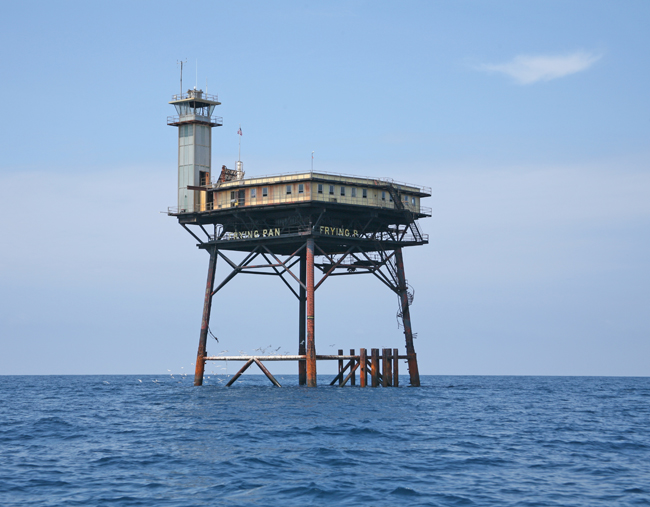
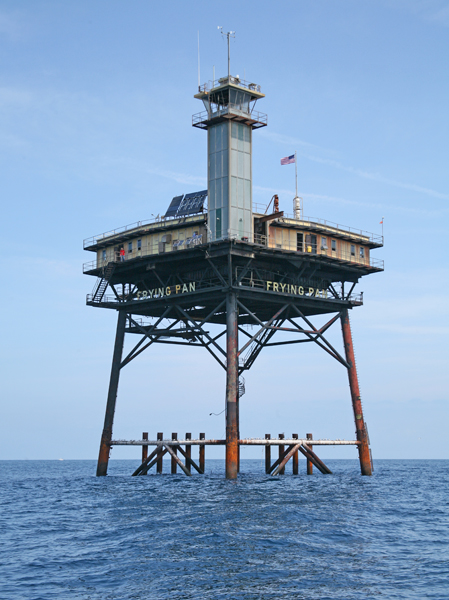
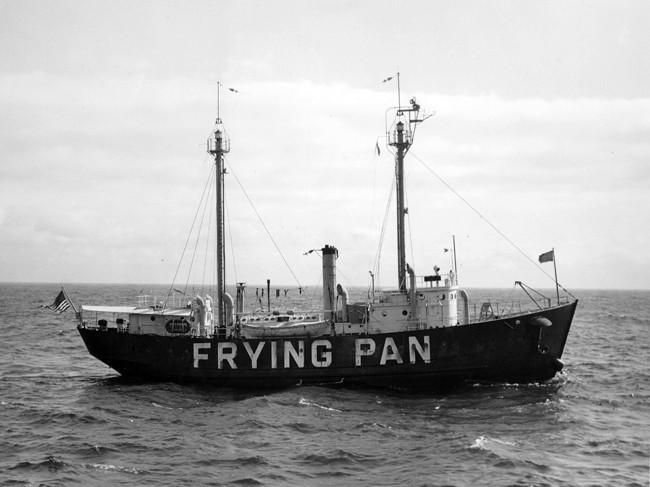
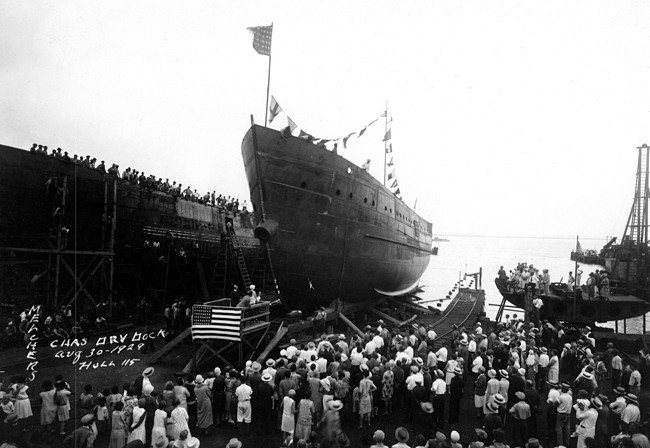
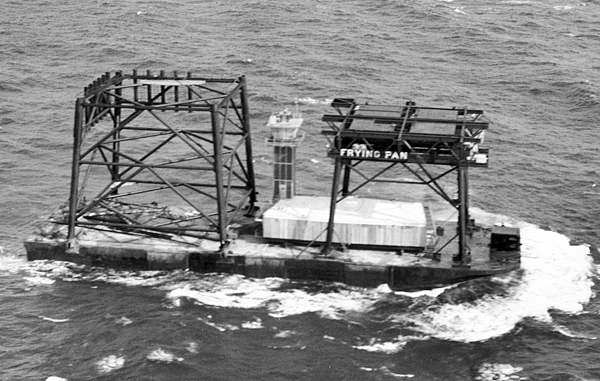
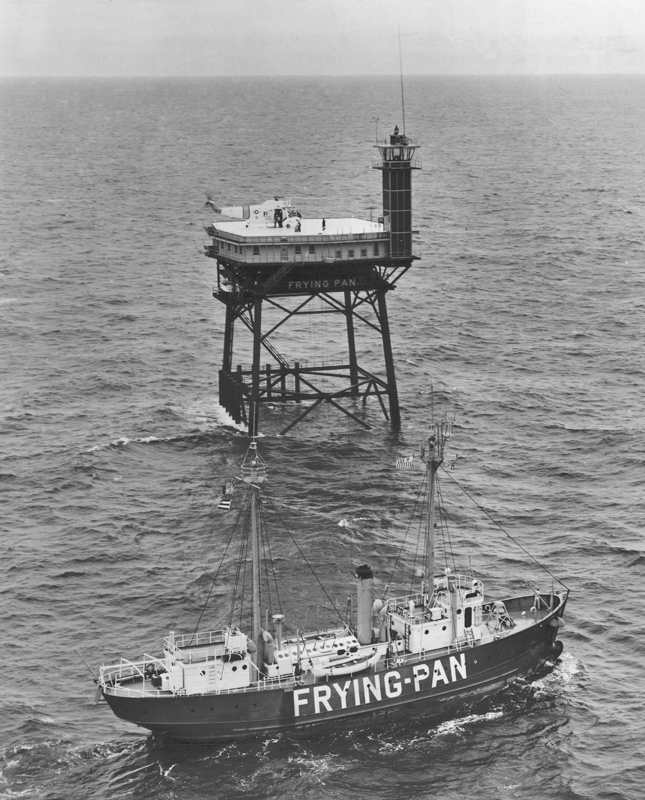
Photo Gallery
Photo Gallery
|
The treacherous Frying Pan Shoals extend some eighteen miles southeast of Bald Head Island, and the first two lighthouses built on the island in 1794 and 1817 proved inadequate at marking the extremities of the shoals. The Lighthouse Board thus ordered the placement of a lightship on the shoal in 1854 and provided the following notice:
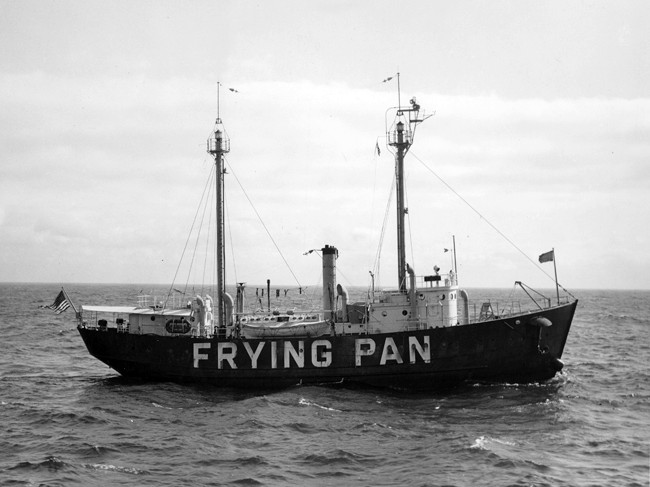
The vessel will carry two lights at an elevation of about 40 feet above the level of the sea, on her two masts—she will be painted yellow, as well as her lower masts, but with white topmasts—and she will carry an openwork oval daymark, painted black, at an elevation of about 58 feet above the water line. Her yellow hull will have "Frying-pan Shoals" in large black letters on both sides.
In 1883, the Lighthouse Board had an experimental iron beacon prepared to test the stability of the shoals, likely with the intent to erect some form of a permanent structure. The beacon was stored at the Castle Pickney buoy depot in South Carolina awaiting an opportunity to put it in position, but record of this ever happening hasn’t been found.
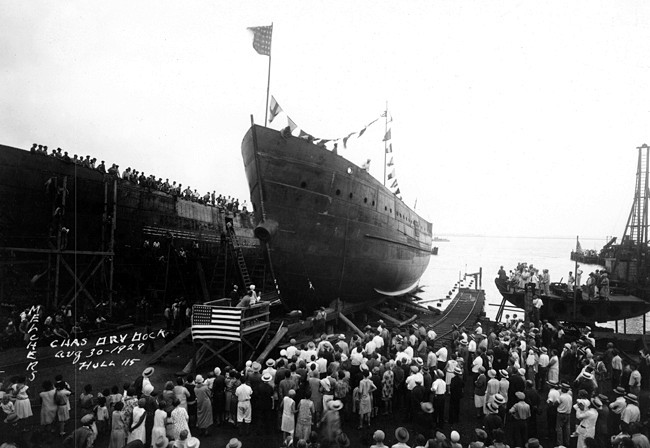
Even after the 150-foot, skeletal Cape Fear Lighthouse was erected in 1903 and equipped with a first-order Fresnel lens that was powerful enough to cover most of the shoals, the Lighthouse Board still felt a lightvessel was needed. Seven lightships served at Frying Pan Shoals from 1854 to 1930, when LV 115 was first assigned to the station. LV 115 was built in 1929 – 1930 at the Charleston Dry-dock & Machine Shop in Charleston, South Carolina and was stationed at Frying Pan Shoals until 1964. The lightship was absent from the station during World War II, when it was commissioned as an examination vessel at Cristóbal, near the Panama Canal, from 1942 to 1944, and at Charleston, South Carolina, from 1944 to 1945.
On June 12, 1932, the steamer Mariastranded on Frying Pan Shoals under favorable daylight conditions. After 1,093 pieces of lumber were jettisoned into the sea along with other cargo to lighten the vessel, the Maria was able to proceed to Newport News for repairs before resuming its voyage to Wilmington, North Carolina and then on to Italy. Standard Export Lumber Company sued the owner of the vessel for the loss of the lumber as the crew of the Maria was using an old Light List. Frying Pan Shoals Lightship had been moved a distance of fourteen miles on July 16, 1930, exchanging positions with a buoy. This change has been published twenty-three times in Notice to Mariners, and the correct position of the lightship appeared in the 1931 edition of the Atlantic and Gulf Coasts Light List, but the captain of the Maria had the 1930 edition of the Light List. Standard Export Lumber Company was awarded $2,662.74 to cover the loss of its lumber after it filed a lawsuit.
David Melvin began his service aboard LV 115 in 1959, when the vessel was known by the Coast Guard designation WAL 537. Melvin recalls that every two years they would return to port for repairs, and he would help place concrete in the bilges where the hull skin was too thin to be welded. A crew of fifteen was assigned to the lightship, but there were typically ten men aboard, as a third would be taking a fourteen-day leave after having spent twenty-eight days at sea. The men stood a six-hour watch, and then had twelve hours off that they could devote to sleeping, watching movies, catching up on correspondence, or fishing, which was excellent at the station.
|
After a couple of terrifying hours, the eye of the hurricane passed directly overhead, and the wind became eerily calm. The men took advantage of the break to go on deck and smoke a cigarette before bracing for the other side of the hurricane. Melvin estimates the height of the seas to have been roughly half of the ship’s length. At the top of each wave, the men could tell they were dragging anchor and soon started to worry that they would fall victim to the very shoals they were marking.
The crew amazingly came through the hurricane without any injuries, but the ship was littered with objects, and all the food in the walk-in refrigerator was on the floor in a big heap. When the captain was able to get a Loran fix, the lightship was found to be fourteen miles south of its assigned position. David Melvin said life aboard the lightship ranged from “sheer loneliness and boredom, to all the excitement you could stand.” He wouldn’t want to relive those two years, but wouldn’t take anything in exchange for the experience.
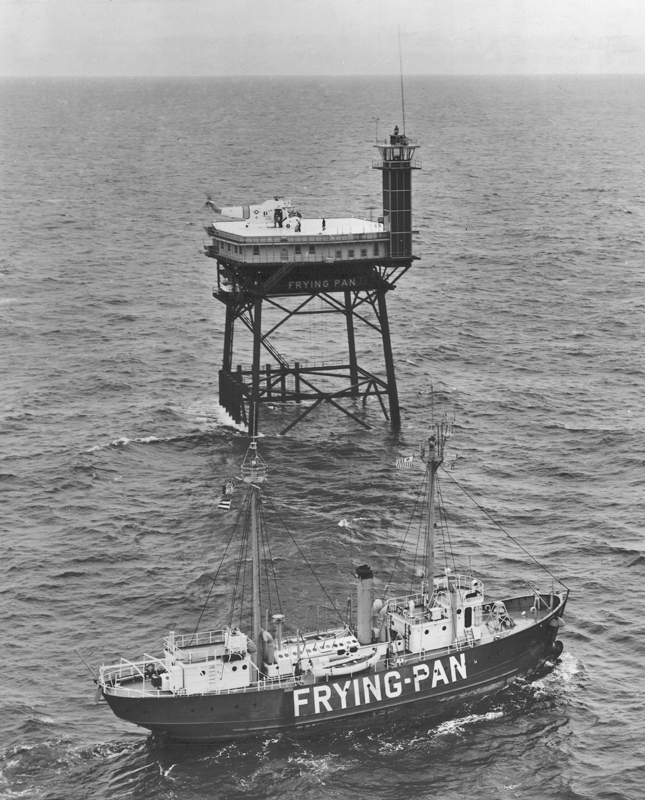
On November 24, 1964, a four-legged, $1.5 million tower, resembling an oil-drilling platform and outfitted with a light tower, was activated on Frying Pan Shoals. With a permanent structure now marking Frying Pan Shoals, WAL 537 circled the tower, gave three blasts of its whistle, and sailed off to prepare for its new assignment at Cape May, New Jersey, as a relief lightship.
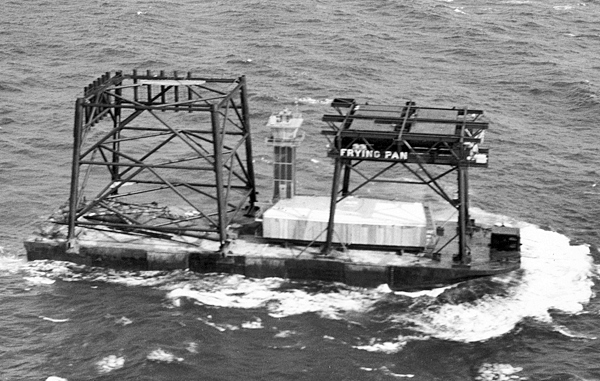
The upper portion of the tower was built in Louisiana by J. Ray McDermott Co. at a cost of $2 million and then barged to the shoals, where it was lifted by a crane and placed atop a four-legged foundation. The steel legs extend nearly 300 feet below the water to securely anchor the structure to the seabed. The deck that housed the crew has 8,100-square-feet of space and is surmounted by a helicopter pad, which doubled as an exercise/recreation area and a rainwater catcher.
Rear Admiral Oscar J. Rohnke dedicated the new tower as part of commissioning ceremonies attended by U.S. Representative Alton Lennon, Ogden Allsbrook, mayor of Wilmington, numerous Coast Guard officials, and the press. Coast Guard helicopters shuttled the attendees to the offshore tower. Oscar B. O’Neal of Rodanthe headed the station’s first six-man crew.
|
Assisted by volunteers, Richard Neal accomplished the following improvements in just two years:
Arch Embler served sixteen months at Frying Pan Shoals Lighthouse, and during a return to the tower in October 2011 while it was being renovated, he left the following note in the comment book:
As maybe the only person in this journal to have served on the Frying Pan of the Coast Guard era, it means so much to get back to this place. Not only is this a unique place in all the world, but a light also in my own life. I came here, assigned in early 1974 to this duty station as an EN 3, to maintain the three diesel generators. I also came here as a 23-year-old human searching for truth and meaning. A friend from high school had a life changing experience and had explained to me that he had believed in Jesus and his life had changed. I wanted to read the Bible at Frying Pan and decide for myself whether it could be true. I did. I came to the conclusion, after reading Luke and John, that God truly did communicate with humanity through the written word, and had atoned for our sins. I believed in Jesus here at Frying Pan in August 1974, and the path of my life changed. It was [as] if light filled every corner of my life. Because of that, I went to the university I did, where I met my wife, who is precious to me still after 34 years. It seems every good thing in my life today is because of the direction change made at Frying Pan, where the light penetrated the darkness.Richard Neal offered volunteer opportunities at Frying Pan Tower for many years. While an adventure at the lighthouse might not have had as dramatic an impact on the lives of the many who were fortunate to experience it as it did for Arch Embler, it was certianly an experience they will cherish for years.
In May 2018, Richard announced that he was going to auction off the lighthouse after roughly eight years of ownership. After a few bids were received, Richard decided to cancel the auction and instead offer fractional ownership of the tower. It is not exactly clear why Richard changed his mind, but he noted the following on his website in announcing the change: “Over the course of the last few weeks it has become clear that the best way to keep the tower on a path of restoration and create an increase in value for a buyer(s) is through a fractional ownership sale. Fractional ownership is a method in which several unrelated parties can share in, and mitigate the risk of, ownership of a high-value tangible asset, usually a jet, yacht or piece of resort real estate.”
In July 2026, Richard announced that his nonprofit FPTower Inc. had sold the tower to new owners. Craig McCotter, one of the tower’s new owners, said they plan to stabilize and restore the tower so it can continue to be used for education and scientific research.
Keepers:
References