Southeast Bay, ON 
Select a photograph to view a photo gallery
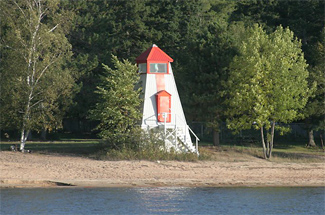
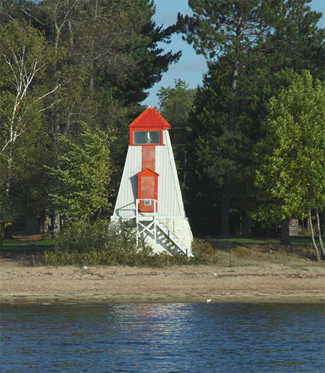
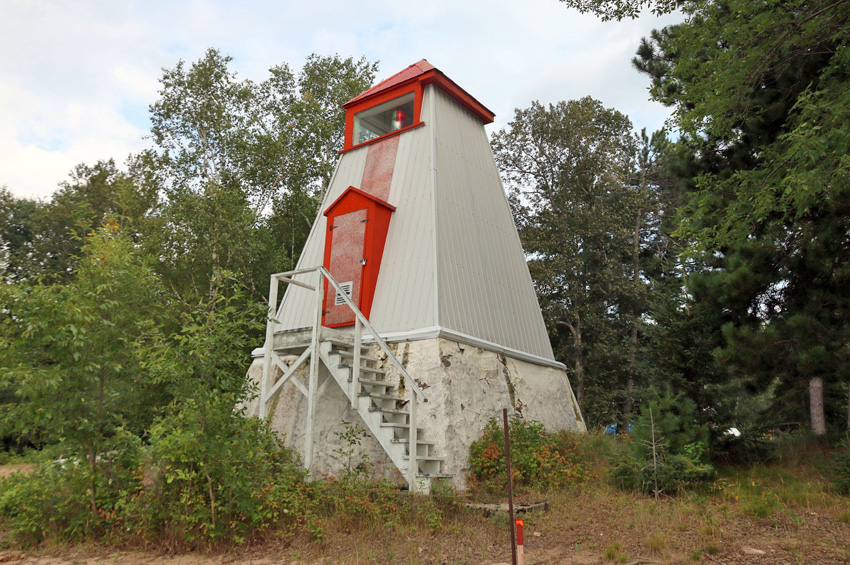
Photo Gallery
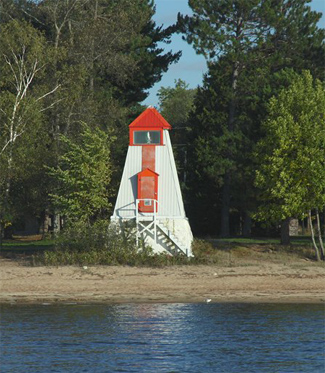
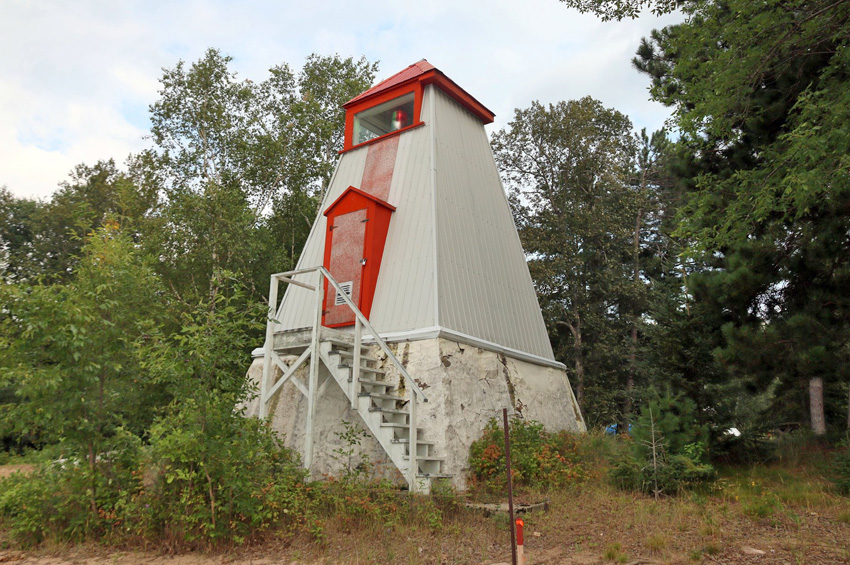
Photo Gallery
Photo Gallery
Along the south shore of Lake Nipissing, marking the entrance to Callander Bay, stands Southeast Bay Lighthouse. Built in 1887, it is the only working historic lighthouse left on the lake. A contract was made in 1886 to place two beacon lights at the mouth of the South River on the southern shore of Lake Nippising, but it was later decided to place one of the lights at the entrance to Southeast Bay due to the increase of shipping there. The Annual Report of the Department of Marine for 1887 describes the lights completed that year at South River and Southeast Bay:
Mr. D. M. S. White successfully completed his contract for the erection of two beacon lights on Lake Nipissing. One of these is established on the extremity of a point near Mr. N. M. Campbell’s tannery on the west side of the mouth of South River, in such a position as to guide steamers to the mouth of the river past the shoals that extend northward and eastward from it. The light, which was first put in operation on the 25th May last, is fixed white, shown from a lenticular lantern hoisted on a mast elevated 28 feet above the lake, and visible ten miles. The mast is 25 feet high, and has a wooden shed painted white at its base.The other light on Lake Nipissing, which was put in Operation on the same day, is located at the entrance to South-East Bay. It is fixed white, elevated 30 feet above the lake and visible ten miles. The illuminating apparatus is dioptric of small size. The lighthouse tower is a square wooden building 21 feet high, painted white, with a red roof, and stands upon a cribwork pier which was built for its reception by Mr. J. E. Booth at no expense to the Department, the stipulation made in changing the site of this light being that it should be done without involving any extra expenditure on the public service. The total cost in connection with erecting these two lights has been $729.85.
At some point Southeast Bay Lighthouse served as the front light of the Southeast Bay Range, but when this range was discontinued in the 1990s, the tower was made a sector light. Its light occults every ten seconds and shows red from 103 degrees to 111 1/2 degrees, white from 111 1/2 degrees to 115 1/2 degrees, and green from 115 1/2 degrees to 123 degrees. Mariners entering Callander Bay know they are in a safe channel, if they see the white light.
Callander Bay measures two miles from north to south, and two-and-a-half miles from east to west. Its water is less than thirty feet deep, and in the winter, it completely freezes over.
During the late nineteenth century, the bay was a hub of logging activity. Steam tugs would transport logs to the bay’s Wasi Falls, where they were lifted into a shoot that carried them over to the Ottawa River System.
The Great Depression was a difficult period for Northeast Ontario, but the area near Callander Bay once again became a buzz of activity, when the Dionne quintuplets were born on May 28, 1934. The five identical girls – Yvonne, Emilie, Annette, Marie, and Cecile – were born two months premature and survived against enormous odds. In 1936, a playground was built, and the girls were put on display for four hours a day. Around 6,000 visitors would stop by each day, and “Quintland” became Ontario’s biggest tourist attraction.
Callander Bay continues to bustle in the summer with vacation cottages, camps, and lodges.
Head Keepers: W. Robert Barr ( – 1889), Matthew Howe (1889 – 1890), Thomas Darling (1890 – 1915), James White (1915 – at least 1923).
References