Warrior Rock, OR 
Select a photograph to view a photo gallery


Photo Gallery


Photo Gallery
Photo Gallery
Roughly one hundred years later, the United States government decided to build a light and fog signal at Warrior Rock to help guide river traffic to and from the Portland area. The owner of the selected site demanded an exorbitant sum, and the government was forced to initiate condemnation proceedings in 1887. After title to the land was obtained in December 1888, plans were drawn up for the combination light and bell tower and a contract for its construction was awarded.
|
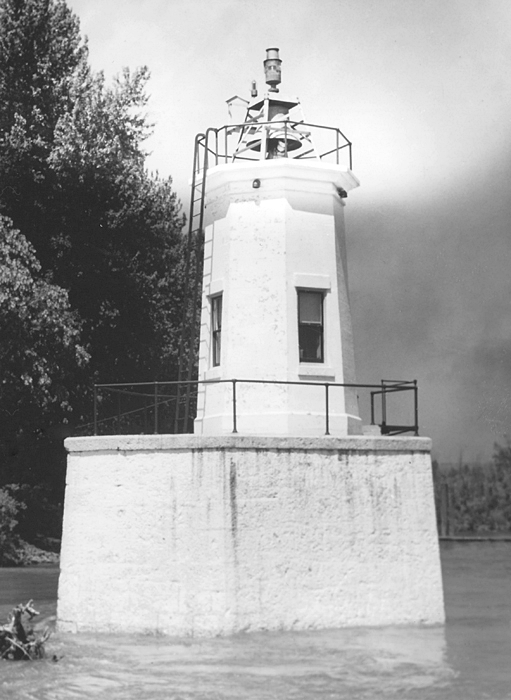
Built in 1889, Warrior Rock Lighthouse was originally a small, two-story structure set atop a sixteen-foot-tall sandstone foundation. The single-room first floor contained the clockwork that operated the bell, a bed for the keeper, a table, and stove, while the second floor was primarily a covered half deck housing the lens lantern and fog bell.
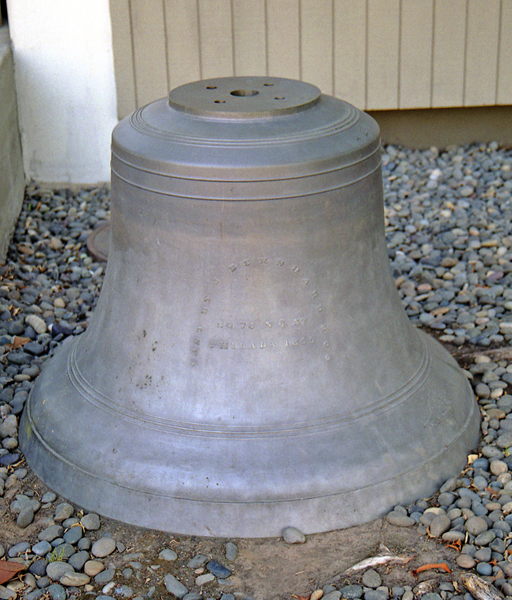
The bell has the distinction of being the oldest fog bell in the Pacific Northwest. Cast in Philadelphia by J. Bernhard & Co. in 1855, the bell was first used at Cape Disappointment at the mouth of the Columbia River. The winds, land contour, and roaring seas at the cape made it difficult to hear the bell, so the bell was discontinued in 1881 and transferred to Puget Sound’s West Point Lighthouse, which was under construction at the time. A Daboll trumpet replaced the fog bell at West Point in 1887, and two years later, the bell was shipped to Warrior Rock. The striking apparatus for the bell was brought in from Washington’s Ediz Hook Lighthouse, which had recently received a stronger one.
During its first season of operation at Warrior Rock, the bell was tolled a single blow every fifteen seconds for 316 hours. Joseph Haybrun, the station’s first keeper, recorded in the station’s logbook that he had “trouble with the bell” and that the “lamp kept blowing out.” Lightkeeper Frank DeRoy, who served at Warrior Rock for a decade, nicknamed the bell “Black Moria” because the striking mechanism would often break and he would have to ring the bell manually for hours.
Keeper Hayburn was born in Kentucky, and at the age of eighteen marched off to fight in the Civil War. According to an article announcing his death in 1912, Hayburn fought in the Battle of Stones River, where only three men in his company survived and ninety-three of their one hundred horses were killed. The Battle of Stones River had the highest percentage of killed and wounded of any major Civil War battle. A total of 24,645 men, or roughly thirty-two percent of those who participated, were killed in the bloody, three-day battle.
As no formal dwelling was provided at the station, the first keepers were given twenty dollars per month to offset their need to find their own housing. In 1912, the Lighthouse Service requested $2,000 to purchase 1.61 acres near the lighthouse on which stood a “fairly good dwelling,” which was being occupied by the keeper. The desired amount was appropriated on October 22, 1913, and the dwelling and other buildings on the adjoining land were acquired by the government.
Frank and Jenny DeRoy transferred to Warrior Rock from Heceta Head Lighthouse in 1925 so their son Robert could attend high school and also receive needed orthodontic work in Portland. Robert could board the steamer America at St. Helens in the morning, receive the necessary care in Portland, and be back in St. Helens that afternoon along with milk he had picked up from one of the dairy ranches along the river. When DeRoy was transferred to Warrior Rock, lighthouse authorities praised him as “one of the best keepers in the district” and note that Warrior Rock Light station had become considerably run down during the last few years’ service of the former keeper due to his physical inability to clean up the grounds after the annual floods that overflowed a large portion of the station’s ground.
When the river was high, the tower’s sandstone foundation and surrounding land would often be underwater. At those times, DeRoy rode an aerial tram he concocted by stringing a cable from a tree near the dwelling to the lighthouse. After the light was electrified in 1928, Keeper DeRoy could simply flip a switch to activate the light and fog bell.
|
Though he has been in the Lighthouse Service for more than 25 years, has sailed on the lighthouse tenders and taken supplies through the surf and slid in the breeches buoy from the swaying masts of the tender to the lighthouse station, and has had countless other experiences, Frank DeRoy, keeper of Warrior Rock Light on Savies Island, Columbia River, Oreg., had a new experience added to his long list this week – he walked on a smooth ice surface and over deep water from his station to St. Helens.Mr. DeRoy made his journey over ice to the St. Helens shore several times before a tank steamer broke the ice in Willamette slough. But now, with the ice broken and his rowboat frozen in, he is marooned, but almost within hailing distance of people who live on the west side of the slough.
On the night of March 30, 1930, the barge Swan collided with the steamer Davenport in the river near the lighthouse. Keeper DeRoy and his son rushed to the river and patrolled the beach, searching for anyone in need of assistance. They aided eleven people that night, sheltering them and providing dry clothing.
In 1935, Keeper DeRoy was retired on disability after suffering a fall at the station. He had climbed a tree to saw off one of its lower limbs so he could have a clear view of Lewis River Light, which was necessary to determine the approach of fog at night, when the branch broke, causing him to fall roughly twenty-five feet onto a woodpile. Keeper DeRoy bounced off the woodpile and landed headfirst on a rock breakwater, before rolling about fifteen feet down toward the beach.
In 1931, the little frame lighthouse was replaced with a twenty-eight-foot concrete tower, built on the same square sandstone foundation. There it remained until May 27, 1969, when a barge ran into the lighthouse causing considerable damage to the foundation and disabling the light and fog bell.
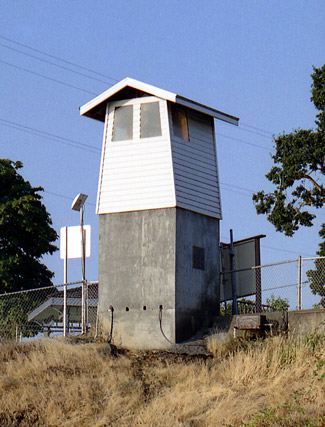
While the Coast Guard debated whether to rebuild the tower, the historic bell was removed. During the move, the bell fell into the river and was severely cracked. The damaged bell was never returned to the lighthouse, and it can now be seen on the north side of the Columbia County Historic Courthouse in St. Helens, Oregon. Along the waterfront in St. Helens, you can also see a half-scale replica of the original Warrior Rock Lighthouse.
Today, a flashing white light is displayed from the tower at Warrior Rock, but there is no fog signal. Warrior Rock Lighthouse is the only one of the three lighthouses established on the Columbia River that has survived. Willamette River Lighthouse burned in the 1950s, and Desdemona Sands Lighthouse was dismantled in the 1930s.
The Chinooks are gone from Sauvie Island, and today the island is a pastoral paradise with pumpkin patches, marble-sized blueberries, and miles and miles of scenic roads perfect for biking. At the northern tip of the island, the rebuilt Warrior Rock Lighthouse continues to guide river traffic along the mighty Columbia.
Keepers: Joseph Hayburn (1889 – 1912), Thomas E. Stanfield (1912 – 1925), Florido “Frank” DeRoy (1925 – 1935), Edmund N. Cadwell (1935 – 1939), Ray I. Loney (1939 – 1940).
References