Patos Island, WA 

Select a photograph to view a photo gallery
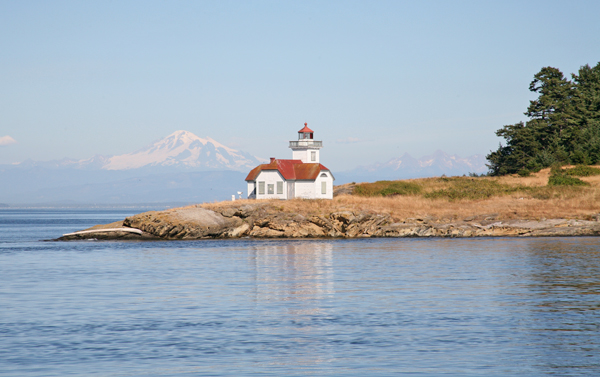
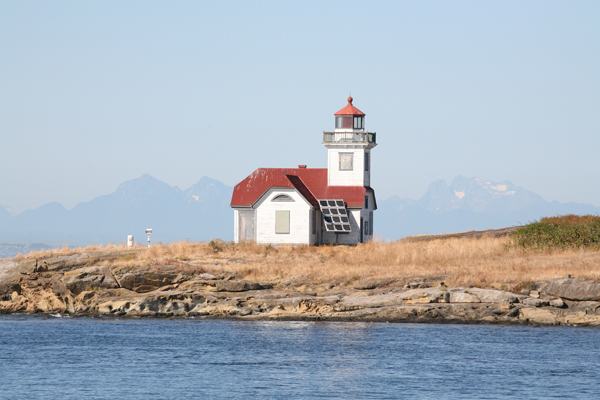
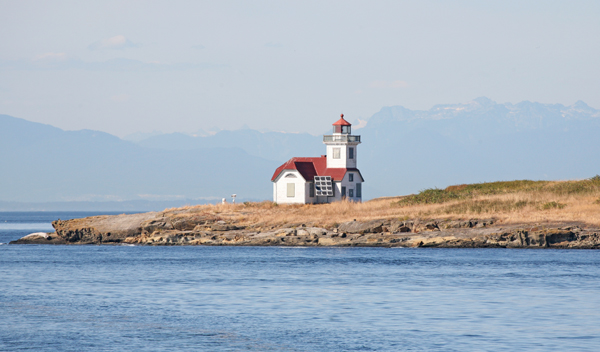
Photo Gallery
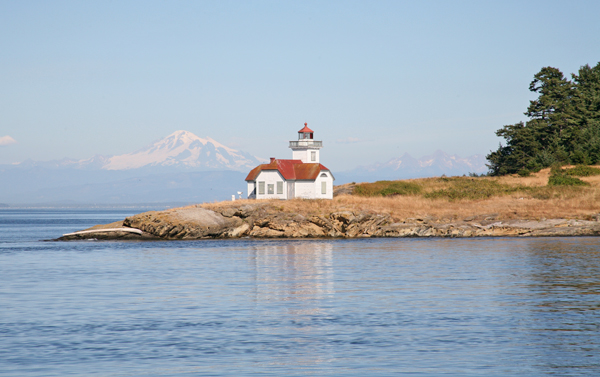
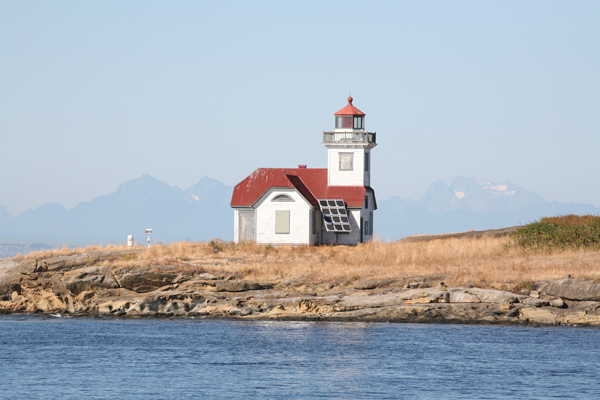
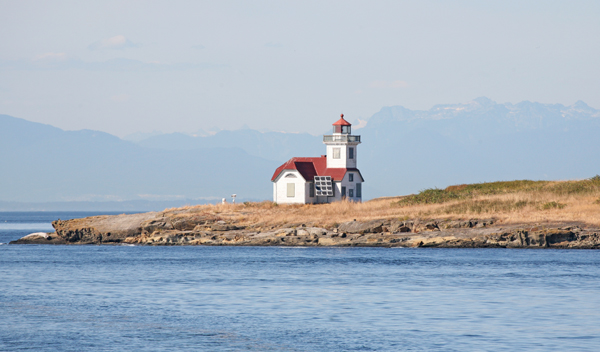
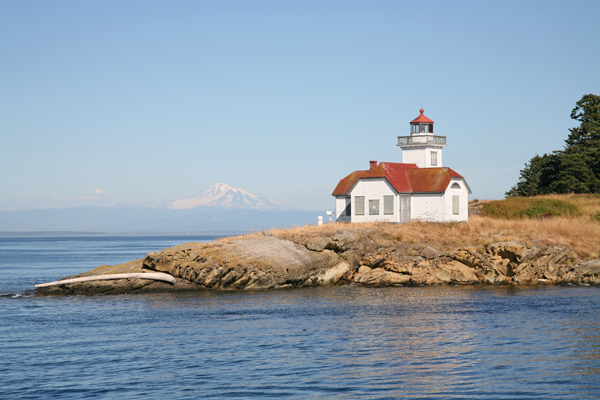
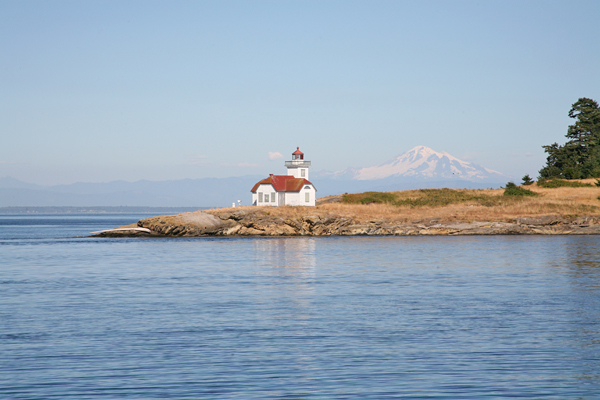
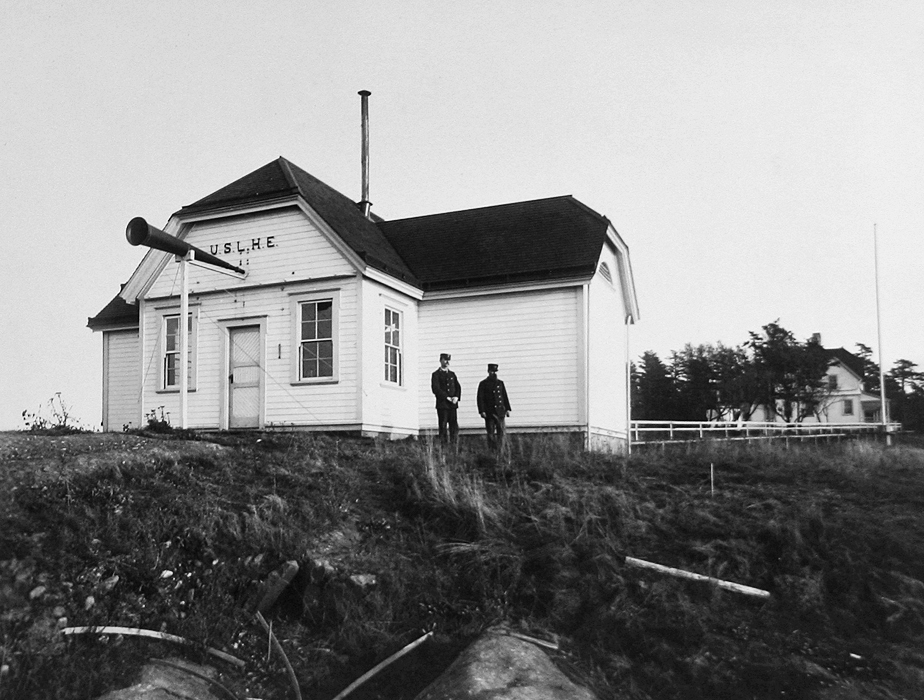
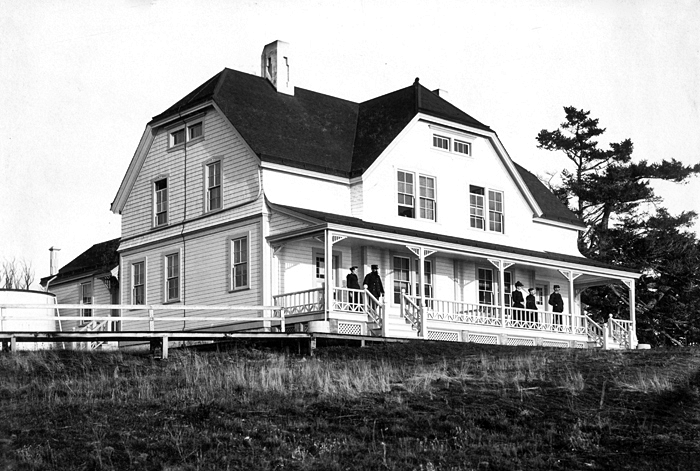
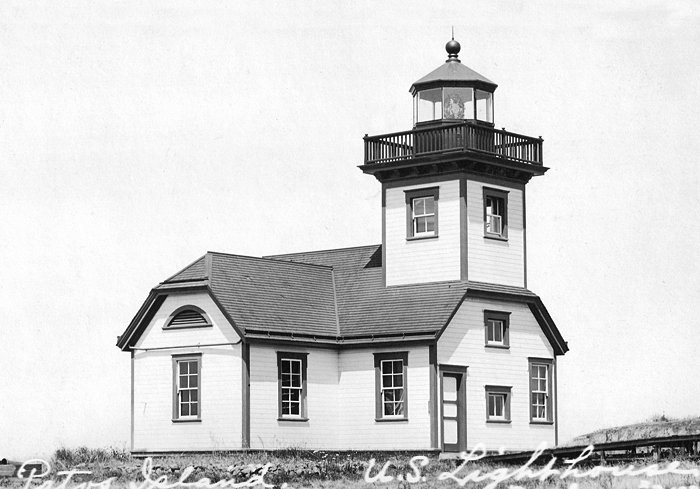
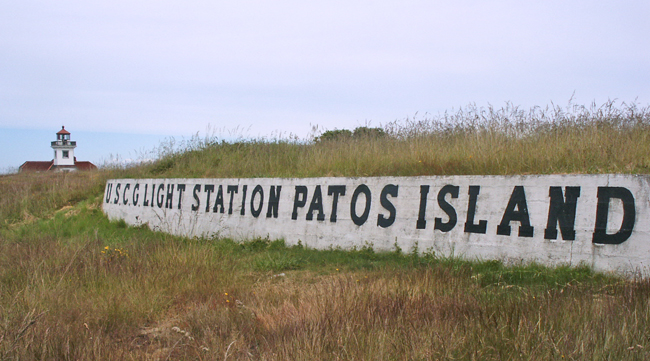
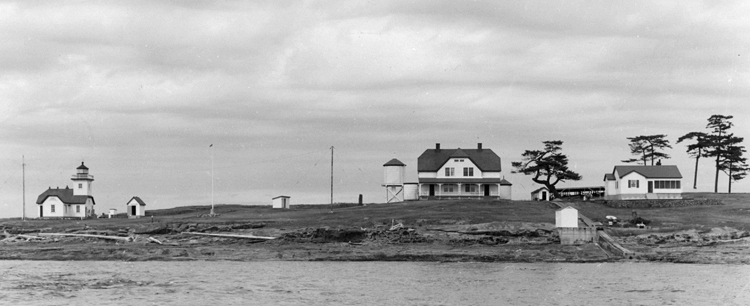
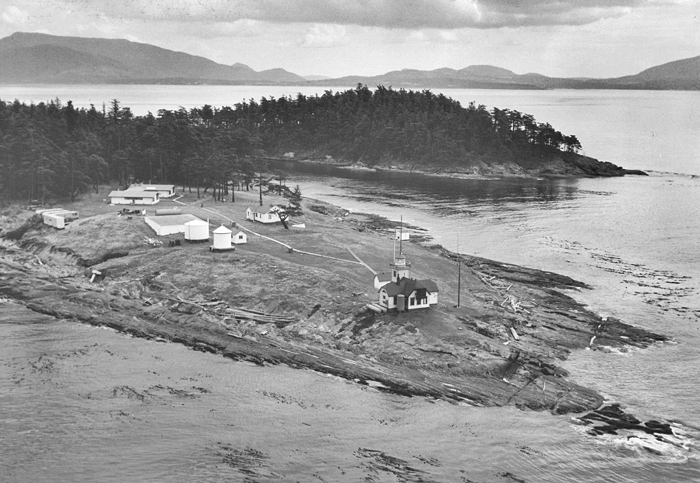
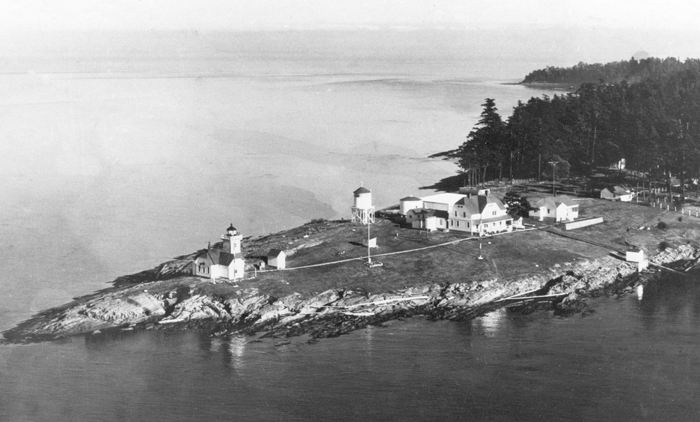
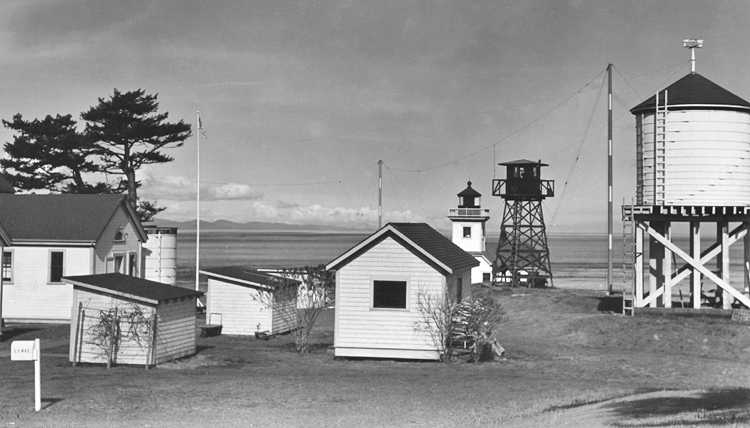
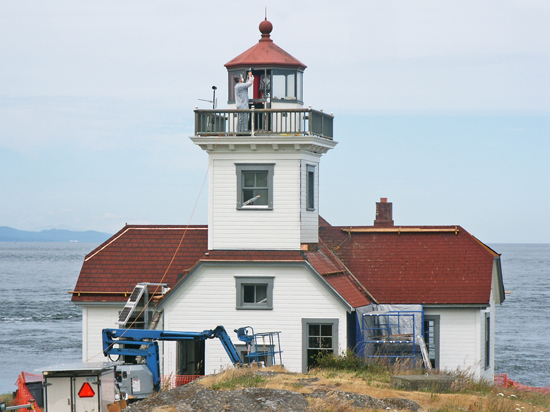
Photo Gallery
Photo Gallery
|
In 1888, the Lighthouse Board recommended a light and fog signal be established on the island to complement one just established at East Point on Canada’s Saturna Island, situated on the opposite side of Boundary Pass.
Patos Island is situated at the north entrance to the Canal de Haro, opposite to the Saturna Island, British America, on the easternmost point of which a light-house has been erected by the authorities of British Columbia. This is a very dangerous point, with currents reaching fully 7 miles an hour. Vessel-masters dislike to approach it in foggy weather, as they are unable to locate themselves because of the swirling, irregular currents. The channel between Patos Island, on the American side, and East Point on the Canadian side, is one used by the Alaska steamers, by the large coal fleet from Nanaimo, Vancouver Island, and by the vessels running in connection with the Canadian Pacific road. Much of this shipping enters at American ports and a large amount of American capital is interested in it. The Board recommends that a post light be established on the west end of Patos Island, with a first-class Daboll trumpet in duplicate. It is estimated that these aids to navigation will cost $12,000.
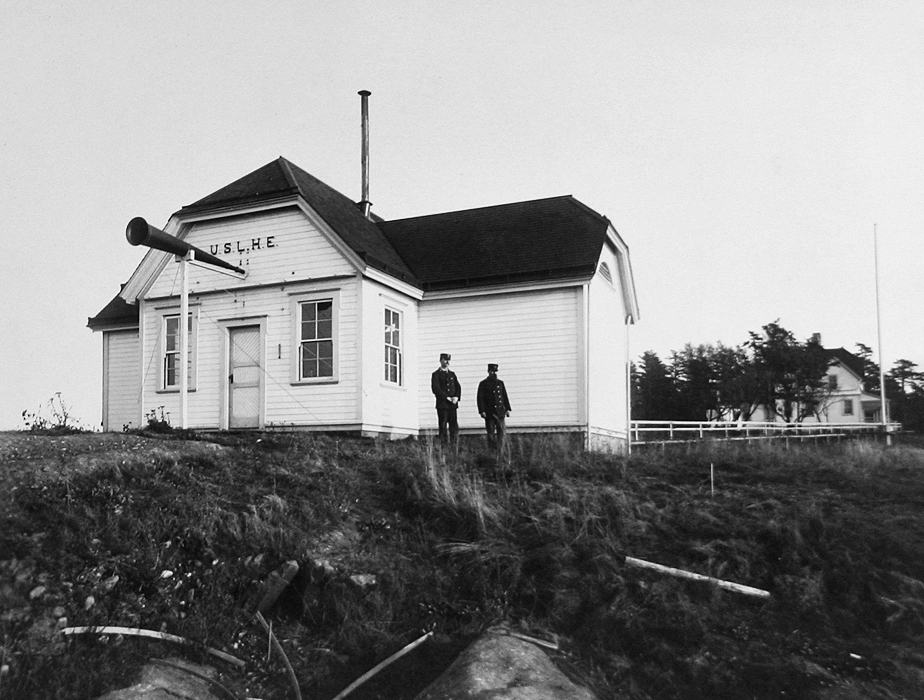
Congress appropriated the requested amount on March 3, 1891, but work on the island did not commence until two years later, after a contract was signed on December 27, 1892. By the end of June 1893, the contractor had erected a double dwelling, fog signal building, water tanks, and a post light near the western end of the island. The fog signal equipment was set up in October, and the Daboll trumpet and light commenced operation on November 30, 1893. In contrast to the white light used by the Canadians on East Point, a red light was exhibited from a ten-foot-tall white stake on Patos Island.
The original fog signal was found to be deficient. New reeds were tried, but it was a longer trumpet installed in 1894 that proved satisfactory. In 1900, duplicate oil engines replaced the hot-air (steam) engines, which could not develop sufficient pressure to properly run the compressors. As part of this change, a 960-gallon, redwood tank was erected in the fog-signal building’s old coal room to provide water for cooling the oil engines.
|
Durgan was transferred from Patos Island Lighthouse to Point Wilson Lighthouse in 1894, and then in 1895 he was promoted to the position of head keeper at Turn Point Lighthouse. After short stints as head keeper at Turn Point, Coquille River, Umpqua River, Heceta Head, and New Dungeness, followed by three years working as a boatman for U.S. Customs in Port Townsend, Keeper Durgan returned to Patos Island in 1905 to become the island’s third head keeper.
Durgan arrived at Patos Island for the second time with his wife Estelle and numerous children, and would become the station’s best-known keeper. Patos Island was a desired station with a mild climate but was also profoundly isolated.
Once a month, members of the Durgan family would take a twenty-six-mile journey over the waterways to Bellingham, Washington for supplies. Their closest neighbor was the Saturna Island lightkeeper, just over three miles away.
The isolation proved devastating when seven of the thirteen Durgan children contracted smallpox. Hoping to get the attention of passing ships, Keeper Durgan flew the flag at the lighthouse upside down as a distress signal. Help did eventually arrive, but tragically three of the children died. One of the surviving children, Helene Durgan Glidden, has written a memoir entitled The Light on the Island telling of her life growing up on the island where she talked with “God,” played with her pet cow, and wandered the beaches, known to her as “the petticoats” of Patos Island. (Some of the information in this paragraph comes from Helene Glidden’s book, which is a fictionalized account of her life on the island. There were thirteen Durgan children, but apparently two died before the family moved to the island. Also, only one child died on the island, and it was likely due to appendicitis not small pox. The 1900 census lists six Durgan children, ranging in age from thirteen to one. Helene was born at New Dungeness Lighthouse in 1900.)
|
Captain Newcombe of the Canadian fishery protection tug William Jolliffe stopped at Patos Island Lighthouse in August 1912 after noticing a distress signal. The station’s assistant keeper, likely William Stark, informed the captain that Keeper Lonholt, showing signs of insanity, had taken a boat and left the station two days before without giving any explanation. The assistant started flying the distress signal after he was unable to perform all the required duties by himself. Captain Newcombe telegraphed Henry Beck, the lighthouse inspector in Portland, who proceeded to the lighthouse.
According to a newspaper account, Inspector Beck “found a different state of affairs than was reported to Capt. Newcombe. It was found on investigation that the two men living alone at the lighthouse had been constantly wrangling and finally their grievances, fancied or real, were carried so far that one threatened to kill the other, and drove him from the island. Then he hoisted a distress signal and when the William Jolliffe responded he reported that his partner had been showing signs of insanity and had stolen a launch and fled.”
|
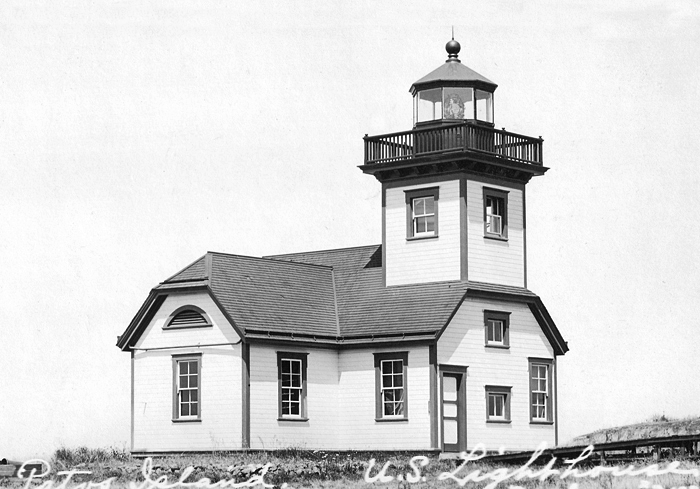
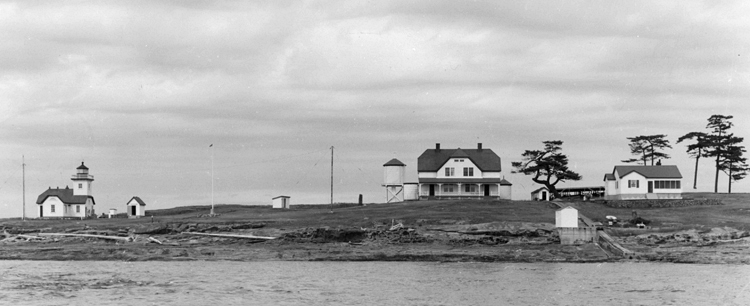
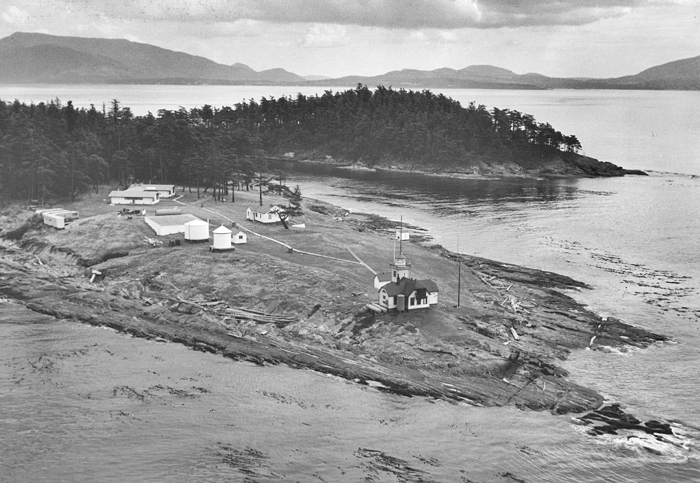
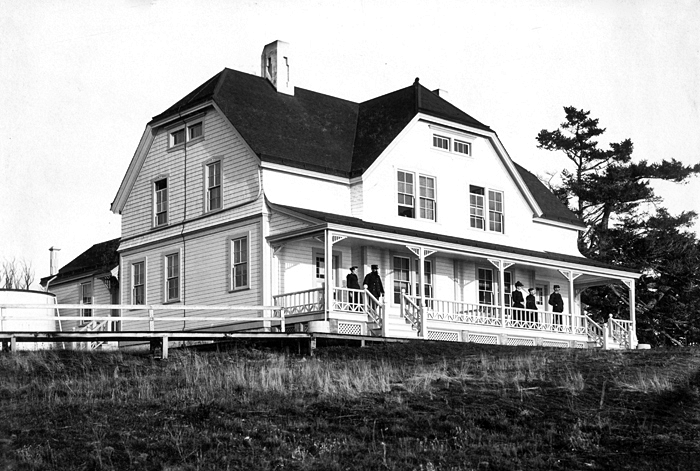
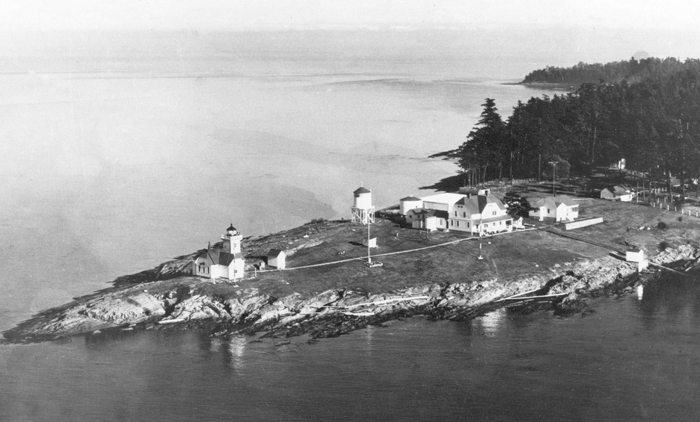
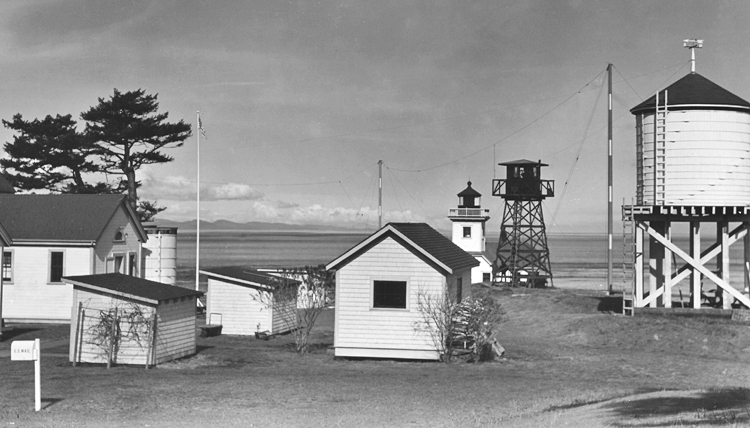
The light was improved in 1908 when a tower, rising to a height of thirty-eight feet, was built atop the original fog signal building to house a fourth-order Fresnel lens. The revolving lens, which produced a white flash every five seconds and had a focal plane of fifty-two feet above the surrounding water, was placed in operation on November 21, and the red lens lantern light was discontinued. Other structures that were on the island with the current lighthouse over the years include three dwellings, various water tanks, an oil house, a barn, and a boat ramp as shown in the historic photographs on this page. A radiobeacon was established on the island in 1936, and during World War II, a lookout tower was erected at the station.
Patos Island Light was automated in 1974. Today, it flashes a white light once every six seconds, with two red sectors marking Six Fathom Shoal and Rosenfield Rock. The station’s fog signal has been discontinued.
The original keepers’ duplex was torn down in 1958 and replaced with a 3,300-square-foot building for the Coast Guard crew. After the Bureau of Land Management assumed control of Patos Island in 2005, the Orcas Island Fire Department was contracted to burn the Coast Guard quarters, which had become a safety hazard due to deterioration and vandalism.
Robert Walker, who spent 1968 on Patos Island with his wife and child, shared the following recollections:
One of the things I remember about Patos was that the fishing was amazing. Our freezers were always full of ling cod, red snapper, and salmon. We had a 16’ Boston whaler which was used for recreation only. It had a very small outboard motor that would hardly get you through the very strong currents. …I remember being afraid of the killer whales. They would sometimes surprise you while fishing and believe me it is a scary thing in a 16' boat, when they decide to pop out of the water in near proximity.The lighthouse was kept in typical military fashion, always freshly painted and cleaned from top to bottom, grass mowed and edged, and very neat and clean.
One of the issues we had there was that all of the potable water had to be brought to the Island (no well). We would get a delivery every month or two from a buoy tender out of Seattle. It would anchor off the North side and fill our holding tank with a fire hose. We had a fairly large wooden holding tank, that would freeze up in the winter leaving us with no water. We would melt snow in the bath tub to have at least some water. This was a big problem for us as we couldn’t do laundry. … I remember recording temperatures well below 0 with the chill factor. OMG was it cold for a California Boy!
After reading The Light on the Island, we actually hiked to locations described in the book in an effort to find any evidence of the rumrunner days and some of the events described in the book. …One day we were run out of the woods by a swarm of angry bees we happened upon. Our dog had more than 100 bees stuck in its fur, and the Seaman that was with me had well over 100 bites, for some reason I didn’t get attacked. That event ended our explorations.
It was the experience of a lifetime living on Patos Island, and I will always cherish that part of my life.
|
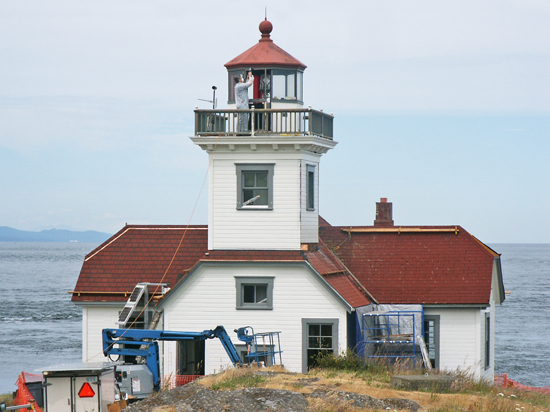
Two childhood friends, Linda Hudson of Lopez Island and Carla Chalker of Wisconsin, formed the non-profit Keepers of the Patos Light in 2007 after visiting the island, which they had read about fifty years earlier in The Light on the Island. Working with the Bureau of Land Management (BLM) and the Orcas Fire Department, the goal of the Keepers is to renovate the lighthouse and preserve the unspoiled beauty of the island. During May and June of 2008, which just happened to be the 100th anniversary of the lighthouse, Tom Lantos Contracting was hired to revitalize the structure. The lighthouse received a new roof, new doors, new windows, new gutters and downspouts, and a new coat of paint, inside and out. In addition, repairs were made to the foundation, chimney, and tower. According to Nick Teague, BLM Ranger for the San Juan Islands, the preservation effort is all about “folks doing good work to preserve this valuable place from becoming a whisper of the past.’
Keepers:
References