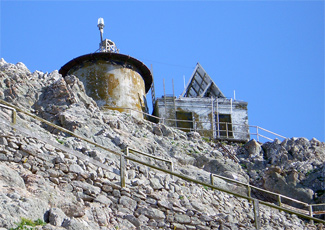
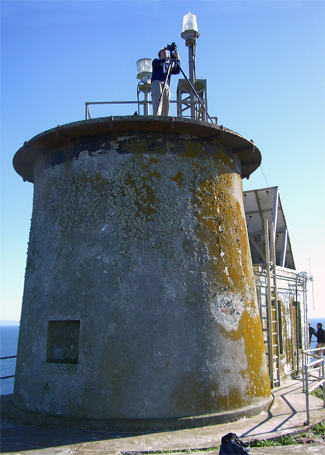
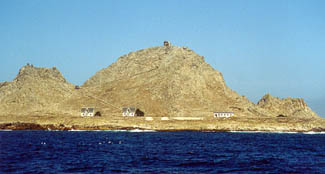
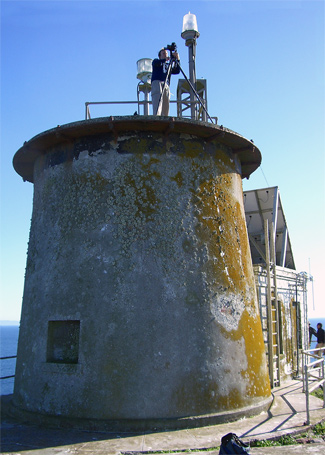
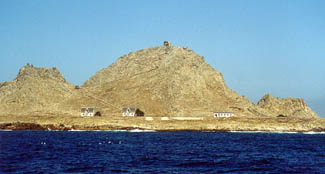
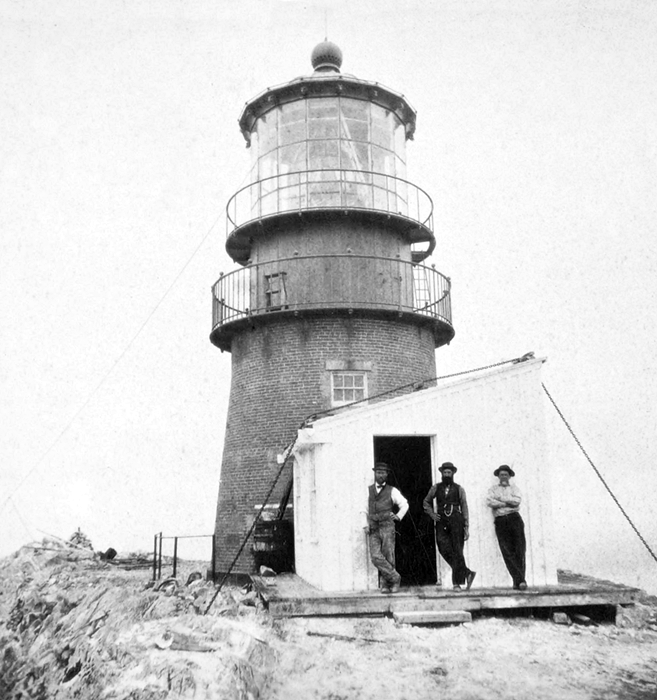
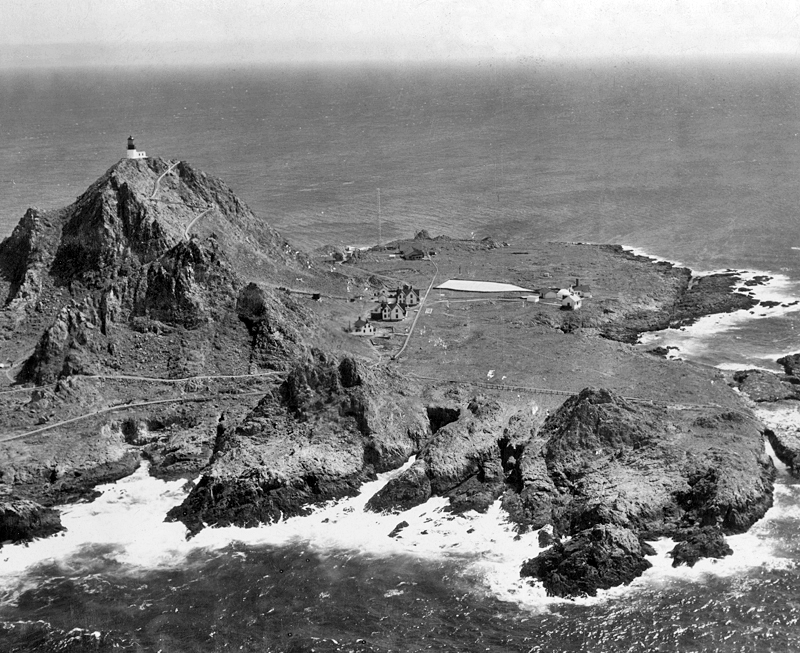
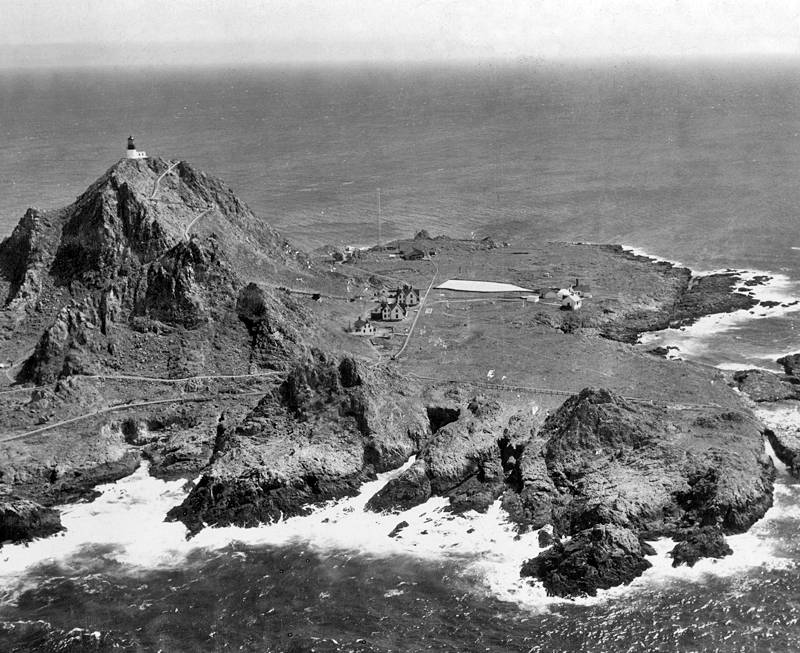
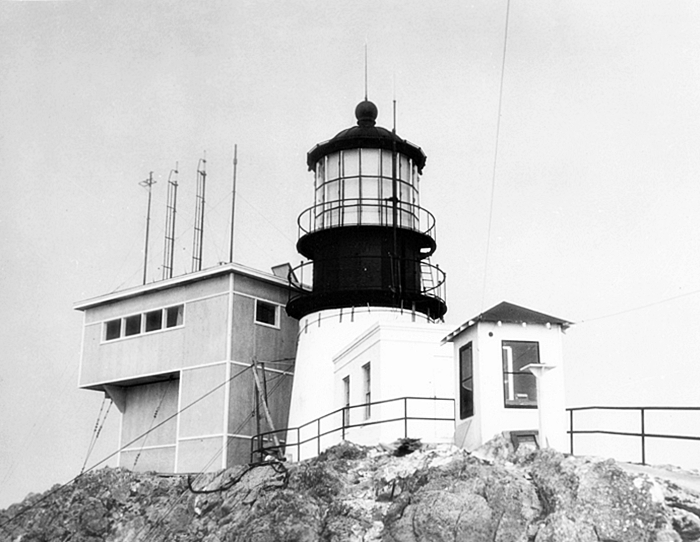
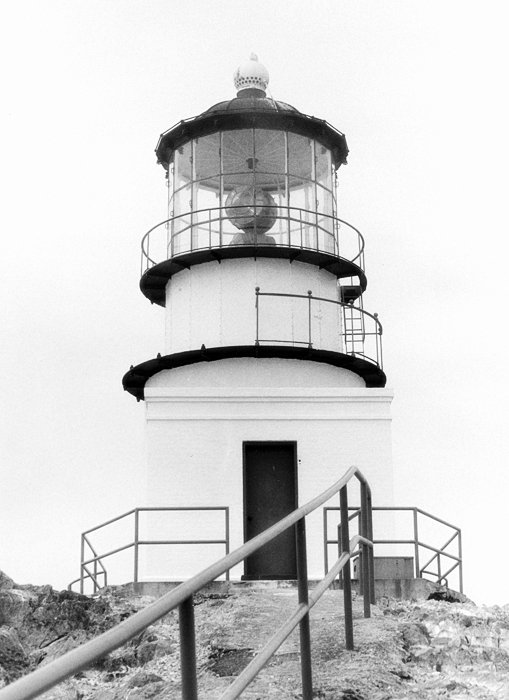
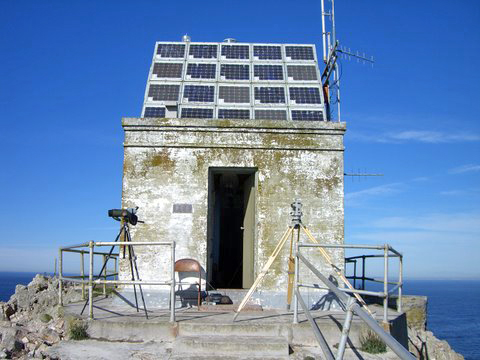
Thirty miles west of San Francisco is found a collection of small, rocky islands. Discovered by Spaniards, the islands were given the name Los Farallones, which means small, pointed isles, but the name has since been Americanized to Farallon Islands. The largest and tallest of the islands is Southeast Farallon Island, which rises to a height of 358 feet, and it was atop this island that Farallon Island Lighthouse was constructed.
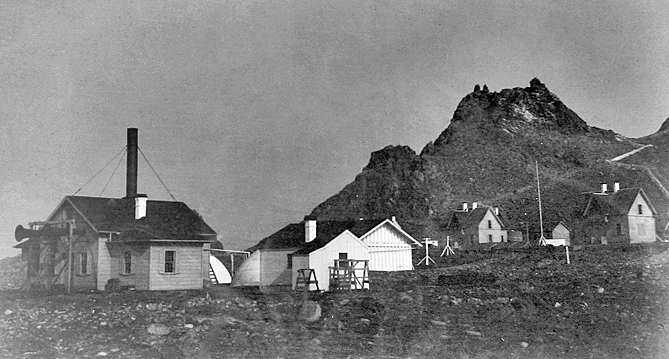
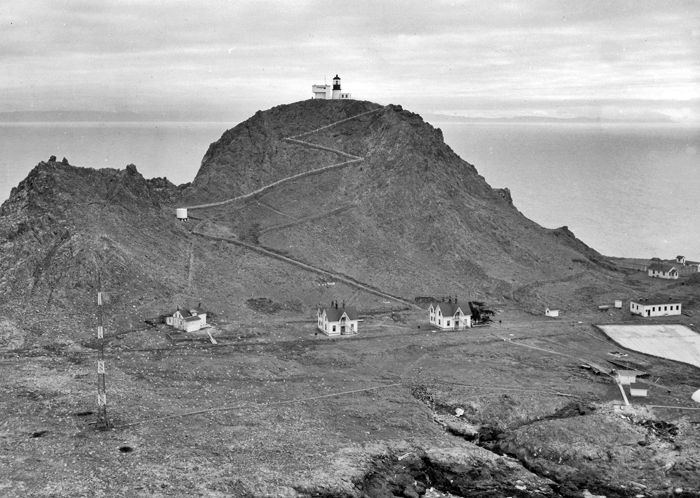
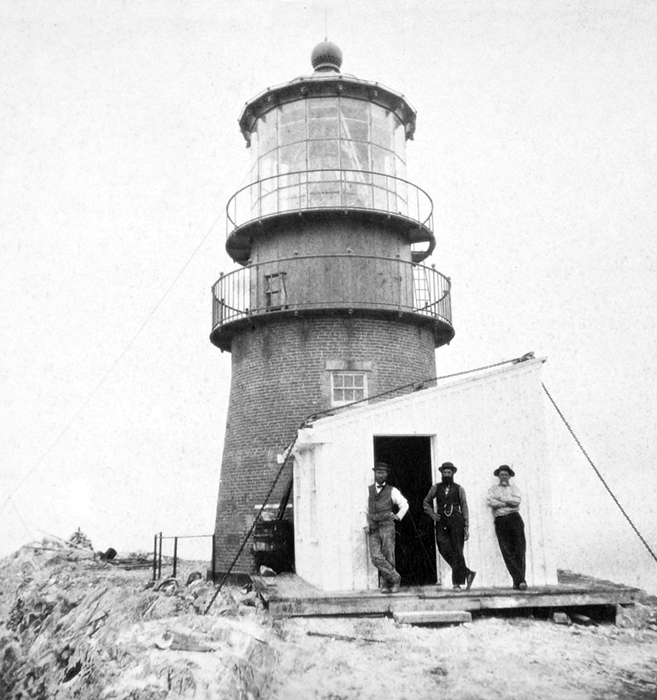
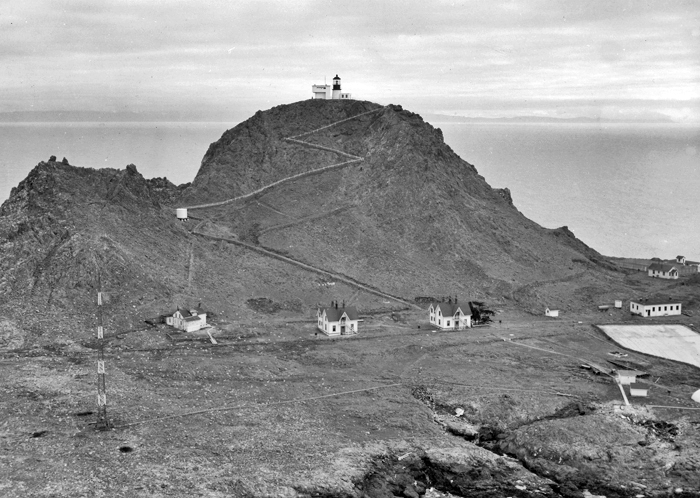
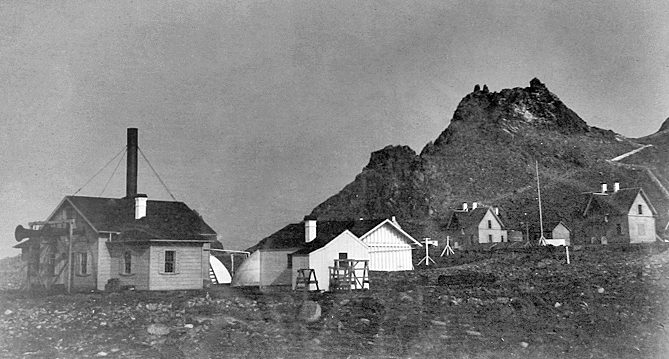
Like most of the early California lighthouses, this light was to be of the Cape Cod design, with the tower protruding through the roof of the keeper’s dwelling. However, due to the narrowness of the island’s summit, only a tower was placed atop the peak, while the keepers’ quarters were built on a large plateau on the eastern side of the island using rock quarried on the island.
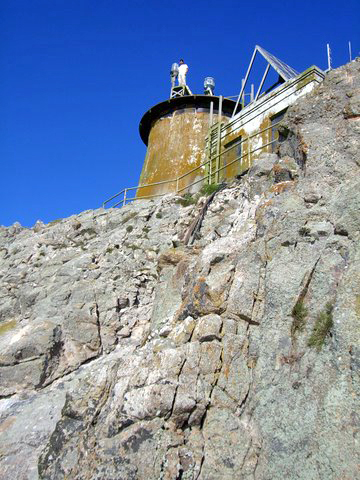
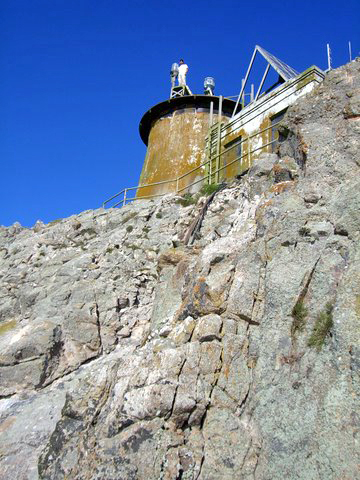
Major Hartman Bache, who took charge of lighthouses on the West Coast in 1855, visited the Farallon Islands on July 5 of that year and found that the recently completed hill-top tower was too small to house a first-order Fresnel lens and would have to be torn down and rebuilt on a nearby site that could accommodate a larger tower. In his report to the Lighthouse Board, Bache noted the difficulty workers encountered in scaling the rocky pinnacle which for two-thirds of its elevation had a slope that was great than forty-five degrees:
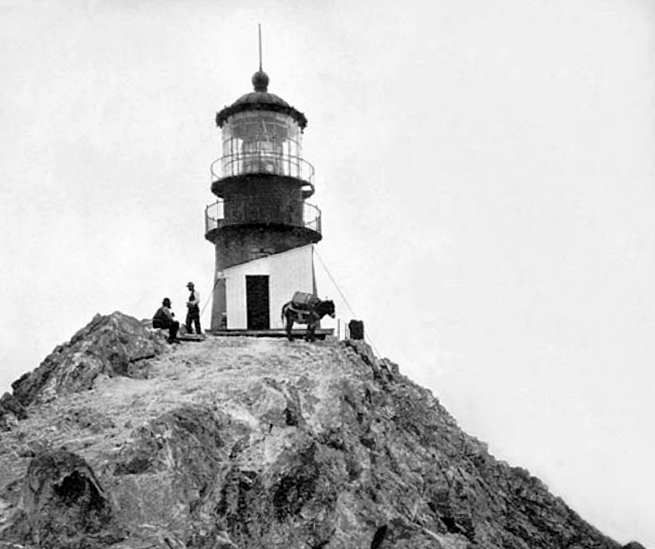
Few, if any, unaccustomed to the ascent, can make it by the use of the feet alone—the hands must be brought into requisition, and even then a false step might precipitate the climber, by a series of pitches, to a depth of nearly, if not quite, 200 feet. The bricks used in the present structure were transported on men’s backs by fours and fives at a time, and then only for the portion of least acclivity, a windlass being employed to raise them the remainder of the height.
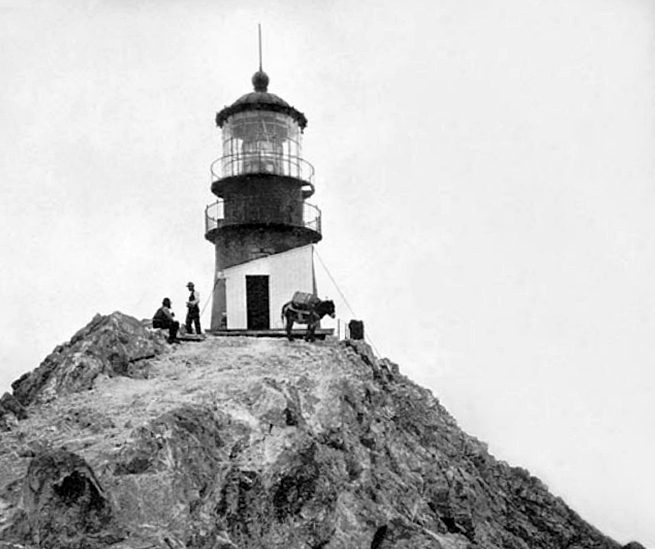
A path was carved out to facilitate construction of the new tower and transportation to the summit of the seventy-three cases that contained the lens and lantern room. After workers staged a sit-down strike, a seasick mule named Jack was brought to the island to help pack supplies up the steep slope.
Farallon Island Lighthouse was lit for the first time on January 1, 1856 by Head Keeper Nerva N. Wines and Assistant John W. Wines, who, respectively were paid annual salaries of $1,000 and $650. The lighthouse was the sixth lighthouse to be activated on the West Coast. Jack the mule remained on the island for eighteen years to help carry oil and supplies up to the lighthouse.
Even with the light, in 1858, the ship Lucas foundered on the island during dense fog, prompting the call for the establishment of a fog signal. Hartman Bache, who had supervised the construction of the lighthouse, returned to the island and proceeded to build a novel fog signal. Intrigued by a large blowhole, Bache harnessed this natural source of forced air, by placing a whistle atop a chimney constructed over the blowhole. Unfortunately, the high surf needed to power the signal did not always coincide with the periods of dense fog. In 1875, a powerful storm produced a strong surge that blew the chimney off its foundation and ended the days of the ingenious fog signal.
On September 20, 1880, a more predictable steam siren commenced service on the island. The siren was converted from steam to oil in 1907, and in 1918 an air diaphone replaced the steam siren. Much to the dismay of the island’s residents, the boisterous fog signal was typically in operation around 1,000 hours a year, or roughly eleven percent of the time.
To provide water for the steam fog signal, a concrete water shed was built on a slope west of the fog-signal house to catch rainwater and direct it into cisterns. As large holes were being blasted in the rocky island to make room for the cisterns, several veins of mineral water were encountered that made lining the cistern with brick difficult. It was first thought that the water could be pumped out while the bricks were laid, but the water was found to contain sulfuric acid that would ate away the mortar. The bricks thus had to be taken out so a costly drain could be cut through solid rock from the bottom of the cistern to the nearest bluff.
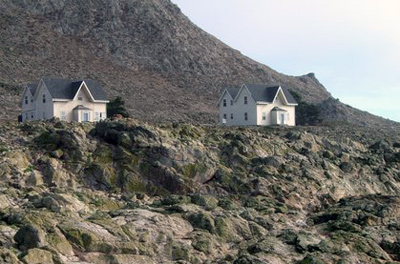
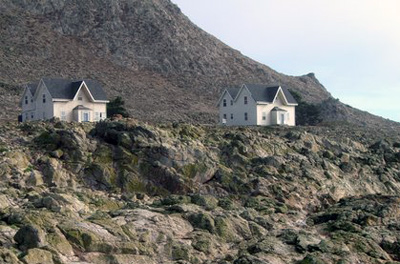
A Victorian duplex had been built on the island in 1878, and an identical one was added in 1880 to provide improved accommodations for the island’s four resident keepers and their families.
Life on the islands was difficult. To provide drinking water, a large cistern was built to catch rainwater collected from the roofs of the dwellings. As a storm approached, the keepers would scramble up on the roofs to remove the bird guano and salt residue that would contaminate the water. At various times, trees were planted to spruce up the island, but few of them survived for long in the harsh conditions. Strong gales would pick up small pieces of granite on the island and sandblast the buildings, requiring gallons and gallons of touch-up paint.
On Christmas Day, 1898, Royal Beeman, the eleven-year-old son of Keeper William Beeman became gravely ill. By the next day, it was clear the child was not suffering from simply too much Christmas dinner. Royal’s mother, Wilhelmina, recalled: “He was in constant pain, moaning and crying pitifully until I could hardly stand it.” A violent storm had been lashing the island for days, but since no supply vessel was scheduled for some time, Royal’s parents decided the only chance for the boy’s survival was to attempt to get him to a hospital in San Francisco aboard the station’s fourteen-foot rowboat that had been rigged with a homemade sail. Royal was wrapped in blankets and oilskins and placed in the bottom of the boat. Assistant Keeper Louis Engelbrecht volunteered to accompany Royal’s parents, and the two-month-old, still-nursing Isabel Beeman was the fifth passenger in the tiny ship.
Wilhelmina gave the following description of the passage: “A rain squall came up and rain drops as big as ten-cent pieces beat down on us…then the rain changed to hail, and the hailstones clattered down on us as if someone were shoveling pebbles. The sea washed in on us several times and we were all shivering and wet.” Eight hours after leaving the island, they reached the San Francisco Lightship, and a pilot boat rushed the company to San Francisco. Despite the heroic trek and the best efforts of a team of doctors, Royal passed away on January 3rd.
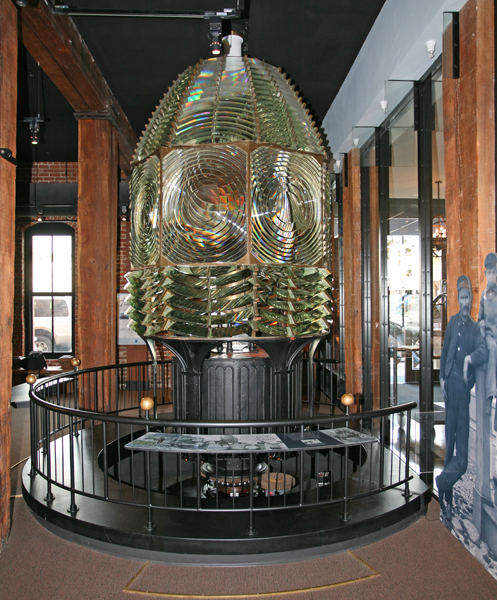
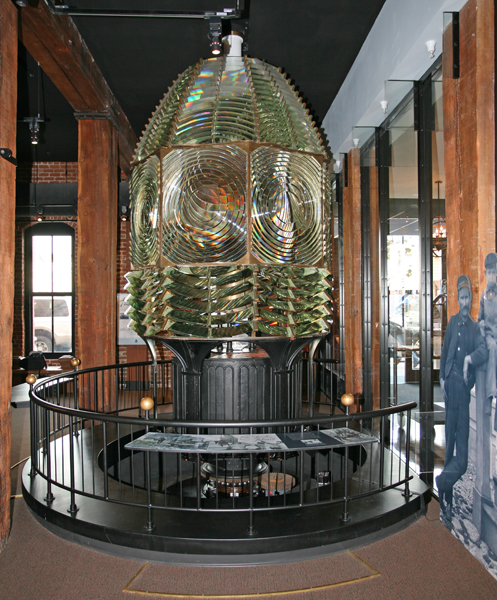
The station’s first-order
Henry-Lepaute Fresnel lens had eight flash panels and revolved once every eight minutes to produce a brilliant white flash each minute. A clockwork mechanism powered by a suspended weight that had to be wound up every four-and-a-half hours caused the lens to slowly revolve atop eight chariot wheels. By 1918, irregularities in the track over which the wheels ran caused the slowly moving lens to occasionally stop, so a nine-pound balance wheel was connected to the clockwork mechanism to give it enough kinetic energy to keep the lens turning.
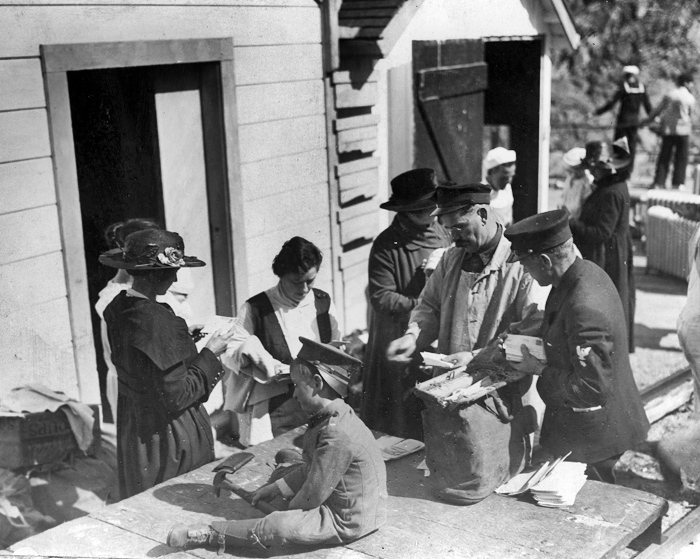
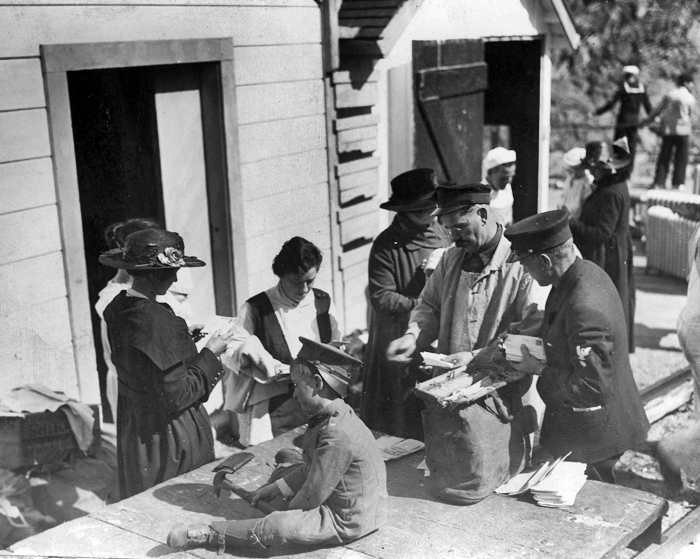
John Kunder served two stints as head keeper on the Farallons, and there were times when he didn’t leave the island for four years straight! With no churches, stores, telephones, or electric lights, the isolated community was living in a different era than those on the mainland. This changed when a radio receiver was installed at the naval radio station. “It is our godsend, our light,” said Keeper Kunder in 1929, referring to the radio. “Time was when we were just as isolated from San Francisco as if we lived 3,000 miles from shore. …We had to rely on weekly visitors for all our news. Never heard music, baseball, football and the like. Now we know everything, just as if we lived right in San Francisco.” Prior to the radio, opening mail every week or so was a highly anticipated event.
Even radio wouldn’t have solved the problem Assistant Keeper Benjamin O. Cameron had on the island in 1900 – that of finding a wife. To rectify this, he sent out a letter to numerous eligible women that somehow made it into the San Francisco Call. He wrote, “I am 5 feet 8 inches tall and weigh 142 pounds. Hair was coal black, but now, at the age of 45, it is turning a little gray. Very expressive eyes, black beard trimmed to a point, also black mustache. Health good. Sound in body and limb. At the present time I have employed by the United States Government as a lighthouse keeper at a salary of $600 a year…I am very particular and neat about the three rooms that I occupy. You will never see any dirty clothes thrown in a corner or dirt swept under the stove or bed, out of sight.” Cameron left the Farallons a few months after his letter writing campaign – perhaps to get married or perhaps to conduct his search for a bride in person.
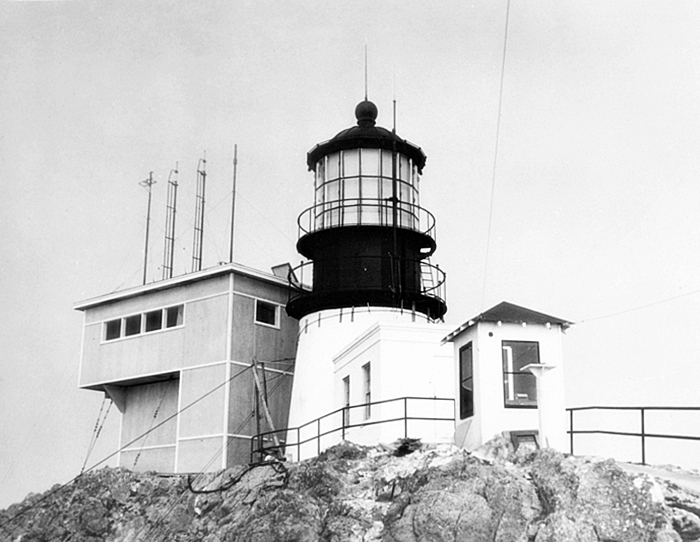
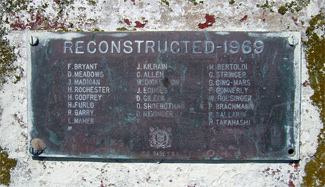
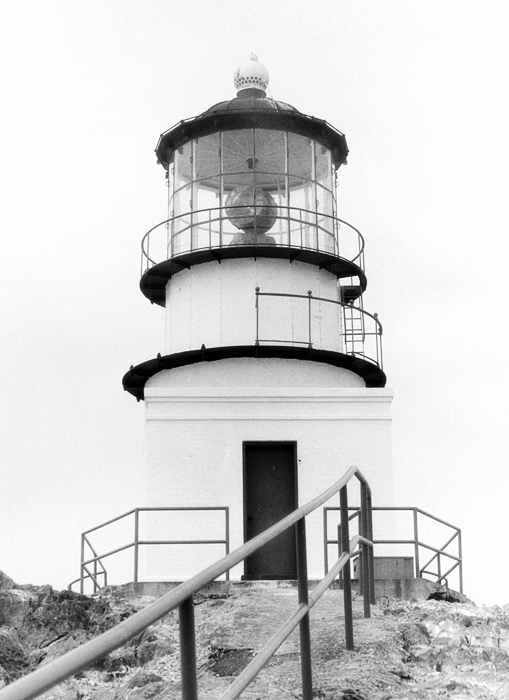
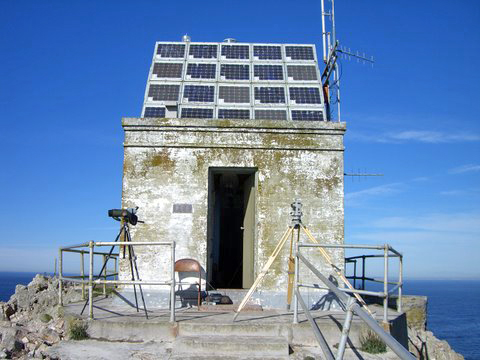
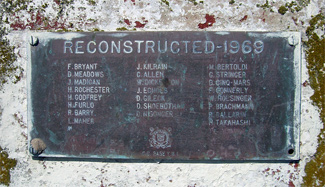
In 1902, the Weather Bureau established a radio station on the island to relay meteorological data to the mainland. Realizing the prime location of the islands for monitoring ship traffic, the Navy also came to the island and set up a radio station in 1913. In 1939, the Coast Guard took over the lighthouse, and when World War II started just a few years later, the population on the island grew to over seventy. After the war, the Navy left the island, but the Coast Guard maintained a presence until 1972. A plaque affixed to the workroom adjacent to the tower notes that the lighthouse was reconstructed in 1969. By that time, the top of the tower and the Fresnel lens had been removed, and an automated aero beacon was placed atop the shortened tower.
The Farallon Islands have long been a haven for several species of wildlife, which, for various reasons, have always attracted man to the islands. During the early 1800s, Russian and Aleutian seal hunters established a camp on the island where they harvested hundreds of thousands of seals for their fur and meat. By the mid-1800s, the seal population had been reduced to the point that the venture was no longer profitable, and the hunters left the islands. About this time, the population of San Francisco experienced a growth spurt due to the influx of gold seekers, and a few entrepreneurial men set out from San Francisco to again exploit the wildlife on the Farallons. This time the plan was to collect the eggs of the murre, a small seabird, and sell them back in San Francisco as a food source. A dozen of the eggs, which reportedly taste quite similar to chicken eggs, could fetch over a dollar. This enterprise proved quite profitable, and egg pickers were found traversing the island in search of eggs during the egg-laying season, which ran from May to July. Competition for the eggs was fierce, and in 1863 two men were killed in an armed conflict between rival groups, which has become known as the Egg War.
Some lighthouse keepers, trying to enhance their meager earnings, moonlighted as egg pickers on their own account, which added to the struggle over the eggs. Keeper Amos Clift penned the following to his brother in October 1859: “The egg season is in the months of May and June, and the profits of the Company after all expenses are paid, is every year from five to six thousand dollars. Quite an item. And if this Island is Government property, I have a right to these eggs and I am bound to try and get it.” The next June, Clift wrote, “We are now in the midst of the egg season, and the Egg Company and the Light Keepers are at war.” An armed group of eggers soon tried to force the keepers from the island, assaulting an assistant keeper in the process. Keeper Clift was removed shortly thereafter by the Lighthouse Service for trying to monopolize “the valuable privilege of collecting eggs.” Clift probably didn’t miss the island too much as the previous year he had written, “I’m getting awful tired of this loneliness; it is almost as bad as the state prison.” In 1881, the government declared sole-ownership of the island, evicted the egg company, and made egg collecting illegal.
In 1950, census taker Helen Mabbott traveled to Farallon Island where she made $2.31 for counting the island’s thirty residents - seven cents a head and seven cents for each of the island’s three dwellings. Even with a free trip provided by the Coast Guard, Helen lost $2.88 on the outing after paying for a new pair of nylons, a new hairdo, and a cleaner’s bill for her coat. If that weren’t enough, she suffered two bouts of seasickness and had to climb to the top of the island to interview a coastguardsman at the lighthouse.
Farallon Island Lighthouse was automated on September 1, 1972, but Coast Guard personnel remained on the island for three months to ensure the automated light functioned properly.
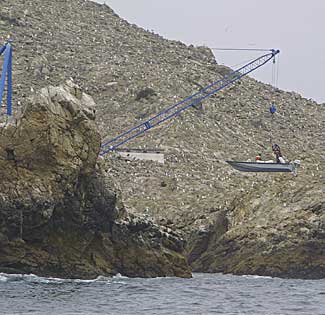
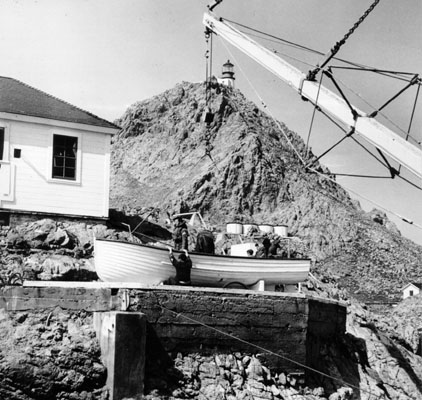
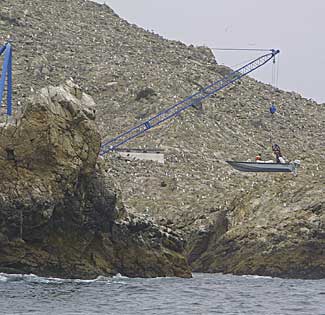
Today, the wildlife on the Farallons attracts a friendlier group of visitors to the islands. Resident researchers, who occupy one of the keepers’ dwellings, study the bird life on the island, while others man a lookout at the lighthouse and boats offshore to study and observe the great white sharks and giant blue whales that frequent the waters. Since the island lacks a good harbor, a large crane is used to launch a small boat to retrieve visiting biologists brought to the island aboard larger vessels. Just getting out to these remote islands is adventure enough, but couple that with a crane ride and one would have quite the journal entry.
Keepers:
- Head: James Powers (1854 – 1855), Nerva N. Wines (1855 – 1859), Amos Clift (1859 – 1860), Jacob Decker (1860 – 1861), Thomas Tasker (1861 – 1871), James McCumber (1871 – 1873), Stephen H. Morse (1873 – 1874), Edward K. Barnum (1874 – 1878), William Windsor (1878 – 1880), Wyman C. Partlow (1880 – 1881), Andrew W. Livingston (1881 – 1883), Thomas Owen (1883 – 1886), William H. Rugg (1886 – 1887), Henry W. Young (1887 – 1890), William A. Beeman (1890 – 1900), Cyrus J. Cain (1901 – 1905), Charles S. Kaneen (1905), Henry Rosendale (1905 – 1914), John Kunder (1914 – 1920), George Cottingham (1920 – 1924), John Kunder (1924 – 1931), Frank W. Ritchie (1931 – 1936), Oliver R. Berg (1936 – 1940), Arnold G. Heard (1940 – 1942), James C. Moore (1942 – 1945), Raymond L. Newton (at least 1950), Neil F. McNab (1951 – 1955), John E. Evenden (1955 – at least 1956), Ralph E. Gingles (1959 – 1960), Billie D. Archer (1960 – 1961), Henry E. Farrar (1961 – 1963), William J. Wheeler (1963 – 1964), Charles Riedmuller, Jr. (1964 – 1965), Donald J. Jordan (1965 – 1966), John M. Baker (1966 – 1967), Barry E. Fisher (1967 – at least 1969).
- First Assistant: John W. Wines (1855 – 1857), John W. Maynard (1859), John H.P. Watson (1859 – 1862), C.R. Fisher (1862 – 1869), Frank Roper (1869 – 1871), James Hurst (1871), Stephen H. Morse (1871 – 1873), Edward K. Barnum (1873 – 1874), Charles H. Lund (1875 – 1876), William Windsor (1876 – 1878), Henry J. Hess (1878 – 1880), John Webb (1880 – 1883), William H. Rugg (1883 – 1886), Walter Young (1886 – 1887), Henry W. Young (1887), Rasmus O. Berge (1887 – 1888), Thomas F. Ryan (1888 – 1889), William A. Beeman (1889 – 1890), Richard A. Weiss (1890), Richard H. Williams (1891), Cyrus J. Cain (1891 – 1901), William J. Smith (1901), Edwin F. Gunter (1901 – 1903), Charles S. Kaneen (1903 – 1905), Wilhelm Baumgartner (1905 – 1907), Arthur W. Pooley (1907 – 1908), Charles A. Byerling (1908 – 1909), Martin F. Rasmussen (1909 – 1910), Edwin F. Gunter (1910 – 1915), George Cottingham (1915 – 1917), Lambert R. Willard (1917), Henry H. Wiesenhaven (1917 – 1918), Harry G. Sherwood (1918), Charles R. Hedberg (1918), Austin M. Small (1918 – 1919), Emory Vradenburg (1919 – 1920), Louis A. Sylvia (1920 – 1921), Wallace Evans (1921 – 1922), Frederick C. Zimmerman (1922 – 1923), James H. Murray (1923 – 1924), Raymond M. Logan (1924 – 1926), Anton Trittinger (1926 – 1928), Thomas A. Atkinson (1928 – 1931), Oliver R. Berg (1931 – 1936), Frank A. Wheaton (1936 – 1937), George S. Ward (1937 – 1938), Leslie Richardson (1938 – 1940), Norman E. Johnson (1940 – 1941), Andrews C. Platt (1941 – 1942).
- Second Assistant: Robert F. Ware (1856 – 1857), John W. Maynard (1857 – 1859), John H.P. Watson (1859), D. McMillan (1859 – 1862), Arthur Tasker (1862 – 1871), W.C. Dolla (1871 – 1872), Charles Stevens (1872), Edward K. Barnum (1872 – 1873),Charles H. Lund (1873 – 1875), Henry J. Hess (1875 – 1876), Charles F. Kildahl (1876 – 1877), Henry J. Hess (1877 – 1878), Joseph M. Page (1878 – 1881), Robert W. Mateer (1881), Stephen Watts (1881 – 1882), Richard A. Weiss (1882), William H. Rugg (1882 – 1883), David R. Splaine (1883 – 1886),Walter Young (1886), James M. Pierce (1886), Rasmus O. Berge (1886 – 1887), Thomas F. Ryan (1887 – 1888), Edwin G. Chamberlin, Jr. (1888 – 1889), William A. Beeman (1889), Martin J. Van Berger (1889 – 1890), Richard H. Williams (1890 – 1891), Cyrus J. Cain (1891), Thomas L. Winthar (1891 – 1893), Richard H. Williams (1893 – 1896), Edward P. Cashin (1896 – 1901), Charles S. Kaneen (1901 – 1903), Thomas L. Winthar (1903 – 1906), Arthur W. Pooley (1906 – 1907), Egbert V. Rogers (1907), J. Lee Palmer (1907 – 1908), Martin F. Rasmussen (1908 – 1909), James Hewston (1909), Zif J. Haskell (1909), Willard D. Miller (1910 – 1911), John F. Parker (1912 – 1915), Otto Niehaus, Jr. (1915), George Cottingham (1915), Joseph R. Marhoffer (1915 – 1916), Harold J. Wright (1916), Lambert R. Willard (1916 – 1917), Paul H. Rappmund (1917), Harry G. Sherwood (1917), Samuel A. Hoover (1917), Harry G. Sherwood (1917 – 1918), Austin M. Small (1918), Fred C. Saunders (1918), Charles R. Hedberg (1918), Emory Vradenburg (1918 – 1919), Charles W. Rogers (1919), Lucius H. Deason (1919 – 1920), Wallace J.A. Atkins (1920), Wallace Evans (1921), George F. Thomas (1921), Henry B. Williams (1921 – 1922), Gustaf O. Stalin (1922 – 1923), James H. Murray (1923), Raymond M. Logan (1923 – 1924), Roy L. Murphy (1924 – 1925), Lyman A. Woodruff (1925 – 1926), Anton Trittinger (1926), Earl Snodgrass (1926 – 1928), Thomas A. Atkinson (1928), James M. Johnson (1928 – 1931), Laurence E.T. Sheffield (1931 – 1932), James E. Kent (1932 – 1934), Herman J. Pfleghaar (1934 – 1936), Albert M. Elston (1936), Lilburn D. Titus (1936), George S. Ward (1936 – 1937), Leslie Richardson (1937 – 1938), Norman E. Johnson (1938 – 1940), James C. Moore (1940 – 1942).
- Third Assistant: George C. Collins (1856 – 1857), Robert D. Reen (1857), Joseph Goldsmith (1857 – 1858), Lorenzo Green (1858 – 1859), D. McWilliam (1859), J.R. Simmons (1859 – 1860), W.B. Decker (1860 – 1862), John Wolf (1862), C.M. Underwood (1862 – 1863), John Bell (1863 – 1870), John T. Wright (1870 – 1872), Charles H. Lund (1872 – 1873), Robert W. Mateer (1880 – 1881), Stephen Watts (1881), Emanuel Johnson (1881), Richard A. Weiss (1881 – 1882), David R. Splaine (1882 – 1883), Philip Savage (1883 – 1884), Walter Young (1884 – 1886), James M. Pierce (1886), Rasmus O. Berge (1886), Thomas F. Ryan (1886 – 1887), Edwin G. Chamberlin, Jr. (1887 – 1888), William F. Hull (1888 – 1889), William A. Beeman (1889 ), Tony Schmoll (1889), Ora A. Newhall (1889 – 1890), Richard A. Weiss (1890), Richard H. Williams (1890), Cyrus J. Cain (1890 – 1891), Thomas L. Winthar (1891), Edward P. Cashin (1891 – 1895), James M. Gore (1895 – 1896), Louis Engelbrecht (1896 – 1899), Benjamin O. Cameron (1899 – 1900), Samuel R. Samuels (1900 – 1902), Adolph Ahlin (1902), Oscar Newlin (1902 – 1903), John B. Mergen (1903 – 1904), Edw. Thomas (1904), Charles C. Bruehl (1904), Thomas C. Grogan (1904 – 1905), William P.D. Holmes (1905), Thomas C. Grogan (1905 – 1906), Egbert V. Rogers (1906 – 1907), Carl L. Winthar (1907 – 1908), Jen Mikkelsen (1908 – 1909), Zif J. Haskell (1909), Willard D. Miller (1909), Robert W. Hanson (1910 – 1911), John F. Parker (1911), Philip Hughes (1912), Winfield S. Williams (1912 – 1915), Harold J. Wright (1915 – 1916), Michael Maxwell (1916), Edward Johnson (1916), Paul H. Rappmund (1916 – 1917), Harry G. Sherwood (1917), Fred C. Saunders (1917 – 1918), Charles R. Hedberg (1918), Emory Vradenburg (1918), Charles W. Rogers (1918 – 1919), Lucius H. Deason (1919), Alfred Cedergren (1919 – 1920), George E. Taylor (1920), Wallace J.A. Atkins (1920), Thomas Frosio (1920), Wallace Evans (1920 – 1921), Friend S. McHarvey (1921), George F. Thomas (1921), Henry B. Williams (1921), Grant Heter (1921), Frederick C. Zimmermann (1921 – 1922), James H. Murray (1922 – 1923), Raymond M. Logan (1923), Richard F. Michaelsen (1923 – 1924), Roy L. Murphy (1924), Lyman A. Woodruff (1924 – 1925), Anton Trittinger (1925 – 1926), Earl Snodgrass (1926), Thomas A. Atkinson (1926 – 1928), James M. Johnson (1928), Laurence E.T. Sheffield (1928 – 1931), George B. Willson (1931 – 1932), Max Schlederer (1932 – 1934), John James (1934 – 1935), Earl F. Mayeau (1935 – 1936), George S. Ward (1936), Leslie Richardson (1936 – 1937), Norman E. Johnson (1937 – 1938), Paul F. Fielding (1938), James C. Moore (1939 – 1940).
- USCG: Paul R. Ridenour (1945 – 1946), Lewis J. Branson (at least 1950), Ivan L. Sharp (at least 1950), Eugene Daniels (at least 1950), Robert Taylor (at least 1950), Clyde Cross (at least 1950), Dan B. Formoe (at least 1955), Norris Tiller (1959 – 1960), Clifford A. Moss (1959 – 1960), William W. Hooper (1959 – 1961), Stephen F. Brewster (1959 – 1961), David R. Shields (1959 – 1962), Bill F. Moran (1960 – 1961), Cecil L. Jones (1961 – 1962), Harrol D. Hanna (1961 – 1962), James G. Namchek (1961 – 1962), Jil G. Chavez (1962 – 1963), Gerald W. Gerboth (1962 – 1963), William J. Wheeler (1962 – 1963), Robert L. Reis (1962 – 1964), Ronald A. Buck (1962 – 1964), David J. McGrath (1963 – 1964), Gustav A. Pfister (1963 – 1964), John J. Smet (1964), Richard E. Munger (1964 – 1965), John W. Stafford (1964 – 1965), Lawrence A. Burns (1964 – 1965), Arthur I. Alford (1964 – 1965), William C. Thomas (1965 – 1966), David R. Longan (1965 – 1966), Curtis S. Marston (1965 – 1966), Dean O. Hensel (1965 – 1966), Donald E. Janson (1965 – 1966), David Falk (1966 – 1967), William T. Matlock (1966 – 1968), Joseph M. Sagapolu (1966 – at least 1969), Lawrence J. Otis (1967 – 1968), Thaddeus K. Stevens (1967 – 1968), Guy D. Rathbun (1967 – 1968), Eric L. Hendrickson (1967 – at least 1969), Ralph M. Swan (1968 – 1969), Richard C. Hiatt (1968 – 1969), John C. Lewis (1968 – at least 1969), Frederick P. Schmidt (1969 – ), Brent T. Franze (1971 – 1972),
References
- Annual Report of the Lighthouse Board, various years.
- The Farallones, Sentinel Publications.
- The Farallon Islands, Sentinels of The Golden Gate, Peter White, 1995.
- The Devil’s Teeth, Susan Casey, 2005.
- Lighthouses of the Pacific, Jim Gibbs, 1986.